Showing posts with label handwriting. Show all posts

Monday, September 5, 2011

25 Incredible Assistive Technologies

Editor's note:  I recently pulled together a compilation of assistive technologies here. I think this guest post from Best Colleges Online  will also be of interest to innovative educators who want to ensure their students have access to multiple learning supports. 


Learning disabilities manifest themselves in countless ways, varying in severity from the very mild to the debilitating and those that impact different elements of education. Yet they almost universally end up equally stereotyped, misunderstood and sometimes even unfairly stigmatized. The rigid traditional classroom structure rarely provides the learning disabled with the resources necessary to meet their reading, writing, math, social and mobility skills or sense impairment. Because of this, many learning disabled students feel marginalized by their peers and instructors alike, oftentimes hindered more by imposed isolation than the conditions themselves. But as technology marches on, so too do opportunities for academic success. No matter their struggle, these perfectly competent, capable individuals probably have something available to close any unfortunate, challenging gaps. It’s all a matter of finding the right answer and finding ways to pay for it — though the more financially strapped have a few options available, depending on their situation and what they require.

Please be aware that this article is not meant to take the place of legitimate medical advice. Different individuals require different solutions based on numerous factors, and only a small sample of the myriad assistive technologies available receives representation here. Take it as a brief overview rather than something even one atom definitive or professional — save diagnoses and prescriptions for the experts.

Sunday, August 28, 2011

Back to School Dos and Don’ts

In his blog, SpeEdChange, Ira Socol provides smart advice about back to school dos and don’ts and I provide my thoughts on each below.


Dos

  1. Offer multiple media versions of information to students so they can read it, hear it, understand it in their native language, etc.  
    • You may want to consider partnering with students and parents to do this.
  2. Offer a wide range of places and ways for students to be comfortable because there is no reason to make kids feel trapped or uncomfortable
    • Craigslist and social media are great places to secure donations.  When I had my library we had a comfy couch, bean bags, pillows, animal chairs and more that were all donated.
  3. Let them eat and drink because people should be able to do that if they’re hungry or thirsty.  
    • When I was a librarian I jumped through hoops and fought unnecessary policies to allow food/drink in the library.  We learned to clean up after ourselves.

Thursday, July 21, 2011

Free Assistive Tech Tools Make Learning Accessible to All

Technology provides a terrific way to remove the obstacles to learning.  Fortunately, many of the tools available are free but what are they?  I reached out to my PLN through Facebook, Twitter, Classroom 2.0 and Google+ to find out.  Here are the fabulous resources shared by my PLN. 

Assistive Tech Starter Kit
The following accessibility tools are recommended to get started with assistive technology.


These are all free (or cheap) and provide both effective Text-To-Speech (thus access to content) and those with Word-by-Word highlighting help build sight-word recognition. One of the best uses of text to speech is to support writing with "read back" editing.
Resource courtesy of Ira Socol 

Tuesday, February 8, 2011

Advice for teaching typing

The only useful class I remember taking in school was typing. I was 13 and I took the class from  Miss Web, long before the Web was anything more than what spiders wove.  Back then, typing meant taking something written somewhere else and then typing it on your own paper complete with erase tape, that you used on mistakes, and that bar that you hit to put the typing carriage back to where you started.  Years later, I was very excited about the electric typewriter, then selectric typewriter which was faster with its typeball instead of those long long bars each with a letter hitting the page.  I haven’t typed someone else’s words in more than a decade.  Today, that’s replaced with a simple file download or cut and paste.  Now the words I put on the page come from my head to my fingers on a keyboard.


I’m often asked, what about today?  When should kids learn to type?  

As someone who learned to use an iTouch/iPhone from a three-year-old and an iPad from a six-year old, I’m keenly aware that kids can start using technology well enough to teach an innovation specialist very early. Teaching children to touch type is a great skill to have early on that will save a tremendous amount of time later.  Also, typing can be fun!  It’s like a race.  


Perhaps the most important reason to get kids typing is it helps get to the thinking faster.  In academic terms this is called cognitive automaticity. With typing we are freed from the slowness of handwriting, finally allowing us to get our ideas down at the speed of thought.  If you’re hung up on the lost art of handwriting, here’s some food for thought.  I haven’t written by hand in more than five years, except for my signature and at the annoying doctors offices that are stuck in the past having me write the same information 500 times over and over.  If I was smart, I’d type it up on sticky labels and paste it on the sheet. 


When it comes to reproducing thoughts, keyboarding is a more efficient and effective way to produce information that is easily sharable allowing the expression of ideas, not the rendering of letters, to take center stage.  


If you like hard facts, here’s what this looks like broken down by words per minute with  handwriting speed. 

GradeHandwriting Speed (Words Per Minute)
1 - 3 5 - 7
4 - 68 - 12
7 - 914 - 17
Source(Amundson, 1995)

With a one-semester typing program a student will usually be able to type about 30 words per minute and a second semester can as much as double the speed.  


So, when should kids learn to type?  

Why not now?  It’s great for hand-eye coordination, letter recognition, and it’s an effective way to share your thoughts and ideas in an authentic medium.  Learning to touch type not only saves time, but it enables one to type while maintaining eye contact.  Additionally, you’ll find that when you learn to touch type on the keyboard, touch typing with your thumbs transfers naturally.  


But what age is best to start?

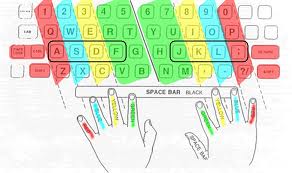
A kid can learn to type as soon as they have access to a device with a keyboard though it’s generally believed that they may not have the motor coordination or finger span to truly touch type until about seven or 8 years of age.  If you don’t have a device with a keyboard, you can find a picture of one, print it out and they can still practice the basic drills like these. Fold it up and bring it on the go.  This can be an activity children can do in the car, bus, subway, or waiting room.  


How to Start Kids Typing on Keyboards Even if They’re To Young to Touch Type
This video has some useful tips, tricks, and ideas to get children started keyboarding who may not be ready to touch type.


What is a good age to start a child using a typing software program?

There are several free and paid for typing programs.  They suggest that they are generally for children 7 and up.  The nice thing about typing programs is that they provide a fun learning environment for children.  The paid for programs generally start at around $20, with most hovering around the $30 range, and the highest end programs coming in around $50.  Here is a nice comparison of some popular kids typing programs.  Strangely, it is missing the one I’m most familiar with for children which is Mavis Beacon for Kids which comes in at $19.95.  


My favorite speedbuilder game is TypeRacer and it’s FREE! What I love about TypeRacer from a pedagogical perspective is that it provides literary passages for typing which is a nice way to expose players to a variety of writing.  The other thing that is really neat is you have a little race car and you can invite friends to compete against you virtually.  The scores of you and your friends are posted making for a fun competition.  You can also race at anytime with others who happen to be using the program when you are.  


In short children of any age can begin exploring keyboards, letters, and screens.  It is an essential 21st century skill and helping them master it early, not only provides a fun and useful activity for children to work on, but it will also help them share thoughts and ideas while saving a tremendous amount of time.  

Thursday, August 26, 2010

The Secret To Getting Every Student Excited About Writing

I often lament how infrequent it is that student work is actually published as I did in these two posts.
- Just Say Yes to Publishing! Exposing The Man Behind the Curtain If He’s Still Saying No.
- 21st Century Educators Don’t Say, “Hand It In.” They say, “Publish It!

During a recent outreach to my personal learning network about this issue Susan Ettenheim shed some light on the issue which is close to her heart. Together with Paul Allison, Susan is involved in a site called Youth Voices (a social network where students and teachers work together to create student-to-student conversations and collaborations). She shared this insightful idea which she and Paul had been discussing.

A lot of student writing is of little interest to anyone beyond the teacher.

So, I reflected about my own experience as a writer and teacher of writing and I realized just how on target this insight was. Upon reflection I remember clearly the day I accidentally got extremely reluctant writers enthusiastic about writing. It was 1997 and I was a first year teacher working as a library media specialist. I loved my work. I got to see students all day and help them learn and explore using books, videos, and a lab full of computers I had donated from a company who was upgrading their technology.

On this day Dr. H’s class came to see me. This was a special education class of middle school students in Harlem with below average IQs. Writing was not high on their favorite activities list, yet on this day I had students that were begging for, no, demanding writing mini lessons, engaging in unprovoked peer review, turning to dictionaries and synonym finders, looking up grammar rules, etc. In fact, I just couldn’t pull them away from their writing. Not only that, once I unlocked the key to my new writing enthusiasts, I had them begging to come see me to do more writing all year long...even during lunch, before school, and after school.

So, what got EVERY student so excited about writing?

I helped my students set up email accounts. A revolutionary concept back in 1997 and one that is still elusive in some schools today. I told the students what their email addresses would be and walked them through setting up the accounts with their own passwords. The accounts followed the same format so they easily knew one another’s email address. I had tossed names in a hat to get things started and the students had to write to the person whose name they drew sharing something they either admire about that person or have learned from that person. The person they wrote to should respond in kind.

The next thing I knew I had flying fingers in a silent classroom except for the excited squeal as one student or another was informed, “You’ve got mail.” All the kids were writing to each other and excited as heck when they got mail. They cared what they wrote and wanted it to sound good. Some wrote emails to family members who didn’t live with them and sometimes did not have consistent mailing addresses. Students were able to help their families set up email so they could stay in touch and they knew places in all communities (i.e. the library) where they could access the internet. Sometimes students just wrote to their parents about something that happened n school that day. Students were excited to connect with each other as well as their families like never before and the momentum never died. The rules of written communication followed that of spoken communication and students knew there were consequences for inappropriate behavior. The students didn’t want this privilege taken away and we didn’t have a single issue of misuse.


I then remembered another really popular writing activity. I had a 5th grade class that had a lot of complaints about the school. I invited the students to write a letter that would go to the school principal and district leaders. I wish I had saved this! They all wrote the improvements they’d like to see and submitted those. These became bullets in the letter and as a class we came up with an introduction and conclusion. The letter was sent and a follow up presentation was scheduled to share the student’s proposed ideas.

Both of these writing activities obviously have something in common.
  • They are real.
  • They affect kids lives.
  • They have real audiences.
  • The desire to write comes from the student, not the teacher.
How much of the writing kids do in school has these qualities?
How can we change this?

An idea comes to mind for me. What if we used the real mediums in which kids write to teach literacy in those areas. Perhaps a curriculum could include something like this:

Ten types of writing your students will want to do

  1. Email writing
  2. Facebook updates and comments
  3. Tweeting and replying
  4. Discussion Boards - Replying and initiating topics
  5. Commenting on blogs
  6. Writing a guest post on a blog
  7. Commenting in newspapers or magazines about subjects of interest
  8. Writing an article for a newspaper or magazine about a subject of interest
  9. Writing to persuade someone / some place to do something you want them to do
  10. Writing to teach others how to do something and knowing how to reach those who care
Not every student will want to engage in all of the above types of writing, but what if instead of an artificial curriculum map filled old-style writing that wasn't interactive, we did something different. What if instead we let authentic purpose and passion drive our writing curriculum. What if we let students help decide the kind of writing that is important to them? What if we let students write for reasons they’d need to write in the real world.

While these suggestions might seem to apply to secondary school students only, there is application for younger students as well. In fact my fourth and fifth graders were some of my most avid emailers back in 1997.

However, it seems it may be more difficult to develop authentic writing experiences for younger students, but there certainly are ways. I think back to when I started my blog. Every post had an audience of at least one person in my mind and that was okay. Instead of writing something and emailing it to that person, I wrote something and sent them the link to my blog. Every student has a built in audience beyond the teacher who genuinely cares about what they have to say and that is their friends and family. What if we shifted the idea of teacher as contrived audience and always asked students to think of a real person(s) to think of before they wrote and their writing would be a gift to that person(s). In some cases this audience might also serve as a peer reviewer and someone, other than the teacher, to talk about their writing to. Imagine students talking to their parents, grandparents, siblings, etc. about a piece they’re writing for them. There is a real person who cares. This person in essence also becomes the teacher’s helper and perhaps even an editor for the student. If this person is family, you’re also working to build the home/school connection.

Now, what about the use of social media with young ones? Not possible, right? Well not really. Early childhood students are closely connected to one of the largest group users of social media. Their parents. In fact, this is exactly why first grade teacher Erin Schoening decided to start using Facebook with her first grade students and their families. She has had tremendous success using this platform as a communication tool with students assigned daily to update an authentic audience of families as to what is going on in their class. Ms Schoening and students parents were constant writing guides in helping to share a well-written message to the classes audience.

The key to unlocking writing passion is simple. We must shift our thinking and move from viewing students as people who we are teaching to learn to write and instead move to regarding students as real writers who we are supporting in their craft.

So how will you be doing this with your students this year?