Showing posts with label Facebook in education. Show all posts

Wednesday, March 25, 2015

5 Rules for Using @ThunderclapIt to Make an Impact + Amplify #StuVoice


Is there a cause or idea your students want to spread? Thunderclap is a great resource to do just that. As described on their site, Thunderclap is the first crowd-speaking platform that helps people be heard by saying something together. You come up with the message and if you reach your supporter goal, Thunderclap will blast out a timed Twitter, Facebook, and/or Tumblr post from all your supporters, creating a wave of attention.

Here's a visual overview of how it works:

Sunday, November 23, 2014

Great Digital Citizenship Activity for Teens to #SayThanks this Thanksgiving

Looking for a terrific Thanksgiving week activity that teens will love? Facebook brings us their "Say Thank you" video tool. Students can let Facebook auto generate the video, or they can put some thought into selecting meaningful pictures and posts to customize the video.

This is a great activity because it opens up the conversation about digital citizenship. Conversations like:
  • What makes a good friend?
  • Do you like how your portraying your friendships online?
  • What kind of friend are you?
  • What do you like about how you share your friendships?
  • What might you do differently after thinking about this?
  • Why is important to say thank you and express kindness in social media?
  • What are some other ways we can let people know they are appreciated?
Here's a sample of what a video looks like:
    

Not only is this a fun conversation starter, it's a great way to look back on those in our lives and how we share these memories with others.

Want to give it a try?  Visit https://www.facebook.com/thanks then pick a friend and give it whirl!
_______________________________________________________________________________

Want to do an activity for preteens or use a tool that's not blocked in many schools? Check out the Thanksgiving template from +PowToon . It provides a fun way for students of all ages to share what they are thankful for this week.

Tuesday, April 1, 2014

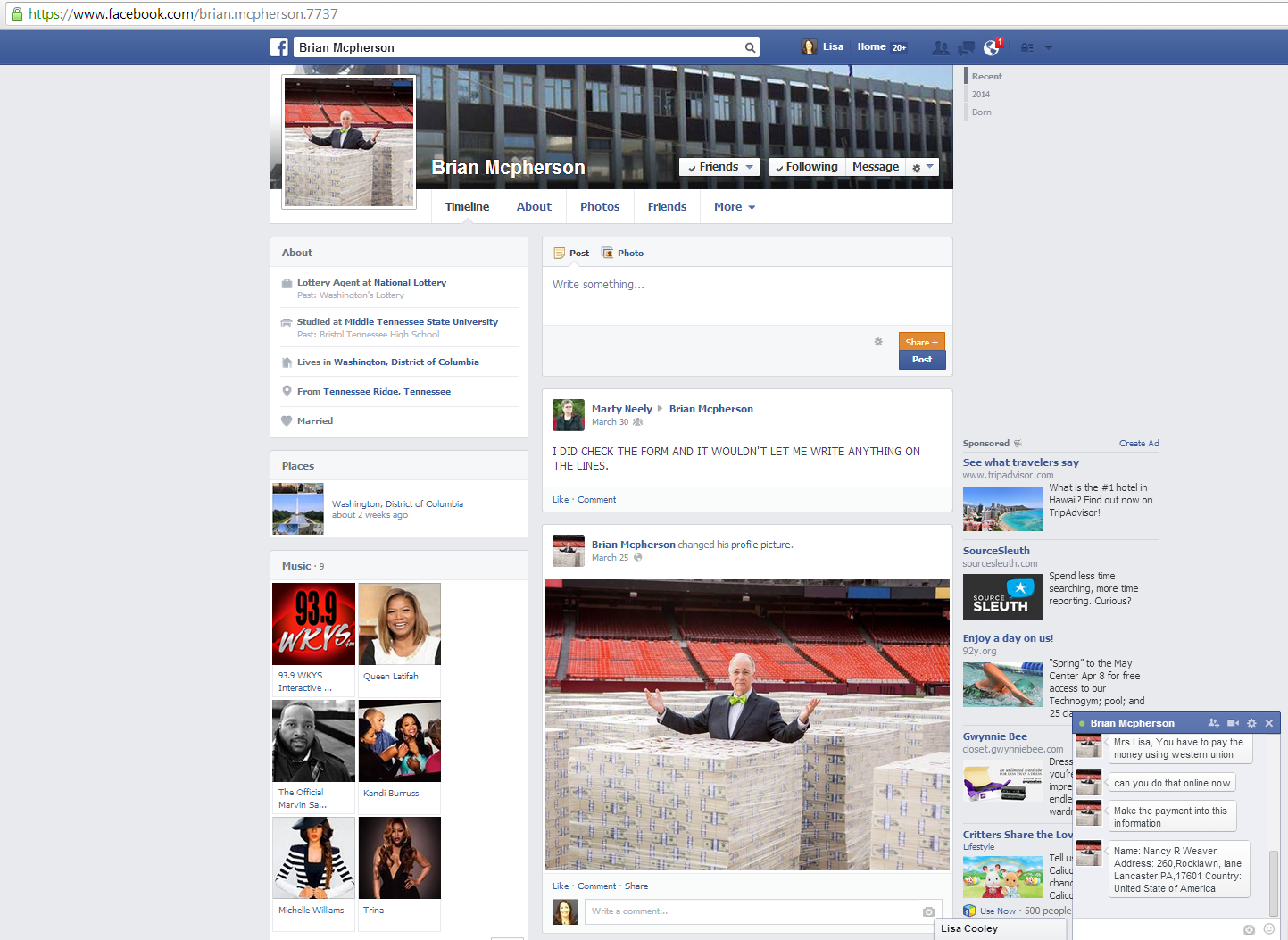
Don’t be fooled on Facebook

This week a relative of mine, who is a senior citizen, friend-requested me on Facebook. Not only do I love to see more and more seniors connecting online, I also love that this provides further opportunity for generations to share their lives. Especially these days when families tend to have busy lives and be spread out.


The relative was a cousin who I don’t see much beyond big family gatherings like weddings and funerals. The next day she messaged me. Nice! She was catching on quickly. We had the usual pleasantries. She asked how the family was in Vegas and said she had been there recently but unfortunately hadn't had time to visit. I gave her the update on my Dad's birthday party and also shared that things at work and home were very well and shared a couple pictures of my pups.


I was impressed at how she jumped right in. Bravo! Then she said she had been trying to reach me about something.

Sunday, March 30, 2014

How to change your Facebook administrator from a personal to professional account

Innovative educators know it's not a great idea to use your personal account to administrate Facebook pages or groups that you are using for your school i.e. school page, library page, sports page.  However, for some, especially us early adopters, you may have a page that has been up and running for years using your personal account.

Don't worry! Switching it to a professional account is easy!

Step 1 - Select "Manage Admin Roles."

Step 2 - Select "Add Another Admin"
This is where you add a Facebook profile that has been set up for professional purposes and is not tied to a personal account.

Step 3 - Type in the name or email of the person you want to add.  This person must currently "Like" the Facebook page to be added.

Step 4 - Click the "x" to remove yourself as the administrator.


Sunday, February 23, 2014

Safety first but don't forget what's next when students use social media

I was looking forward to checking out this post from my Twitter feed:
I'm thrilled that schools like the Patrick Henry Middle School are willing to put themselves out there and share in the mainstream media that Facebook isn't something to be afraid of, but rather we can teach students to use it safely.

Maybe I'm just impatient, but aren't we ready to move past the conversation about the fact that Facebook won't kill you and travel toward this:

Monday, December 2, 2013

How to set tagging permissions on Facebook

When working with innovative educators, I advise them to set tagging permissions that require them to review photos and posts before they accept the tag. This helps avoid having an unprofessional picture/post visible to others and also helps ensure that teachers are putting their best FOOTprint forward.

Here are the four steps required to set your tagging permissions.


Sunday, December 1, 2013

10 ways to get more likes and engage members on your Facebook page

So, you’ve started a Facebook page. Congrats! However, Facebook is no fun unless there are others there with you. Here are ten things you can do to drive members to your Facebook page today.


  1. Invite people to like your page Go to the top right side of your page where it says “Friends.” Under that it says “Invite your friends to like this page.” Select “See All.” This allows you to invite friends based on “Recent Interaction,” “location,” or a group to which they belong.  Ask others to do the same.
  2. Update your username When you update your page username, you give it a clean name free of hyphens and a number string. Do this by visiting https://www.facebook.com/username and giving the page you select the name you’d like.
    You can go from this:
    https://www.facebook.com/pages/The-Innovative-Educator/150269418336196
    to this
    https://www.facebook.com/TheInnovativeEducator

Sunday, September 22, 2013

The trick to making your Facebook group an overnight sensation


You may have noticed that there are some groups that appear to be popular or wildly successful after mysteriously acquiring hundreds or thousands of members overnight. Wow! You might be thinking. This group is really onto something to be able to get so popular so fast. You may even wish you were able to figure out how to do the same. You can! The way this happens is not a mystery. Sure, there might be some groups who have honestly earned their numbers, but it's usually not overnight. It’s good to know the difference between those groups who came by their numbers honestly and those who only merit the appearance of popularity. 


Read on and you’ll earn how anyone can start a Facebook group and gain thousands of members overnight. Once you learn, it’s your choice to decide how you feel about such practices.

We all know overnight sensations are rare.  The ones that appear to be are generally engaging in practices like those outlined in Ryan Holiday’s book, “Trust Me I’m Lying.”

Here’s the trick…

Sunday, July 28, 2013

5 Best Practices to Consider When Using Facebook with Students

This post was original featured on Smartblogs on Education

Innovative educators realize that to run for office, run a business, or change the way things are run where you work or play, being savvy with the use of social media is important. Now you are ready to take the plunge with your students to help them change their lives and the world for the better. Before you get started, consult with your school or district to find out their guidelines and policies and keep these best practices in mind.


  1. Friending Some educators do not realize that you don’t need to friend your students to interact with them online. You can create a page or group that your students can like or join without being one another’s friend or seeing one another’s feeds.  Connecting with students via groups and pages only is a great practice for educators concerned about keeping the lines of professional and personal distinctly separated.

Friday, April 19, 2013

Newsflash: Social media is real life

Co-authored by Lisa Nielsen and Lisa Cooley

A recent Common Sense Media story about Facebook Home warns parents that the new Facebook Home app will be an ever-present distraction in the lives of young people. It states that as your teen's engagement with friends via Facebook goes up, engagement in the “real world” can go down.  

Adults need to wake up. We need to take a step back from the notion that online communication is interaction in a world that is not real or is somehow less valuable than face-to-face life.  This impulse to dismiss social media as a “distraction” is detrimental to both ourselves and our children.

Social media has come to be a modern day tool, just like those we use to build houses and cars. While you can, of course, build a house or assemble a car without machines, it would be hard, if not impossible, to run a successful company without doing so.  Likewise, in today’s world, if you want to run for office, run a business, or change how things are run where we live, work, or play, you probably use social media to do so effectively. Just like the machines that build our homes and cars, social media, has become the tool that makes college, career, or success in building a movement more attainable.

Wednesday, April 17, 2013

Know the "Other" side on Facebook

One of the best practices that I recommend for educators who are using Facebook with students is to create a group or a page where teachers and parents or students can connect, collaborate, and create. One of the nice things about groups and pages is they allow you to message members without having to be Facebook "friends" with them.  Recently however, a new twist has been put in place that innovative educators should be aware of. 

If you want to message a student with whom you are not friends, it will cost you a dollar for the message to go straight to their inbox as you can see from the below message. 


But not to worry. Here's how to get around the fee.

Monday, March 18, 2013

5 ideas to inspire students to use social media for good

"High School Musical" star Monique Coleman is a youth empowerment advocate who recently provided advice about using social media to do good.  Below is the advice she shared on her site http://gimmemo.com followed by her video where you can hear her for yourself sharing these ideas.  If you like what she has to say, you’ll be happy to know you can connect with Monique on Twitter.  She is co-hosting the March 18th Student Voice Twitter chat on the topic, "How can influential figures and organizations play a role in empowering the student voice?" Use the hashtag #StuVoice and tag Monique at @GimmeMoTalk. The chat starts at 8:30 p.m. eastern standard time.

5 ideas to use social media for good

Wednesday, February 13, 2013

What's in your feed? 3 ideas to manage content on Facebook, Twitter, & Google+

Guest post by Josh Birdwell | 19-year-old Co-founder of Skillstarter

For some, social media is a place to announce or read every thought or post pictures of the weekend's regrets.

Not for me.

I am a targeted user of social media who knows how to customize platforms such as Facebook, Twitter, and Google+ to work for me.

Here’s how.

1) Facebook
I use Facebook groups, which are a big part of my browsing time, with Uncollege Network and the Under 20 Network taking a front seat. I have attended events connected to both of them in San Francisco and New York City. As a result, Facebook has become a place of empowerment and connectivity to invaluable communities.  

To make Facebook as efficient as possible, I unsubscribe to “friends” who post random or senseless updates. I also eliminate boring Farmville feed updates by turning off all senseless notifications and hide pointless updates.

As a result, every I visit my homepage I end up opening articles or connecting with friends globally. I chat with my friends from the UK to Sweden on a regular basis. Befriending self-driven people allows me to receive advice and support in my life. I thought I was alone in some areas, but boy was I wrong; I am finding more people who are in the same boat.

It doesn’t end with Facebook.

Sunday, February 3, 2013

8 ways to use social media to connect and coordinate with parents

Social media can be a powerful tool to coordinate and connect with parents.  At the school level, this is important work for everyone, from the classroom teacher to the principal. Some districts even have paid school employees called parent coordinators who are responsible for engaging with and involving parents in the school community. It is their job to create a welcoming environment for parents as well as to identify and address parent and related school/community issues.

While many of us are familiar with traditional notes home in the backpack, flyers, and newsletters, social media takes our ability to create, maintain, and grow connections with parents to a whole new level.

Here are some ideas that explain how.

1) Facebook

Parent Coordinator Sara Cottone of P.S. 46 in Staten Island, N.Y., welcomes parents to “like” the Facebook page she created for them. Most recently, the page was a terrific vehicle for sharing planning and logistics information as it pertained to the bus strike. Earlier this year it was a godsend as one of the few ways parents could communicate during Superstorm Sandy. The page is also used to update parents on trips, school performances and other events like picture day. The page is interactive, too. Parents can use the page to comment, ask questions and find out information. Cottone and other parents are always on hand to respond and provide feedback.

For more information visit:  Parent Guide to Facebook.

Thursday, January 24, 2013

Embracing social media use in schools with a toolkit for administrators

Looks like more and more cities are following the lead of NYC and embracing the use of social media in schools. Most recently the Chicago Public Schools has put together toolkit of resources—video, documents, and links to other sites—for principals and staff who want to use social media to connect with their school communities. 


The toolkit, has useful resources that will be helpful regardless of what city or town you work in. It highlights creative and effective social media use by schools with a focus on Twitter and Facebook.

The toolkit includes:

Wednesday, January 2, 2013

Extraordinary education happenings in 2012

17-year-old Nikhil Goyal nails it with his take on the Best of 2012: The Five Most Extraordinary Things to Happen in Education for GOOD magazine.

Goyal hits on five transformative developments effecting education this year.  The one I'm most jazzed about for innovative educators is how students were able to use the power of social media to have a voice in the education conversation.  

From Goyal:

The Students Speak Out: 
Students around the nation have seized the national microphone and have begun articulating their voices in education. With hundreds of student protests documented, young people are no longer willing to sit idly on the sidelines. In September, I published my first book on revolutionizing education from a student’s perspective. Earlier this month, Stephanie Rivera and few other college students launched Students United for Public Education in an effort to stop the takeover of public education in America. The group even had a protest. 
And this past summer, Zak Malamed founded the StuVoice movement, corralling student leaders onto one platform, giving spotlight to their voices, and making some dents in education policy. For one, Malamed, Matthew Resnick, Joshua Lafazan, myself, and a few other students signed a letter to New York Governor Andrew Cuomo demanding that students be added onto the New York State Education Reform Commission. With the power of social media, we will not stop petitioning, marching, protesting, and rallying until our voices are heard and represented. As educator Diane Ravitch once said, “When the students awaken, the national conversation will change.”
One of the most import jobs of innovative educators is empowering our students to have their voices heard and represented. It is imperative that we ensure students are prepared to effectively use the tools of their world to change their world.  
Read the rest of Goyal's extraordinary happenings here

Friday, September 14, 2012

Facebook - To block or not to block - that is the question


Guest post by by  | Cross posted at The Way I See It

I have had numerous conversations recently with teachers and administrators (building and district level), as well as community and school board members, concerning student-use of Facebook during school.


The conversations have ranged from productive to contentious; from philosophical to policy-laden; and, from reaffirming to thought-provoking.

One thing the conversations have always been is necessary.

A little background.

We are in our first year of a 1:1 implementation with Google Chromebooks in grades 9-12. We have phased in our 1:1. The first year (thanks to an opportunity from Google) we tested 500 Google Cr-48s in some high school classrooms. Then, last November, we placed a cart of Chromebooks in each language arts and social studies classroom in our high schools. This all led to handing out a Chromebook to each high school student just a few weeks ago.

One additional important piece of information - we have always blocked Facebook for students in our schools.

But, as the new school year began, we started using a new web filter and we didn't block Facebook.

So...guess how long it took to get feedback on Facebook being open for students? You got it - no time at all.

I also have to mention that I have been a proponent (possibly our district's loudest proponent) of leaving Facebook - along with other social networking sites - open for our staff and students.

Here is some of the feedback I have heard:
  • Students are on Facebook 'all the time.'
  • Students are distracted in class.
  • This was not the intended use of the devices we handed out to students.
  • The students 'won't get off Facebook.'
  • Facebook has no place in schools.
I am certainly of the thinking that it is our responsibility as educators to teach more than content. Of course, that has always been the case in schools. But it seems that schools have decided en masse to pass on responsible online behavior solely to the world outside of school.

In a 2010 eSchool News article - "November to Educators: Let students use online social tools" - Alan November was quoted saying something that has stuck with me ever since. He said that if educators don't teach students how to appropriately use these tools, they are 'shirking' a key responsibility.

More recently, Lisa Nielsen wrote in a the Journal article titled '7 Myths About BYOD Debunked':
"Instead of banning and blocking, schools need to work with students to create responsible digital citizens and have necessary consequences in place when there are violations, just as is the case in real life. When we address the problem, rather than blame the tools, we move toward creating responsible students."
I spent an entire day talking to 7th grade students about Facebook, and why Facebook (among other sites) is typically blocked at schools. My takeaway from those conversations is that students, for the most part, understand the reasons why schools block social media sites. They understand what it would take to make sure these sites stay open in schools. They understand it takes responsible use.

My overwhelming feeling was that they want us to teach them responsible use.

I know there are real challenges to leaving Facebook open. I also know there are real solutions.

Facebook, and other sites, become much less distracting in classrooms that have clear expectations, routines and procedures. And, more importantly, in classrooms where students are able to engage in authentic learning opportunities.

The amazing thing is when students are engaged in those kinds of learning opportunities, tools like Facebook become even more important. Students are able to learn real things, create real things and share real things.

I was amazed at how many of the 7th graders I had the opportunity to talk to had Facebook friends who live outside the United States. We talked about how cool it might be to discuss the book they are reading with their 'friends' in Russia (one of the countries a student mentioned).

That's the power. That's why we need to teach responsible use. That's why we need to educate ourselves.

That's why these conversations are so important.

Monday, July 30, 2012

5 steps to building social media presence from scratch

Gone are the days when imparting knowledge was the primary work of a teacher. Today’s teachers need to be able to support their students in knowing how to effectively connect, communicate, collaborate, cooperate, and create. This means that to prepare today’s youth for success in the world, educators must become savvy users of social media. Opting out of online worlds which students can use to change the world, is no longer an acceptable option for teachers.  

But getting started can be scary.

The video below features my interview with Author Learning Center where I share ideas for how authors, and really anyone, can begin to build their social media presence.  Below the video are the ideas spelled out with a focus on education for innovative educators who are interested in developing a robust online presence and start connecting with others who share their ideas.
  

5 steps to building social media presence from scratch

Friday, July 27, 2012

Facebook finally considers opening up to the under 13 crowd

If you know kids under 13 you might also know that many of them have Facebook accounts and for good reasons like connecting with family and friends, sharing pictures, playing games, and finding others with similar interests.  For innovative educators the under 13 rule has been frustrating as Facebook can be used powerfully in middle school where you may have some pre-teens.  


Well, now Facebook is developing technology that would allow pre teens to use the site under parental supervision and I'm hoping that this could eventually be extended to educators as well.  Facebook is looking into connecting children's accounts to their parents' and using controls that would allow parents to decide whom their kids can "friend" and what applications they can use. 


Check out this video from the Wall Street Journal to learn more.


With Facebook's move to allow preteens access, schools will need to consider how to best support educators that want to integrate this into meaningful learning opportunities for students.  

Monday, April 16, 2012

Not Letting Teachers “Friend” & “Follow” Kids Online? Think Twice!

Guest post from Michelle Luhtala | Cross posted at Bibliotech.Me
Editor's Note: This was written in response this post on The Innovative Educator blog.
flickr.com/photos/digitas
Almost 70% of 18-34 year-olds expect 2012 presidential candidates to have a social media presence (Digitas, 2011). A 2008 study by Cone’s, Business in Social Media Study,revealed that 93% of social media users expect companies to have a social media presence, and 85% expect the businesses to interact with their clients via social media – it is safe to say that that percentage has increased in the past four years. Almost 60% of Fortune 500 companies maintain active corporate Facebook and/or Twitter accounts (Sociable360.com). As a school librarian, when I want to check out a publisher or book distributor, I look them up on Facebook and Twitter. I skip the website, because I know that the content will probably be six months old, at best, whereas the social media profile will be current. For customer support, I will choose Twitter over a phone tree, any day.