Showing posts with label assessment. Show all posts

Monday, February 27, 2012

Don't judge a fish by its ability to climb a tree - The problem with assessment

Editor's note: This is one of my favorite stories highlighting some of what is wrong with assessment, but first a great comic that captures the fables sentiment and a quote.

‎"Everyone is a genius. But, if you judge a fish by its ability to climb a tree, it will live its whole life believing that it is stupid." -Albert Einstein

The Animal School: A Fable

by George Reavis

Animal SchoolOnce upon a time the animals decided they must do something heroic to meet the problems of a “new world” so they organized a school. They had adopted an activity curriculum consisting of running, climbing, swimming and flying. To make it easier to administer the curriculum, all the animals took all the subjects.

The duck was excellent in swimming. In fact, better than his instructor. But he made only passing grades in flying and was very poor in running. Since he was slow in running, he had to stay after school and also drop swimming in order to practice running. This was kept up until his webbed feet were badly worn and he was only average in swimming. But average was acceptable in school so nobody worried about that, except the duck.

The rabbit started at the top of the class in running but had a nervous breakdown because of so much makeup work in swimming.

Wednesday, December 14, 2011

Could The Key to Teacher Effectiveness Mean Dropping Certification Requirements?


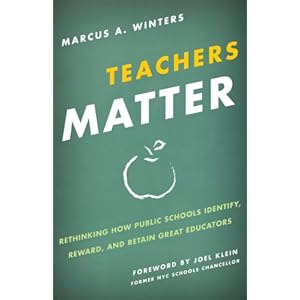
Teachers Matter: Rethinking How Public Schools Identify, Reward, and Retain Great EducatorsMarcus A. Winters explained that there is no correlation between certification and teacher effectiveness at a recent Manhattan Institute for Policy Research event held to announce the publication of his new book, “Teachers Matter.” Winters went on to propose the idea of  removing the barriers to becoming a teacher, suggesting that since there is no correlation between certification and teacher effectiveness, anyone with a college degree should be given the opportunity to teach if they are able to find someone to hire them. The fact is that many of us who went through teacher preparation and certification programs know they were not very helpful when it comes to the realities of the classroom. It is no surprise then that such certification has little impact on student success.

I think Winter’s idea deserves some attention, particularly in the case of secondary studies, but I wonder why he believes that a college degree should be required. If you are an expert in your field, chances are you may have reached this success without such a degree. Especially, if we consider experts who may be interested in taking up teaching upon retirement from their career. Academic inflation is only a recent phenomenon. Historically the majority of careers i.e. business, programming, entertainment casting or directing, writing, advertising, photography, art, etc. did not require such certification for success.

Monday, March 28, 2011

Using TPACK as a Framework for Tech PD, Integration and Assessment.

Henrico County Schools System has adopted the TPACK as the Framework for professional development and 21st Century Learning in the Henrico County Schools System.  Henrico County is one of the largest and earliest districts to pioneer and implement a one-to-one initiative.  They have adopted this model as its conceptual framework to guide their progress towards the 21st Century Learning. The following video will set the stage to provide insight into how this school district uses technology for relevant and real-world learning.


See How Henrico County School District Incorporates Technology into Learning.
Henrico 21 Overview from HCPS Instructional Technology on Vimeo.

To see more videos visit this link.


Below are some essential pieces toward meeting their vision.  


The TPACK Model
The TPACK Model was created in response to the need to provide a framework around the important pieces of innovating learning with a focus on Technology, Pedagogy, and Content Knowledge.  The overlap of these three components is where the 21st Century classroom is most powerful. Here is general information on TPACK and The general framework of TPACK for Henrico's 21st Century Learning

This is a diagram of the model.

Tuesday, February 15, 2011

Are Report Cards Really the Best Tool for Capturing Student Learning?

I recently become a fan of Joe Bower's blog, "For the Love of Learning" where he spends a lot of time explaining why he despises grades and wants to abolish homework. He shares the reasons for his sentiment as well as many alternatives.  You can read about his dislike of grades here and his dislike of homework here.  He's also a fan of Alfie Kohn who has provided the foundation for many of his beliefs and in his Museum of Education post, he shares a collection of his poignant articles like grades provide little to no information for students to use in order to actually improve. 


As I reflected upon my own experience as a learner I realized that my report card had summed up my whole year or entire college experience with a few computer-generated numbers or letters that made me easy to quantify for school report cards and district report cards and state report cards and maybe federal report cards, but they didn't really say much about who I was as a learner.  


I then took a look at how many unschooling and homeschooling families report on student learning collected at askpauline.com at this link where you'll find samples like K's 3rd grade summary/log, A's 7th grade unschooling summary, and many more.  When you read these ungraded reports of how children spent their year, you get such a deep insight into who these children are, what their passions are, and how they spent their year.

Compare that to typical report cards our students get today and you'll easily be able to tell who's got it right when looking at "The No Child Left Behind" accountability lead system of better ed = more tests and harder tests OR the Joe Bowers and Alfie Kohns of the world. 

Monday, January 17, 2011

We would prefer not to take your tests.

This was also published in the Huffington Post.  You can check it out there along with the several dozen readers comments here.

Around the nation more and more school districts like New York City are considering making teacher performance ratings public. One of the many problems with this, simply put, is that the state tests which these tests are based on, well...they suck. Yep. I said it. My background is in K - 8 as a literacy and technology as a former literacy coach, tech coach, library media specialist, and current innovation manager who spent many days grading these subpar assessments. Because of my background and experience, I’m going to focus on the high stakes standard literacy tests K - 8 and explain why they suck.


Background In Reading Assessment
Students read at different levels. Each level has attributes associated with it and there are strategies that learners can take to move to the next level. Teachers assess student reading levels with something called a running record. Today with technology, these readings can even be recorded, so if necessary, the student’s actual running record or reading assessment could be shared. Teachers generally assess student reading at the beginning, middle and end of the year and can easily measure the growth of a student say from a G-Level reader to a J-Level reader. This makes sense as a measurement of student learning. It also allows for students to independently take ownership of their reading level and it is very easy to get families involved in strategies to support students. 


The Problem with State Reading Tests
State reading tests provide all students on a grade level with the same test. While the test is an accurate measure of the students who fit the reading level the state arbitrarily has chosen, most students are left behind either because the reading level is too advanced or too easy. In essence the tests assess how well students are doing on something they can’t read well yet...Answer: Not very well. OR...we assess them on something that is below their reading level...So we don’t know growth, we only know they can read that well. 


In another words, we’re not really assessing student reading level.

What we do know is that developmentally children become ready to read at different ages (click this link to hear John Taylor Gatto's thoughts on this). We also know that forcing reading on children is actually a deterrent for attaining growth. Finally, we know two extremely important factors in the attainment of reading fluency is family involvement and socio economic class. 


None of these factors are in the control of the teacher!

What I propose is that we stop creating a test that makes teachers and students absolutely bonkers, and instead use the running record reading assessments that teachers already use to measure student reading level. Though, while this solves this issue of assessing reading more accurately, it doesn’t take into account that the factors that accelerate reading, really have nothing to do with the teacher. 


On to writing...
As shared in Four Reasons Innovative Educators Should Boycott Standardized Tests, the problem with the way writing is assessed in standardized tests stems from the fact they use an outdated and irrelevant method of assessment. If teachers are doing their jobs effectively, students aren’t just focusing on hand it in teaching. Instead they are focused on “publish it” learning, meaning students are communicating authentically to real audiences using the learning style that best matches their strengths. Student work can ideally be kept in a portfolio that can be assessed for writing achievement.

Wouldn’t you want to measure a teacher by how she helps her students publish for authentic audiences in area of deep personal passion rather than how she helps a student write about a topic the state dictates?

The problem with the current method is this.
  • We are not measuring what is important. The student’s ability to authentically communicate about topics of importance to them.
  • We are valuing writing as the most important method of communication. While this method works well for some, others may excel at communicating through video, cartoon, animation, audio casts etc. etc. We are losing focus of what is important.
  • Studies show that students empowered to use technology for communicating will demonstrate improvement however, their scores on writing the old fashioned way with pen and paper will decrease. Sadly, I’ve seen teachers refuse to let students use their own technology because they didn’t want their test scores to decrease. YIKES!!!
Not only is all of this bad enough, but these are high stakes tests for students too, meaning, if they don’t pass, they don’t move on to the next grade level doomed to sit through the same stuff that didn’t help them learn before and putting them in a category that diminishes their chances of success in the future.

This should give just a little insight into why these “teacher assessment” are really not the right way to go. If you’re convinced, you might be thinking, okay, that sounds nice, but there’s nothing we can do. The state makes us take these tests. 


There is a movement bubbling up called The Bartleby Project started by John Taylor Gatto which you can read about here. It’s a call to action for students to simply write across the top of their test, “I prefer not to take your test.” The premise being that students and parents should be empowered to decided how their child should best be assessed and not forced by the state to be subjected to very questionable assessments. 


The project has a growing following with a Bartleby Project Facebook Page, a number of reprints of John Taylor Gatto’s Bartleby Project proposal from his new book,Weapons of Mass Instruction floating around the web, and a huge round up of videos on You Tube. I’ve included two X-tranormal creations below.

One is a short video from a child’s perspective and the other is taking from John Taylor Gatto’s proposal for those who prefer watching to listening.


Monday, October 18, 2010

Meeting the essential conditions necessary to effectively leverage technology for learning

Does your school meet the essential conditions necessary to effectively leverage technology for learning? Below is a chart you can use with your schools to help them see if they do.

Wednesday, September 15, 2010

Tools Innovative Educators Can Use to Assess the Infusion of 21st Century Skills Into Instruction

Editor's Note: As the new school year starts, and innovation is on the minds of educational leaders, I've had several ask that I reshare this post from last year.

As I visit schools around NYC teachers and leaders are often eager to show me the great ways they are using technology to enhance instruction. Sometimes I see fantastic things such as during my visit to Kappa IV, CIS 339, PS 005X or IS 93. Other times, such as during a recent visit to a school, I see the technology being used as nothing more than a typewriter or a glorified chalkboard. In cases like this when I ask principals, “How are you assessing your teacher's use of 21st Century skills?” or I ask coaches, “How are you helping to ensure your teachers are incorporating 21st Century skills into the classroom,” they come up blank.

If teachers don't know what the expectations are, principals don't know what to access, and coaches don't know how to get them there, then there is no real way to measure success. Here are a few easy (and free!) assessment tools innovative educators can use to measure, identify, and discuss 21st Century education practices.

Assessing Teachers

Technology Integration Matrix

Website: http://fcit.usf.edu/matrix/index.html
Description: The Technology Integration Matrix (TIM) illustrates how teachers can use technology to enhance learning for K-12 students. One of the things that makes this such a fantastic tool is that it has a video demonstration of what each level actually looks like. The TIM incorporates five interdependent characteristics of meaningful learning environments: active, constructive, goal directed (i.e., reflective), authentic, and collaborative. The TIM associates five levels of technology integration (i.e., entry, adoption, adaptation, infusion, and transformation) with each of the five characteristics of meaningful learning environments. Together, the five levels of technology integration and the five characteristics of meaningful learning environments create a matrix of 25 cells as illustrated on the website.

Classroom Visitation Rubric

Website: http://tinyurl.com/21stCenturyrubric

Description: The class rubric was created by New York City Department of Education principals, technology coaches, and teachers from one-to-one laptop schools. It was created to assess technology in the classroom in the following areas: Instruction, Technology Integration, Professional Development, Differentiating Instruction, Learner Centered, Classroom management, Use of software and online tools, Classroom Environment, Computer use, Presentation technology use (i.e. projector, interactive whiteboard.). It is recommended that a school/teacher only select one or two areas to focus on at a time. The rubric is and excel document that can be downloaded and instantly calculates each teacher’s score with room for comments and notes. The document can be modified and updated to each school’s needs.

Assessing Administrators and Tech Coordinators

School 2.0 Reflection Tool

Website: http://etoolkit.org/etoolkit/reflection/about
Description: The Reflection Tool presents questions that are designed to help you reflect on your skills in technology integration and to identify areas for growth. These questions are based on the Technology Standards for School Administrators developed by the International Society for Technology in Education (ISTE) and the Skills Framework developed by the Consortium for School Networking (COSN.) Upon completion, the respondent receives a profile for self-reflection. S/he can then request links to resources that the responses indicate might be helpful and store them in the “your personal resources” section of the site.

There are many, many assessment tools out there. Some free, some require a fee. If you are interested in looking at additional tools, I invite you to visit TIE's Tech Assessments. You can also join the conversation at Classroom 2.0 by visiting Technology Assessment for Schools, Leaders, Educators, Students.

For further reading visit these links published in the February 2009 issue of eSchool News.

Wednesday, August 4, 2010

Who Owns the Learning and Assessment?

Personalization is the big buzz word in my world this year.

Personalized learning. Personalized learning environments. Personalized assessments.
Personally, I'm thrilled!

But what is this? What does it mean? And, as Alan November asked numerous times at his conference #BLC10 last month, "Who owns the learning???" Well, the students of course? Though when you look in a typical classroom frequently that is not evident.

Digital Ethnographer Michael Wesch recently shared an idea I loved. Students enroll in his class knowing upfront what the learning goals are. He has a blank slate for the class syllabus on a wiki. Together he and his students determine how they will meet their learning goals and in many cases that is different for different students.

Here is what I've heard lately about these concepts.

Personal Learning Environments
Thanks to Celine Azoulay for sharing with me this video of a student who gives a tour of her personal learning environment in a 7th grade life science class.


Personalized Assessment
"We can't ask students to move to personal learning and then have us as their teachers own the assessment." - Dean Shareski

This insightful quote is from the inspiration behind these next two pieces I recently read.

Students Must Own Learning & Assessment | Dean Shareski

Personalized Assessment | Dean Shareski


Here we get an overview on Personalized Assessment from Dean Shareski as he considers what personalized assessment and evaluation might look in personalized learning environments. He also shares two forms of personalized learning environments- putting learning in the context of student passions and interests, and giving students "unprojects" as described by middle school math teacher Chris Harbeck.

This is certainly an important topic that I plan on putting a lot more focus on this year, including, hopefully, some student perspective as well. Stay tuned.

Wednesday, July 29, 2009

An Innovation Roadmap: Criteria for Innovative Schools in the 21st Century


Today I will be joining a colleague from Teaching Matters at Alan November’s Building Learning Communities conference to speak with school leaders from around the world. We will be discussing the following questions.


  • What is a 21st Century School?
  • Where does my school stand on the continuum of 21st century success?
  • Where do I want to be?
  • How might I plan to get there?

At the conference we will be exploring this concept and looking at this question using a newly created tool called the Rubric for School Innovation. The Rubric provides a guide for thinking about different stages in the development of an innovative school. This tool offers a set of guiding questions and indicators of effectiveness and innovation, especially innovation made possible by technology.


You can find out where your school sits right now by visiting What Level is Your School? at The Innovative Principal area of the Teaching Matters website. Leaders can complete this with their staff, discuss the results, discuss where they want to be and then begin building an action plan for innovation to get there.


-----------------------

Twitters can follow tweets during the conference using the tag 21CL

Tuesday, July 7, 2009

ISTE Classroom Observation Tool

Editors Note: As you may have noticed, I list blogs I follow on the bottom right side of The Innovative Educator. From time to time I like to feature posts from these bloggers that I encourage my audience to read as well. Here is one such post.

In his blog, the Techominivore recently wrote a post on the new ISTE Classroom Observation Tool. He shares, "ISTE has developed a wonderful tool to help schools assess their technology integration efforts. The Classroom Observation Tool provides a checklist to guide you in observing how education technology is affecting classroom instruction. The tool is built on top of Adobe Air and allows you to work offline and then upload your results so you can access them from anywhere and share them with your instructional teams."
To find out how to download the tool and learn more visit his blog at http://techomnivore.com/2009/06/11/iste-classroom-observation-tool/.