Friday, February 4, 2011

I was an experiment

Kate Fridkis blogs at Un-schooled and Eat the Damn Cake.

I think maybe I’m not anymore.

But I was an experiment.

No one was really sure how homeschooling would work out when my parents decided to give it a go. I mean, there were a few kids who had made it through, like the Colfaxes up on the farm in Northern California, who trotted off to Harvard after mastering all that goat herding and fence building. I don’t think my parents expected me to go to Harvard. Actually, I know they didn’t.

(This picture makes me really jealous of the Colfaxes. source)

I am the first born. It sounds a little epic when you write it (and when you put it in bold). Like there’s probably a prophecy somewhere about me and how I’ll save the world from Voldemort or something. Which I feel like there probably isn’t, because I haven’t had to learn any magic yet, and I’m getting kinda old for that sort of thing.
My brothers had it easier. By then, it seemed like homeschooling was working reasonably well, even though there was no real evidence that I had learned any math.

I am very cutting edge. You know, I’m part of a tiny group of grown unschoolers who are out in the world, doing stuff. Being people. Succeeding wildly. OK, maybe not that last bit. But I’m not sitting for hours on end in Grand Central Station, either, staring at the enormous clock in the hopes that eventually I’ll learn to tell time.

We used to make fun of each other (us homeschoolers), saying, “Can you tell time yet? Can you tie your shoes?” We were aware that everyone expected there to be big, obvious gaps in our educations. Even our parents thought there might be. Because we were an experiment, and no one could really be sure what would happen.

It was pretty clear from very early on, I’m sure, that I was no Colfax boy. First of all, I’m a girl. I liked dolls a lot. I liked reading fantasy novels, not classic literature. In fact, I hated classic literature. How embarrassing is that? For my parents. For me, even now. I still get this urge to lie and say that I loved Dickens and Dostoyevsky as a child. I read them. And I readThe Scarlet Letter and The Count of Monte Cristo, and The Old Man and the Sea, and everything else kids are supposed to read. I even disliked Pride and Prejudice at the time. It took me years and years to appreciate this stuff.

I was just being me, but it must’ve been nerve-wracking for my mom. She may have been wondering, “When is any of this going to stick?” Or “There is a distinct possibility that the girl will NEVER be able to add two numbers together.”

She was pretty polite about it in front of me. But sometimes I saw the fear in her eyes. She was afraid she was doing me a disservice. She looked nervous about her decision. It was a big, big decision after all.

But I never minded being an experiment. It was enormous amounts of fun. People always asked me if homeschooling was good for me. Like, “How’s it going?” As though at nine I’d look up, cock my head like a little bird and chirp, “Well, I don’t know. The free time is lovely, but I feel like I’m not acquiring sufficient fundamental information about European History.”

Are you kidding me? I was actually thinking, “I’m building a giant raft that’s gonna float on the pond!” And stuff like that. Which worked out pretty well for me, in the end. Because I now build the ships that the world depends on for efficient bulk product transportation.
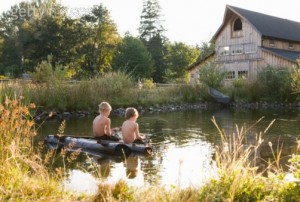
(I couldn’t find a picture with a girl in it. source)

OK, no. Building a raft didn’t inform my eventual career. But because I had a lot of fun as a kid. And a lot of time to keep having fun. And no one to tell me I was weird and funny-looking and bossy (all of which was true). And without all that, I don’t know where I’d be. But I’m pretty sure I like it better here.

So I don’t really mind that my life has been a massive experiment. Any experiment that involves that many fantasy novels and late mornings in bed seems like an amazing idea. Even now.

My Twitterish EduCon Take Away

I attended EduCon 2.3 last weekend at the Science Leadership Academy in Philadelphia. It was an excellent experience. Hundreds of motivated, interesting, forward-thinking educators discussion ideas in education. This edition of my periodic cartoon posts consists of a quote or thought from each session I attended. Kind of like Tweets, but in a cartoon format. Hope you like it. Feel free to comment.

Thursday, February 3, 2011

10 Ways Facebook Strengthens the Student - Teacher Connection

In our data driven world of education today, we often forget that behind all that data real students whose hopes, dreams and desires are often left behind or unnoticed. Don’t be fooled by the data that points to success by numbers rather than faces.  When you scratch past the numbers, you’ll find many real kids who know these tests have been politicized and that what is most important is their connection with adults who care about them.  This was evident during my recent trip to Educon where I had the pleasure of attending a panel featuring students who shared the importance of, “teachers relating to them as people, not just students”  For them this helped develop a deep level of trust with their teachers who they knew really cared about them deeply and were looking out for their best interests.  

Some students told stories of running a marathon with their teachers, others shared how great it felt for them that their teacher who coached them in a sport or activity saw them shine in a particular area of their life.  The students also explained how the use of Facebook has help strengthen their connections with teachers and their principal.  They also shared, that, they don’t “expect” their teachers to be friends with them on Facebook, but appreciate it when they do.  Below are ways that they, their teachers, their principal and others have have found Facebook to be an effective tool in strengthening the educator / student bond.  
  1. Reaching out to a student in need
    Students shared that sometimes it’s hard for them to approach a teacher or even really reach out for help face-to-face.  Sharing a disappointment on Facebook can be easier. Students shared how touched they were by encouraging words from a teacher either on their page, or as a face-to-face follow up.
  2. Getting a peak into the lives of students
    Facebook provides a window into the worlds of students.  A look at a student’s Facebook page might explain a little something about how or why a student may have reacted to something on a particular day.  As one student said, “We are people, not just students. Facebook is a great reminder of that.”
  3. The family connection
    Students at the Science Leadership Academy explained the great importance of their peers and staff as family.  Facebook is a terrific way to share and keep up with family.  They appreciate having that opportunity.  
  4. Instant learning and homework support
    A student might notice a teacher online and use the pop up chat to ask if they mind giving advice about a topic they were studying. If their teachers (or principal) is available s/he can offer support. Luna, a student at SLA explained it this way, “We can still get teachers to help us while we’re at home doing our homework instead of having to wait until the next day. Teachers feel a lot more accessible and also approachable.”
  5. Snow Day - Update!!!
    Not sure if school will be open or closed on a snow day?  Check it out on your teacher and/or Principal's page on Facebook.  You’ll find the answer and a whole lotta comments.
  6. Facebook lets teachers create a no excuses environment
    This came directly from a student who shared that she liked that Facebook kept all students accountable.  When you’re friends with your teachers and students on Facebook, you generally best really be sick on a sick day, or you’ll be outed.  Furthermore, students like the idea that if you get stuck with school work you can always post it on your Facebook wall and tag some friends and teachers who will be able to chime in with advice.
  7. Snow days and sick days don’t hold you back
    Just because students are home doesn’t mean they can’t participate.  During a recent snow event teachers and students connected on Facebook about assignments and assessments, barely missing a beat.  For a student who is sick, she can post that on Facebook, tag key people, and get filled in on what she missed in real time.  
  8. Using facebook teaches you how to deal with the world and the way it works
    Students like the fact that adults are connecting with them using real-world tools that they’ll need to know how to use effectively to be successful.  At the writing of the article,
    Egypt’s Facebook revolt was taking place.  Kids are keenly aware of the power of social media and want to be empowered and trusted to operate in such environments.  They feel neither a school or government should ban them from using powerful tools to communicate and connect.  
  9. Facebook as a Learning Portal More and more students are using Facebook for learning and not just to talk to others about what they’re working on.  One Science Leadership Academy student shared that for physics a group of her peers created a Facebook page about motion.  They created it as a learning portal that contained, definitions, photos, videos, articles and discussions.  Not only was this a learning portal for these students, but it remains on Facebook as a learning tool for others studying the topic. 

    Librarian Michelle Luhtala helped break the ban on social media in her school. See what happens when students are given the trust and freedom to learn using Facebook.

    Facebook Group  as Collaborative Research Log from michelle luhtala on Vimeo.
  10. Mobilize in an instantWhen Science Leadership Academy students found out that a snow day was declared on the first day of their Educon conference for educators, they jumped into action on Facebook where their principal shared a note as well as words of encouragement to all students. The principal shared this status up date at 10:45
    Chris Lehmann There's going to be a horde of kids at SLA tomorrow. This is EduCon, and this is *their* school, and a little snow isn't going to stop them.
Both his note and status updates were met with plenty of comments from spirited students and educators.  

There are more and more educators and students like those at the Science Leadership Academy who are harnessing the power of social media to connect more deeply with students.  Unfortunately for some it’s an uphill battle, but one they plan to fight none-the-less in today’s 21st century world, we know life doesn’t just happen face-2-face.   

-----------------------------------------------------------
Share your thoughts:  Librarian Michele Luhtala is one such teacher who does a good job of capturing the sentiment of students where Facebook is blocked in her post 'Tud-ish but true.http://bit.ly/yfilter and teachers can visit http://tinyurl.com/yfilter .

Wednesday, February 2, 2011

Learning by Doing - Students Can Solve The Issue of Sanitary Drinking Water with Global Experiment

Guest post by Alan Parker

In his 2011 State of the Union address, President Obama noted that “We need to teach our kids that it's not just the winner of the Super Bowl who deserves to be celebrated, but the winner of the science fair.”  The International Year of Chemsitry (IYC), a yearlong, international celebration of chemistry organized by some of the leading international chemistry institutions in the world gives students an opportunity to be a part of just the sort of activity the President was referring to.  Andrew Liveris, president of the International Council of Chemical Associations, notes, “95 percent of the things that touch our lives — such as food, water, shelter, transportation, and medicine — are made possible through chemistry,” and the purpose of the IYC is to help show people just how integral chemistry is in everyday life.  
Students can participate in the celebration by joining the Global Experiment called “Water: A Chemical Solution,” which could potentially be the largest chemistry experiment of all time.  Students from across the world will join in the water themed experiments by testing how chemistry can be used to purify water so it can be consumed. More specifically there are four activities that students will complete while taking part in the experiment: 1) acidity 2) salinity 3) filtration 4) solar still.
While The Global Experiment requires the involvement of parent or teacher to ensure safety and provide guidance and support, an education in chemistry is not required. The experiment comes with precise directions with regard to the methods and tools necessary for the successful completion of the modules.  According to the IYC, the experiments will cost very little, if anything at all, to get as many people participating as possible.  The experiments are open to students of all ages and there are options for students in elementary, middle, and high school.
The International Year of Chemistry begins February 6th, and the Global Experiment runs all year. If you believe that your child or your class would have fun participating in the experiment visit the website!  It is a simple yet terrific method to get students engaged with science, and it also gets students involved in helping to solve the issue several countries have finding sanitary drinking water.  When Liveris was in grade school he says he became “hooked on the knowledge that chemistry would open the door to innovations that would make the world a better place.”  The Global Experiment, will give more students the opportunity to feel this way.

Alan Parker is a blogger based out of New York, NY who writes about alternative energy, green business, sustainability, and climate change.
Follow on Twitter @AGreenParker

Tuesday, February 1, 2011

5 Ways to Shift How We Look at Public Education

Over at ASCD Edge, in his post,  "Thrive and Drive," Walter McKenzie asks, "What if the biggest change that has to take place in education is a cultural shift? What if we shifted how we look at and think about public education?"  He suggests the following:
  1. Schools tightly aligned with all other community agencies to support all the needs of our children in concert. 
  2. Communities valuing education as the engine for their economic future.
  3. Teachers no longer acting like civil service employees working to a contract.
  4. Unions no longer pretending that one teacher is just as good as another.
  5. A respect for education and the service it provides to a free and open society and a competitive global economy, both by educators and the American public.
I'd add in something about not just preparing students for college and/or careers but also as citizens. You can check out his whole post here.

Why “The Race to the Top” is nothing but a race back to the 20th century.

Marc Prensky shares some smart ideas in his latest piece, “The Reformers Are Leaving Our Schools in the 20th Century - Why most U.S. school reformers are on the wrong track, and how to get our kids’ education right for the future.” In it he shares some big ideas about ed reform that sound much different than what we’ve been hearing lately in national conversations.  Prensky suggests we replace the current three “R’s” (readin’, ritin’ rithmetic) with the “3 C‟s”: Character and Passion, Communication and Problem Solving, and Creation and Skills. I’d explicitly add Publishing and Sharing authentically (couldn’t think of a “C”).  While he does have that embedded in the other components, I think it should stand at the forefront.  


Deleting Curriculum
Prensky suggests, that while some of the big ideas in education are still important, it has become over-stuffed and one of the first orders of business is deletion or figuring out and eliminating those things that are no longer truly needed, yet take up tremendous amounts of class time. He suggests that, “to those who maintain that students should take years of 1,000-year-old geometry because it helps their logical thinking, we must respond: “So does programming, and it will help them get jobs.”


Connecting with Kids!
Prensky explains that our hardest and most pressing educational problem is not raising test scores, but rather connecting our kids’ education to real life and to the fast-evolving world of the future. He says that it is our inability to make the material we are currently required to teach in school real and interesting for today‟s students – call it relevance, or engagement, or something else – that makes so many current efforts unsuccessful. And our teachers know it.


Learning because it’s on the test rather than because it’s important to know
He provides an interesting insight, saying, “The real reason kids have to learn most of what they are taught today is ‘because it’s in the curriculum,” not because it will be useful long-term. He suggests this could be easily verified by having adults take the SATs and making their scores public.” I’d extend this to the regents exam as well.  And, as long as we’re talking about making scores public, for parents who want teacher quality scores public, I’d suggest we use those same scores to make “parent quality” scores public.  I bet there’d be a shift in assessment then.  


Data (not passion) driven learners
Prensky then hits on one of my favorite topics which is that the current U.S. education system ignores almost entirely the thing that has always been America‟s greatest strength: the passion of our people.He laments that amazingly, our current education places no importance on even knowing the individual passions, or interests, of our students, and most teachers don‟t ask – not necessarily because they don‟t care, but because they are so occupied with all the other required tasks (such as teaching for the tests) that they feel they have no time. See some of my thinking on this in these posts, When passion drives instruction no child is left behind ,Preparing Students for Success by Helping Them Discover and Develop Their Passions, and Differentiating Instruction is NOT Hard if We Tap into Student’s Passions!


Real answers for “Why am I learning this?”
He then touches on one of my biggest disappointments with school and explains that everything we teach should also be matched with a clear answer to the student‟s constant question of “Why am I learning this?” Students should be taught to immediately use what they learn to effect outcomes in the world, and change it for the better. He gives a great example.  “They can use their knowledge and skills to create Public Service Announcements for local TV and radio stations.” I can’t tell you how many teachers and principals are excited to show off the great audio or video PSAs their students made that just sit unpublished on the tech teacher’s computer or perhaps the school website...never ever reaching an authentic audience.  


Embracing the Student - Teacher Connection
Prensky then shared a huge complaint that many students have which is that too many of their teachers don‟t know them as individuals. In fact in today’s connected world, many adults are have become afraid of teachers getting to know their students as people.  Somehow, with the advent of the web, teacher is seen as predator.  Prensky suggests that at the very least, all our teachers should know what their students‟ passions are and help those students approach their school subjects through the lens of those passions. This is similar to the passion profiles I explain in #8 of 10 Ways Technology Supports 21st Century Learners in Being Self Directed.


Some Concrete Solutions
Prensky doesn’t just point out the problem.  He goes on to provide some concrete solutions like his Five Skills Framework, that if applied to all subjects, would create thousands of new problem-solving and communication experiences over the course of an education, and become a useful tool in students‟ 21st-century lives.


The five skills are:
  1. Figuring Out the Right Thing to Do
  2. Getting It Done
  3. Working With Others
  4. Doing It Creatively
  5. Continually Doing It Better


He also shares a variety of “easy to do/big impact” steps.  Here are a few of my favorites:
  • Less “telling” by teachers (and allowing kids to research the answers to guiding questions on their own);
  • Always connecting what is taught with real-world outcomes;
  • Treating students as learning partners;
  • Employing students‟ own tools (particularly video and cellphones) for learning;
  • Offering students far more choices, rather than mandating what all must read or do


Why this is important
He reminds readers of the importance of heeding different reform advice suggesting the answer is not to fix a broken system, but rather create a new and updated system.  He makes his case by sharing that the data our current system measures is often inappropriate for the real educational goals, explaining what they hold people accountable for is typically wrongly defined, and they are training leaders to lead in the wrong direction. Nevermind the fact that the ones to gain the most from these tests are the for-profit testing companies who make millions on the backs of our children and are the ones who developed the new Common Core Standards.  I share my concerns about these standards in this post and this one.  


Prensky warns Americans that the statistics of the past are no guarantee for our children‟s future. Stating that , “Past statistics are reliable predictors only if conditions remain roughly the same – and in the case of education and jobs, almost everything is changing radically. The world will continue to change even faster as our students grow up; and in this environment of hyper-change, all bets are off. Remember how many people believed (based largely on past data) that housing prices would always go up – until they fell? The only way to ensure that the positive link between more education and better jobs applies in the 21st century is to make major changes to the education we give our students.”

Prensky mirrors my recent concerns that I shared in my post, Don’t Respect Your Elders, Respect Each Other explaining that our current education is frequently demeaning and disrespectful, too often unnecessarily subordinating the individual needs and desires of students to those of the system. Ultimately Prensky warns that our educational system neither teaches nor tells teachers directly that the most important part of their job is connecting with students, not delivering content and his article and upcoming book provide some ideas for addressing this further.