Wednesday, October 12, 2016

Get Inspired By & Connect to #CDEtop30 #EdTech Transformers

Innovative educators love discovering and implementing new ideas to update practices that re-imagine and redefine teaching and learning. One great way to consider practices that can be useful where you work is to learn about what others are doing to innovate where they work.

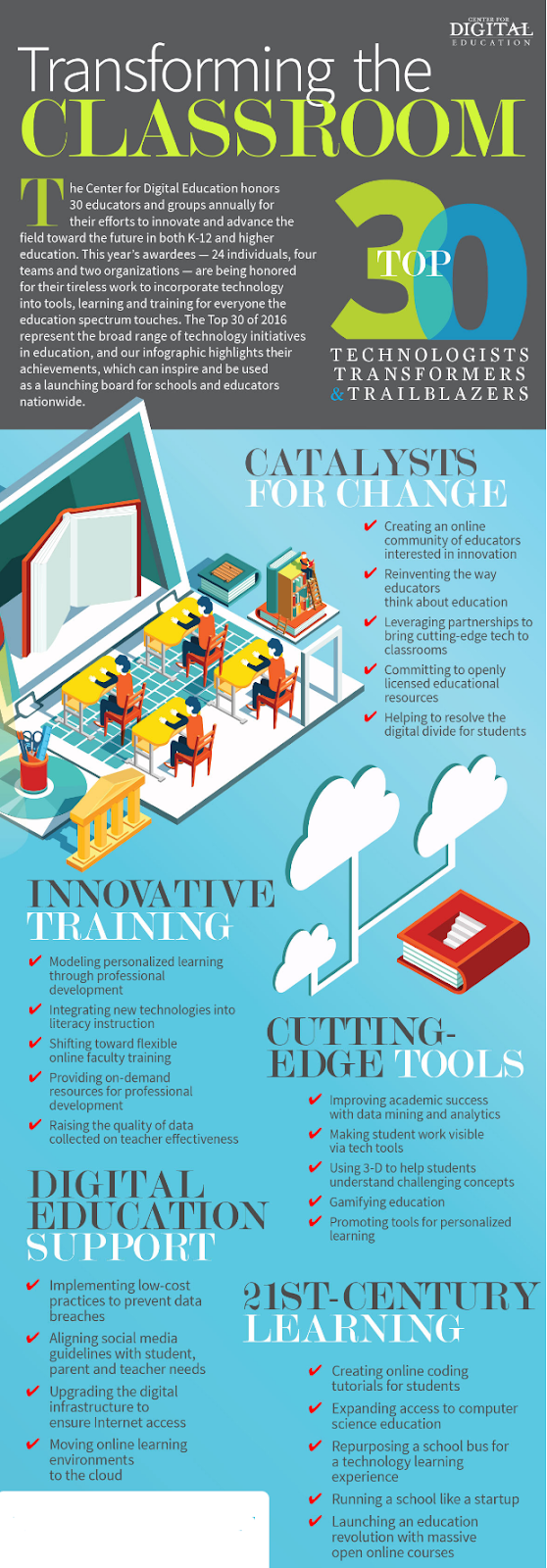
The Center for Digital Education helps make that possible with their infographic that highlights the Top 30 Technologists, Transformers and Trailblazers achievements. Take a look at these practices and see if there is at least one which can inspire you to try to bring this to life where you work.  


In the below infographic (full-size here) you will see these five categories:


  1. Catalysts for Change
  2. Innovative Training
  3. Cutting Edge Tools
  4. Digital Education Support
  5. 21st Century Learning

Want to know more? You can read the details, see the list of awardees, and read their profiles. As you do consider if there is something that stands out that you wish to see implemented where you work. If there is, in the age of social media, access to the source is just a Tweet away.  Each profile includes a sample Tweet and most contain the honoree’s Twitter handle.


Here are 5 sample Tweets to get you inspired:

Below is the "Transforming the Classroom" infographic. Within each category you will notice the various strategies taken to transform education.

Sunday, October 9, 2016

3 Innovative Solutions to Combat #EdTech Issues #CDEtop30

Three obstacles to successful integration of technology into teaching and learning include:


1 - Innovative educators often work in isolation
2 - Guidelines and policies for tech use are lawyer, not student or teacher, friendly
3 - Lack of tech expertise and funding for professional learning opportunities


Do any of these sound familiar?


If so, read on to discover how these problems inspired innovative solutions. As you do, consider if any of these are solutions that can be implemented where you work.


Problem - Lack of Tech Expertise & Funding for Learning Opportunities

Solution: Developing and leveraging partnerships to build expertise across the district in using cutting-edge technology.
IPPD logo   Google Slides.pngThe Story
Not long after Carmen Farina was appointed as school chancellor in 2014, she noticed that while schools were equipped with technology few teachers were using it to transform teaching and learning. The problem started two years prior when the U.S. Department of Education has failed to reauthorize funding to enhance education through technology so in August 2012 ed tech offices in all five boroughs of New York City were shut down as the funding ran dry. The Ed Tech Director and staff developer positions across the city were eliminated. It’s no surprise that a few years later the lack of support was evident in classrooms.

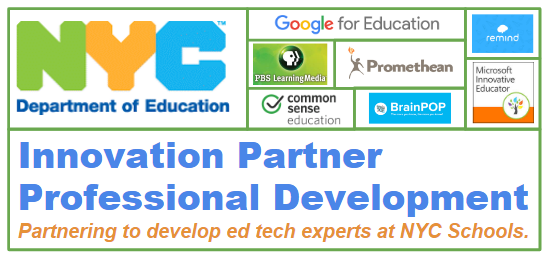
When tech isn’t used effectively it is not only the schools that suffer and look bad; it is also those who provide the technology to the schools who look bad. So I reached out to leaders at the technology resources most commonly used in schools. Places like Google, Microsoft, PBS, SMART, Promethean, BrainPop, and Common Sense Education. I asked them to work with me to build cohorts of teachers who would become certified in the use of their product. The solution implemented was the Innovation Partner Professional Professional Development program.

To do this interested educators would complete an application which would help identify across the city those who already know and love the product and have experience in sharing what they learn with others. We would bring these teachers together to connect with each other, have a direct connection with the company, and of course share their knowledge across the schools and districts. As a result we had experts and evangelists across the city that could ensure tech resources were used effectively.

This was a win-win that has ultimately resulted in more than 1000 experts identified and developed across the city. They can now support teachers in a number of ways. Some are inviting others to visit their classrooms to see how to implement the technology in which they have expertise. Some are recording or live streaming the work they do to share with others interested in their work. Most are providing support to colleagues in online communities. Nearly all are sharing what they learned by providing professional learning opportunities to teachers during weekly professional development time, conference days in the city and some are even speaking at conferences both nationally and internationally.  

When companies and school systems partner to develop educator expertise, everybody wins.  

More information


Problem - Innovative Educators Work in Isolation


Solution: Leverage social media to create an online community to connect educators interested in innovation.


The Story
facebook group.png
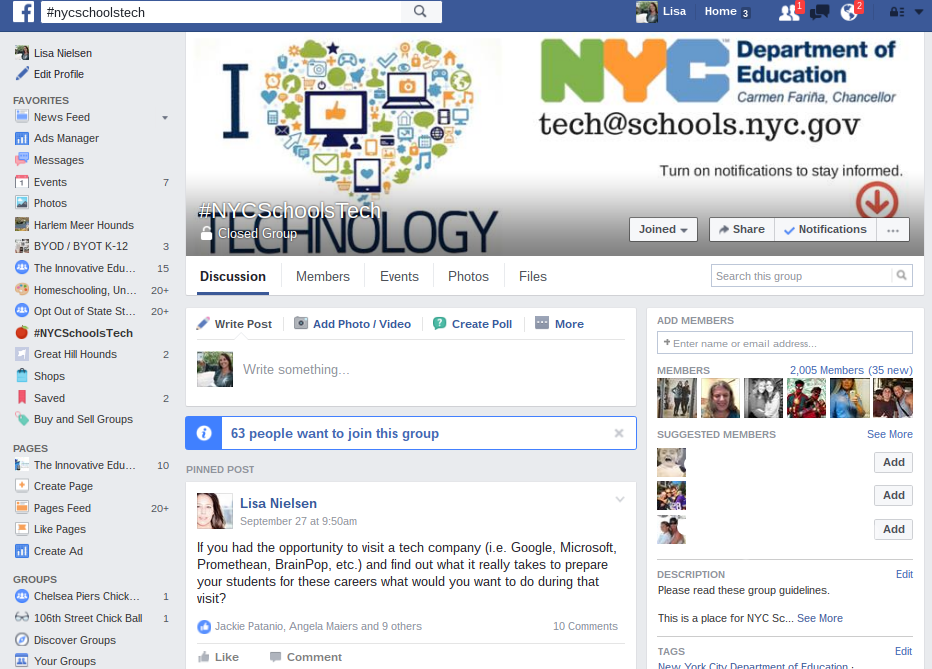
NYC Schools had educators interested in doing innovative work across the city but they often felt isolated and unsupported in their schools where few teachers were integrating technology. For the most part these were not teachers in 1:1 environments but rather those who teach in a lab or bring a laptop cart to the classroom. Most schools had at least one person on staff who was the resident tech guru, but when you’re the go-to person, who do you go-to when you need support?  

This problem was the impetus for starting the #NYCSchoolsTech group on Facebook. Two years later there are more than 2000 members in the group passionate about educational technology. This includes educators, district leaders, as well as representatives from companies who create the tech resources our teachers use.  


As a result this group has become the “go-to” place for innovative educators across the city when they need support or have questions. Innovative educators are no longer alone but rather a part of a learning community of thousands.


More information
  • You can read more about the how the community came about  here.  
  • You can read what community members feel about the program here.

Problem - Need for Friendly Tech Guidelines


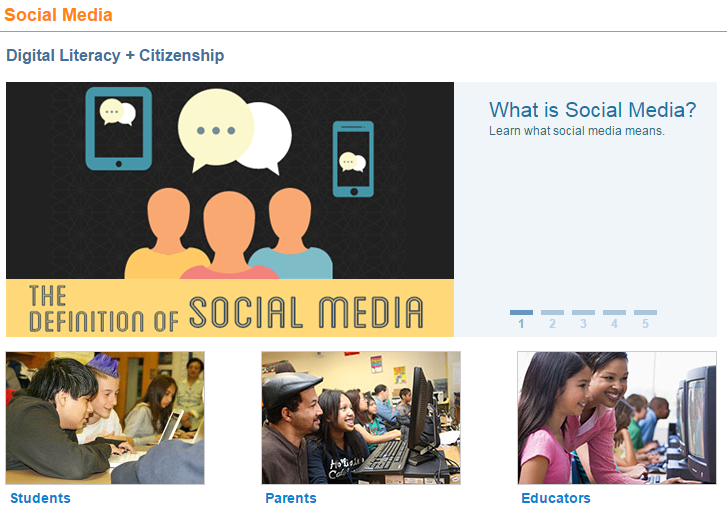
Solution: Engage students, teachers, and parents in a participatory design process to create user-friendly social media guidelines.


The Story
Digital Literacy   Citizenship   Social Media   New York City Department of Education.png
When the NY Post reported NYC schools Chancellor Dennis Walcott said that when it comes to communication between students and teachers on social-media sites like Facebook, “We prefer they not interact,” I had a problem. My take is different and I shared that via a comment that was picked up as it’s own story: I shared that I felt “One of the most important things educators can do is to ‘interact with students.’ The chancellor should be praising educators who do this.”


My innovative and practical way of looking at the issue resulted in the district bringing me on board to share ideas about responsible social media use. This started with the collaboration between young people, parents, and a dedicated affinity group of teachers who together worked to create guidelines for students (along with guides for parents and teachers) which are used in New York City and have been the foundation for social media guidelines and policies in other districts as well. All materials are available at no cost.


More information
  • The guidelines, along with student materials and parent and teacher guides are available at Schools.nyc.gov/socialmedia.
  • You can read about how we engaged in the participatory design process here.

These solutions have been successfully implemented in New York City and were recognized by the Center for Digital Education who featured them in their current issue featuring Top 30 Technologists, Transformers and Trailblazers.

What has your experience been? Have you encountered problems that have or can become inspiration for innovation where you work? If you have innovative solutions that you’ve implemented or are thinking about implementing, we’d love to hear them. Please share in the comments.

Saturday, October 8, 2016

The 3 Hottest Posts Everyone's Reading

If you haven’t been keeping up with The Innovative Educator, don’t worry. That’s what this wrap up is for.  Here are the three hottest posts that you don’t want to miss!

Taking the top spot for the first time is Social Media Becomes Key to Forming An Educator Learning Community.

After that is a post called #Get2Yes w/Principals which includes a useful infographic created by @Eileen_Lennon  with 8 strategies to get your principal on board with whatever it is you are proposing. The advice from former principal @Levy_Jason includes being aware of the four resources needed for any project. Don’t know what those are? Read the post.

Rounding out the top is 6 Skills Students Today Must Develop. It includes some terrific tools to ensure these are the 21st century skills your students develop and provides a useful framework for implementing this work and having conversations about what students need for success today.  

If any of these posts are of interest, check em out and share with others using the buttons below on Twitter, Facebook, email or whichever platform you like best.

Entry
Pageviews
Oct 2, 2016
3870
Oct 5, 2016
2943
Sep 28, 2016, 1 comment
2737


Wednesday, October 5, 2016

#Get2Yes w/Principals During Thursday's #NYCSchoolsTechChat

Learn how to #Get2Yes with your principal during our sixth monthly #NYCSchoolsTechChat taking place tomorrow, Thursday, October 6th at 3:30 pm Eastern Standard Time. During this chat we will have our first special guest. Jason Levy (@Levy_Jason ) will join us to help educators determine what they want from their principals, their current strategies to get there and help them get their principal to say yes. Jason Levy is a former principal who currently serves as an advisor to school leaders. You can read more about him in his LinkedIn profile.


You can prepare for the chat by thinking about answers to these five questions:

  • Q1 Share an idea or decision abt which you successfully encouraged your principal to #Get2Yes #NYCSchoolsTechChat
  • Q2 What strategies worked or didn’t when you’ve tried to #Get2Yes w/your principal #NYCSchoolsTechChat
  • Q3 Share 1 area or idea in which you want your principal to #Get2Yes this year. @Levy_Jason will give feedback. #NYCSchoolsTechChat
  • Q4  It’s time for an AMA with @Levy_Jason Ask him anything abt how to #Get2Yes w/your principal #NYCSchoolsTechChat
  • Q5 Give a shout out by RT, like, or reply to someone who has inspired you to #Get2Yes in today's #NYCSchoolsTechChat
Remember to respond using the hashtag #NYCSchoolsTechChat and question number to which you are responding.


The infographic below was the inspiration for this chat.
Loading...
Loading...

The chat can be viewed live and it will be archived at https://www.participate.com/chats/nycschoolstechchat

Sunday, October 2, 2016

Social Media Becomes Key to Forming An Educator Learning Community #CDEtop30

A problem can be the inspiration for innovation. When I started my career in education as a school librarian my problem was that I was an island unto myself. While the library was a wonderful place to work, I longed for a community with which I could share ideas and learn.


That was one of the problems that became the inspiration for the work I do now which was recognized by the Center for Digital Education who recently selected me as a Top 30 Technologists, Transformers and Trailblazers.


As the director of Digital Engagement and Professional Learning at the NYCDOE I was thrilled to be given permission by my forward-thinking supervisor Jane Pook to do the job of ensuring educators were engaged and connected. I accomplished this by creating digital communities across various platforms.  


It was our Facebook community that really took off. We now have more than 2000 members, who are passionate about innovation and technology, connected, sharing ideas, and providing support to one another.  In addition to teachers, the community has experts from companies that provide the platforms and programs we use, who serve as a powerful resource to directly support educators. District leadership has also been inspired to join the group. As a result our teachers have access to and support from decision makers. All this has resulted in a tremendous level of trust and a feeling that we are a team in this together to support our students.


Some districts fear social media, but ours embraces it. When an online community is run effectively (here are tips on how to do that) you can create a supportive tone and culture. Gone is the negativity sometimes associated with social media platforms. The teachers appreciate that they are no longer alone. In an instant they have a large network to provide support and guidance.  The community also provides a wonderful platform not only for sharing upcoming learning opportunities but for teachers to connect with and know which of their colleagues are attending events.  


Now teachers across the largest district in the nation find, connect, and support one another via a tool that many districts ban… Facebook!


As I shared in my interview with the Center for Digital Education, “In my career, I never have experienced so much excitement across a district.”


We did not need to make an investment in an expensive platform or secure funding for this work. Instead, our district was able to stop the typical fear and start to embrace free social tools educators are already using to communicate, connect, collaborate, celebrate, and better serve our students and families.  It an honor and pleasure to bring our amazing, inspiring, and passionate educators together and watch the magic that happens when educators who, like me, were once an island unto themselves, are now empowered to come together as a community.


Saturday, October 1, 2016

The 3 Hottest Posts Everyone's Reading

If you haven’t been keeping up with The Innovative Educator, don’t worry. That’s what this wrap up is for.  Here are the three hottest posts that you don’t want to miss!

Taking the top spot for the first time is 6 Skills Students Today Must Develop. It includes some terrific tools to ensure these are the 21st century skills your students develop and provides a useful framework for implementing this work and having conversations about what students need for success today.  

After that is a post where I share ways that Books (and videos too!) Can Help Us Talk abt #BlackLivesMatter. The post has useful ideas such as inviting your students to help determine which books and videos should be available for class and school libraries.

Rounding out the top is The Biggest Barrier to Real Learning. Want to find out what it is? Then check it out.

If any of these posts are of interest, check em out and share with others using the buttons below on Twitter, Facebook, email or whichever platform you like best.

Entry
Pageviews
Sep 28, 2016, 1 comment
3998
Sep 25, 2016, 3 comments
3329
Sep 14, 2016, 2 comments
2994