Showing posts with label #Stuvoice. Show all posts

Sunday, November 22, 2015

The Teacher Is Not The Most Important Factor When It Comes To Learning

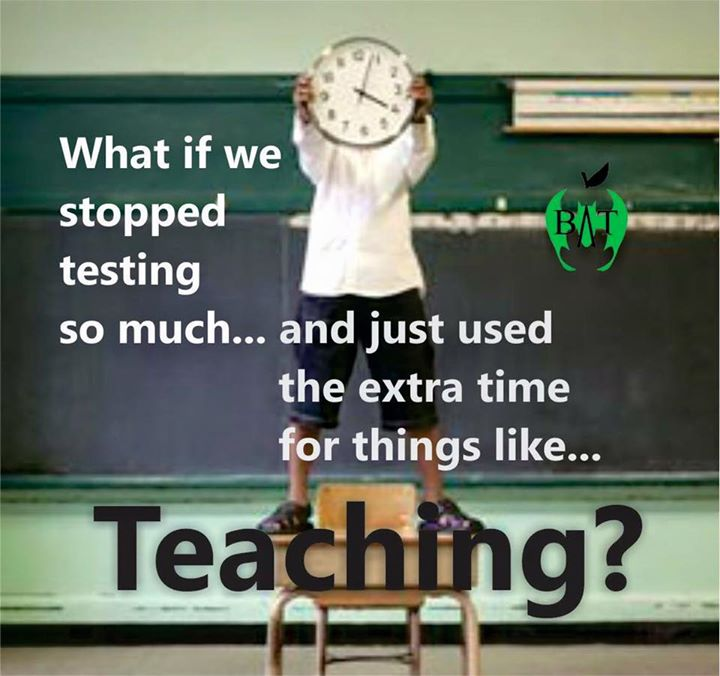
A familiar refrain I hear among educators is this: “When it comes to learning, we can all agree that the most important factor is the teacher.” Teaching is widely considered the most important when it comes to the education of children. Parents often believe it. Politicians say it. Ed Reformers buy it. Badass Teachers agree -- as illustrated below.

But it’s not factual. 

Wednesday, June 3, 2015

Engage Students + Capture #StuVoice with Today’s Meet

Capturing student voice and engaging students in robust discussion and questioning is an important element of the Common Core Standards. It also increases teacher effectiveness and student achievement. 
  
With traditional teaching methods, reaching students who are either, too shy or not motivated to participate, can be difficult. Darlynn Alfalla, the Tech Coordinator at Wagner Middle School provided advice to the “Questioning and Discussion Study Group” at her school. She helped an interested teacher, Robin Danky, incorporate a back channel called “Today’s Meet” into her lesson.


It worked like a charm. Here is the video which outlines the results.
Click this link to view video.

Tuesday, February 17, 2015

The Social Media Game Elementary School Students Should Be Playing

I'm a student voice advocate. Fortunately, my employer supports this and as such, we have been incorporating the voice of students in the guidelines around social media (You can see the teen guidelines at schools.nyc.gov/socialmedia). Most recently I had the opportunity to speak with hundreds of elementary students about social media and which platforms they are using. Admittedly, I'm not much of a user of social media platforms for the under 13 set, so I knew I had a lot to learn. Interestingly, across the board, one platform rose to the top and I had never heard of it before.


The platform is called MovieStar Planet and it promises players "Fame, Fortune, and Friends." Interestingly, though not surprisingly, the first reaction from many of the adults about this game was negative. Online gaming? Social media? Fame, fortune, friends = narcissism. Blech. 

When I suggested this would be a great game to be reviewed on an education site, I was told, the site only reviews games that were educational. For some it seems if kids like it and it plays to their need for attention, it has to be bad.  

Not so.

Here is how MovieStar Planet describes their site:

"MovieStarPlanet is a social website where children and teenagers work together with their friends to create cartoons. MovieStarPlanet is a blend of Facebook and YouTube with a learning dimension added." 

Here's how it works:
In MovieStarPlanet you get a personal virtual MovieStar which is used in movies, chat rooms and games.

In the Movies and chat rooms a microphone can be used to record speechlines and voice chat - please see the "How to record sound" instruction movie for details about how to record sound.

Your MovieStar earns fame points and StarCoins (the virtual money in MovieStarPlanet) when you participate in the MovieStarPlanet virtual world.

StarCoins are earned when other users watch your published movies, when you watch and rate other movies, and when you play games in the chat rooms.

Fame points are earned when other users watch your published movies.

Your MovieStar starts at level 0, and when you earn fame points you rise in levels. New levels give access to new animations and access to chat rooms reserved for MovieStars at higher levels. 

So you might be reading this and be a bit freaked out that young people are being social online. What if someone says something mean? What if someone is not who they say they are?  

Real concerns indeed which is why it is important for adults to be in the online worlds of young people.  That said, when I talked to the students, they could have given a class on the topic. They definitely knew how to handle it.
-Tell the person nicely that you don't like what they are saying.
-If they continue block and report them.

That usually did the trick. If not, they say they'd get a parent or teacher that wouldn't "freak out and ban it" involved. And, that's a real concern for kids. Too often one negative thing happens and the response from adults is to ban and block (like this school did) rather than empower and prepare our youth who are growing up in a world where being savvy on social media in crucial.  

Think about it this way.  What better way for children to develop literacy skills then to chat with each and create movies for a real audience. And, bonus. The children have the opportunity to connect with others from around the world.  

Now check out who is behind the creation of MovieStar Planet:
The Danish Ministry of Science Technology and Innovation in cooperation with The Danish University of Education, and a number of elementary school teachers.In 2009-11 the development of MovieStarPlanet is part of the research and development project about the use of games in education called Serious Games on a Global Market Place

Here are the education objectives: 
The cartoons in MovieStarPlanet are small and very simple, focusing on using English in new and motivating ways. The cartoon medium is used to practice the written English skills of the children allowing them to:
·         read and write screenplays
·         watch their own and other children’s Movies so that they practice listening to and understanding/interpreting the English language

For the children, MovieStarPlanet is ideal for:
·         participating in ”language games” and role-plays
·         using digital media to create simple or more advanced texts
·         communicating with children in other grades and schools
·         understanding and performing simple or more advance language actions
·         using digital media for creative expression

Ready to get started? 

·         Teachers: Head on over to the teacher's center.   

·         Students: www.moviestarplanet.com is freely available on the internet and can be freely used in education or privately by anyone.

·         Parents: Read http://info.moviestarplanet.com/parents.aspx.


·         Everyone: Safety first. Read this: http://info.moviestarplanet.com/safety.aspx

Tuesday, January 27, 2015

Struggling To Connect With Students? Let Them Get To Know You

Guest post by James Alan Sturtevant

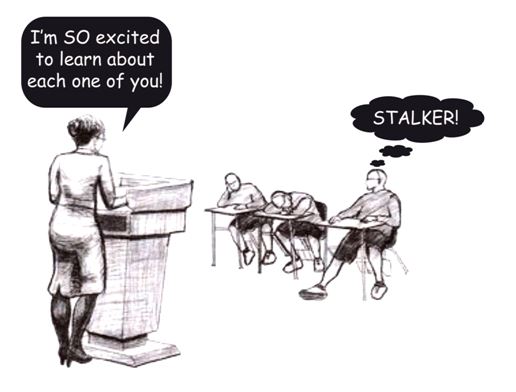
Teachers are often lectured, “Get to know your students!” That’s not easy to do! A lot of kids can be pretty closed down. And, if you try to get to know them before they’re ready…it can be counter productive.
pic 1
Bonding with students is fundamental to the learning process. John Hattie, in his landmark book “Visible Learning”, created a list of 138 influences on student learning. He placed student-teacher relationships in 11th place, far ahead of many things one might think more important. State departments of education, like in Ohio where I live, are requiring resident educators to demonstrate that positive relationships are being fostered in classrooms.

Sunday, December 14, 2014

Good news for #Students - Screentime Is Good For You!

The next time someone shares with you another piece of shock journalism with claims that research says if kids use tech they'll get fat and stupid, arm yourself with this piece (10 Points Where the Research Behind Banning Handheld Devices for Children Is Flawed) which debunks that research. If you don't feel like reading it, it says this: The research cited against technology use for youth focuses on passive television viewing or addiction to video games that are usually of violent nature. 

Of course video game addiction and passively intaking information for hours on end is bad for anyone. In those cases the problem is usually not the technology, but rather the lack of a responsible adult guiding these young people.

However, when young people have responsible parents and teachers in their lives, this does not describe what most young people do with technology. When responsible adults are involved in and understand the digital lives of young people, great things happen. Below is an arsenal of material that explains how today's youth are using technology effectively.  Pick a few of your favorites. Then share, and shift the conversation from lamenting about "kids today" to celebrating the wonderful things young people are doing when given proper support and access technology.  

Wednesday, November 19, 2014

Stop Letting Good Students Do Bad Presentations

The good news is that more and more often students are presenting at education conferences. The bad news is that they’re doing a poor job and it’s their teacher’s fault. 

Don’t be a teacher who let’s your students give a bad presentation. Before you have your students present make sure you’ve prepared them with these tips.

Thursday, September 18, 2014

Student Voice Live - 9/20 in NYC: Calling All Innovative Educators

Guest post by student, Keaton Wadzinski


It started with just a few students and allies connecting over Twitter. Then came the weekly #StuVoice Twitter Chats, Facebook conversations, then Google Hangouts, which all led to the first ever Student Voice Live! in April of 2013.

What caught on so quickly? The Student Voice movement.

Once started, the spark of student voice caught fire, igniting the drive to create Student Voice, the for-students-by-students 501 (c) 3 non-profit dedicated to revolutionizing education through the voices and actions of students.

Event details
Innovative Educators are invited to join in this exceptional work on Saturday, September 20th, at Student Voice Live! 2014 at Shootdigital Studios (23 East Fourth St. New York, NY, 10003). Come to contribute your ideas, support, and passion by registering at http://stuvoice.org/student-voice-live. If you can’t attend, you can watch via livestream here and follow our Twitter stream @Stu_Voice!

Monday, January 13, 2014

Engage with @ArneDuncan during #StuVoice Twitter chat

The voice of students is of utmost importance and today those students are harnessing the power of social media to take a stand, be heard, and take action around the issues that affect them.  It seems Secretary of Education Arne Duncan and his team are interested in listening.

Today, January 13, 2014, Secretary Duncan will be moderating a special one-hour #stuvoice Twitter chat to get feedback from students on how we can keep college affordable and how the Administration’s college rating system can be useful for students and families.

You can join tonight. 

Details...
What: #StuVoice Twitter Chat with Secretary of Education Arne Duncan
When: 8:30pm EST Monday January 13, 2014
Where: Follow the Twitter conversation starting at 8:30pm on Jan. 13, with the #stuvoice hashtag and follow @ArneDuncan and @Stu_Voice.


For more information visit the Student Voice website http://stuvoice.org/, Facebook page https://www.facebook.com/thestuvoice, and Facebook group https://www.facebook.com/groups/stuvoice. You can also subscribe to the Department of Education’s Youth Voices newsletter, and follow ED Youth Voices on Facebook.

Sunday, December 22, 2013

Teen @CGressmanTHS builds a PLN to spread ideas about the key to giving the gift of learning

High school student Courtney Gressman made a powerful public service announcement as part of her social studies class titled “Learning is NATURAL. The Way We Learn Should Be OPTIONAL.” Unlike most high school students, however, her work didn’t stay locked in the walls of the classroom. Gressman explains, “Our class is a very opinionated group of independent, connected learners. We use tools such as social media to gain knowledge, perspective, and to have diverse conversation where anyone can be included.”

As such, the first thing she did upon the completion of her PSA was to Tweet it.


The PSA was meant to address the problem of lack of student input in education and to show students AND adults that there are different ways to learn and teach. Gressman explains, "One of these ways in my own life is #SandersTHS, my class in which I made the PSA, but I know we could be doing so much more at my school to provide all students with independent learning opportunities so we can truly learn the way we want and need to. We all deserve and want to have more freedom in our education."