Showing posts with label screen time. Show all posts

Sunday, April 12, 2015

Screentime - Focus On Quality, Not Quantity

teen girl textingThere’s a lot of debate about screentime for youth. Not only is it important for teachers to be familiar with the research, but Holly Flanders, CEO of Choice Parenting reminds us that parents, nannies, and any childcare provider must also be armed with accurate information. Flanders was recently quoted in the New York Post explaining why misinformation and misunderstanding can be a problem. “Most nanny relationships fail after a buildup of small issues that explode into something beyond repair.” The same holds true for parent-teacher relationships.


So what should the adults raising our youth know about screentime?  It may not be what you think.


Unlimited screentime is fine... if used responsibly.

Sunday, March 1, 2015

Screen time: It's not about how much. It's about how.

Editor's Note: A version of this post was originally posted on career advice expert, Penelope Trunk's education blog. If you'd rather read it (and the comments) there, go here.  

There’s nothing the press likes better than a story that generates real panic for teachers and parents…especially when it has the stamp of science to give a the panic an extra edge.
That’s exactly what happened when the media (Scientific American, Wall Street Journal,CNN, New York Times) ran a story about the American Association of Pediatrics (AAP)recommendations on children and screen time. One to two hours a day for children older than 2, they said, and no screen time at all for those younger than 2. Longer than that is dangerous to their health and their development.
An educator or parent today reading this probably had one of these reactions:
1.  You are a failure because your students are in front of screens much more than 1 or 2 hours a day.
2.  You don’t let students use computers so you’re good.
OR 
3.  Seriously? What year is this? Who is doing this research?
If you fit into the third reaction, you are likely someone who has seen amazing learning from screen time for your young people: building, creating, coding, reading, writing, and more.
Why would adults want to limit that?
We wouldn’t.
So why would the AAP make such out-of-touch recommendations?

Sunday, December 14, 2014

Good news for #Students - Screentime Is Good For You!

The next time someone shares with you another piece of shock journalism with claims that research says if kids use tech they'll get fat and stupid, arm yourself with this piece (10 Points Where the Research Behind Banning Handheld Devices for Children Is Flawed) which debunks that research. If you don't feel like reading it, it says this: The research cited against technology use for youth focuses on passive television viewing or addiction to video games that are usually of violent nature. 

Of course video game addiction and passively intaking information for hours on end is bad for anyone. In those cases the problem is usually not the technology, but rather the lack of a responsible adult guiding these young people.

However, when young people have responsible parents and teachers in their lives, this does not describe what most young people do with technology. When responsible adults are involved in and understand the digital lives of young people, great things happen. Below is an arsenal of material that explains how today's youth are using technology effectively.  Pick a few of your favorites. Then share, and shift the conversation from lamenting about "kids today" to celebrating the wonderful things young people are doing when given proper support and access technology.  

Thursday, February 21, 2013

Think twice before limiting screentime


The American Academy of Pediatrics (AAP) recommends limiting a child's screentime to no more than one or two hours a day because, they say too much screen time has been linked to the following issues: Obesity. Irregular sleep (see #7). Behavioral problems. Impaired academic performance. Violence. Less time for play.

This begs the questions:
How much does this century-old academy really know about screen time? It seems not much. This out-of-touch Academy confuses passive television watching with interactive screen time which makes it a flawed study to begin with. Next up: Why don’t they address the research that supports that sitting in school all day leads to many of these problems as well? 

If the AAP really wanted to help address these issues, instead of focusing on parents and screens, they’d be making recommendations to schools about things like getting kids up and out of their seats.

Wednesday, March 14, 2012

Why I Let My Kids Have an Internet Presence

 | Crossposted at dirt under my fingernails


Eva and Ian using the computer Eva bought with income from her book sales. Those sales have in part been made possible by her website.
Education and technology – it seems everywhere I look folks are talking about it. Should we do more, less? What about virtual schools? Interactive white boards? Cell phones? Facebook and Twitter? Should we let kids be out there on the ‘net? Should we post their pictures? Won’t they be kidnapped??
These are legitimate conversations, and each person has to make these kinds of decisions based on their own comfort levels and according to the needs of the individual child. I know people who are aghast that my kids each have a website with their names attached. I know many others who don’t even blink about it.

The way I see it, there is risk in everything we do. We put our kids on school buses every daywithout seat belts. We let them play contact sports. We drive our cars on roads with thousands of other imperfect drivers (the legal license age here is just 14!!). We fly in planes. Heck, we get up in the morning. I figure you can get injured or killed just as easy staying safe at home as you can if you travel across the world. But personally, I would take the second, far more interesting option.

So yes, I let my kids have a presence on the internet – first and last name and everything. And though I’m sure there are risks involved, the benefits for us far outweigh them. Here are some of those benefits:
I’m going to be talking mainly about Eva’s online presence, because it is more fully developed than Ian’s is currently.  Ian is still developing product for his site; once he has sheet music that bands can use, he’ll be able to connect with people in much the same way that Eva has. We are also still developing his website’s overall message and determining how it will best benefit other kids and musicians.


It Provides Real-Life Motivation for Quality Work
I talk a lot about doing away with grades for my kids’ work and instead providing the same types of motivational opportunities that drive adults. Kids aren’t so different from adults in that respect. Getting an “A” might feel good, but having your story published in a magazine feels better. Eva knows that her books aren’t just going to be filed in a cabinet, but read by dozens and dozens of people, many of whom she’ll never meet. Talk about motivation to produce quality work.

Friday, February 17, 2012

Making Screen Time Limits Gentle and Fun

Guest post by Cathy Earle


Transitions can be hard for kids, and sharing can be even harder. It would be lovely if everybody on the planet could have their own top-of-the-line computer, but it's not a reality in all schools and families. Even the least-scheduled homeschoolers can't play Minecraft and Wizard 101 whenever they please, because there are appointments to keep, baths to take, meals to eat, beds to sleep in, and hopefully fields to run in! Whether parents and teachers limit kids' computer time in order to share one computer among several users or because of educational or health reasons, enforcing “screen time” limits can be very frustrating.
There can be whining, begging, bargaining, or even all-out arguments.

Industrial Designer Justin Thoreau Lund tells me that he found himself in this situation with his normally mild-mannered daughter Vega. He writes:

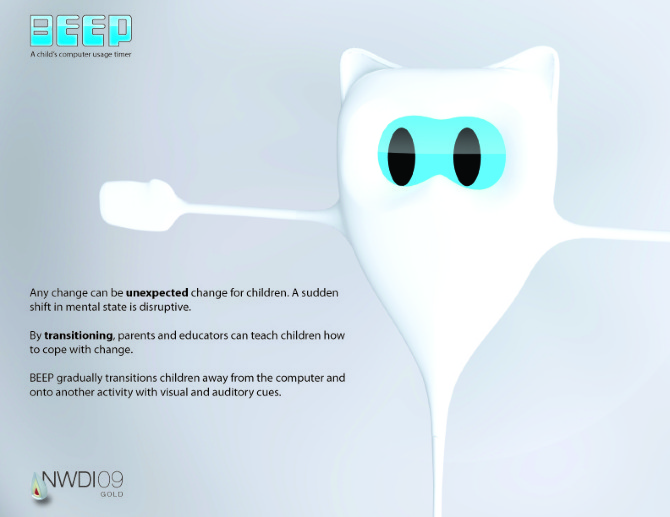
Our attempts to come to a mutual understanding regarding screen time were the inspiration for BEEP, a USB device that gently transitions kids off of a computer when their allotted screen time is up. BEEP has bendable arms that allow the timer to be positioned on the computer monitor, and BEEP's animated eyes act as visual cues showing the passing of time. As a child's screen time winds to a close, BEEP falls asleep, and so does the computer.

This idea won a notable design award, which led to press coverage and statements of interest from many people. This inspired me to take this idea from its conceptual stage to completion, and I spent two years developing the idea further. BEEP is now ready to move to the production phase, and I have launched a social funding campaign on Kickstarter.”