 Vicki Abeles, producer of the film Race to Nowhere is asking for innovative educators to take a minute or two to tell your story in front of a camera. Please share what actions -- big or small -- you, your family, or your school taken to break out of the “Race to Nowhere." Think about the small steps you've taken. Did you sign a petition, ask for homework-free holiday breaks in your school, speak to a teacher or administrator about homework, testing or the school schedule? Did you make changes in your home, change the conversation with your family and friends, attend a school board meeting or advocate for more time for recess? Did you make changes to support more balance or time together as a family?
Showing posts with label Race to Nowhere. Show all posts
Showing posts with label Race to Nowhere. Show all posts
Wednesday, January 9, 2013
Make your Race to Nowhere movie!
Vicki Abeles, producer of the film Race to Nowhere is asking for innovative educators to take a minute or two to tell your story in front of a camera. Please share what actions -- big or small -- you, your family, or your school taken to break out of the “Race to Nowhere." Think about the small steps you've taken. Did you sign a petition, ask for homework-free holiday breaks in your school, speak to a teacher or administrator about homework, testing or the school schedule? Did you make changes in your home, change the conversation with your family and friends, attend a school board meeting or advocate for more time for recess? Did you make changes to support more balance or time together as a family? 

Monday, May 2, 2011
The Innovative Educator Talks to Parents as Partners about Fixing the School and Not the Child
I'm excited to be joining Parents as Partners on Monday May 2, 2011 at 9:00 PM Eastern Standard Time (GMT-4) to talk about my ebook for parents “Fix the School Not the Child” which you can download right from my blog.
I wrote this guide after watching the movie "Race to Nowhere" because I was surprised that the parents featured in the film, whose children were suffering because of school, seemed to feel they were powerless to do anything different. I thought, wow? Really? They just kept subjecting their children to the same thing that was causing them to suffer. I intended to write a blog post in response, but that quickly turned into a twenty page booklet containing 20 ideas for parents who are sick of "Waiting for Superman" and tired of having their children in a "Race to Nowhere."
To date there are more than 8000 people who have read the guide and have been empowered with ideas to do what is in their children's best interest. My goal is for parents to share it far and wide with other parents in their children’s school and, if they have online spaces, I hope they will place it there as a free guide for others.
Location: http://tinyurl.com/ETTPasp
You can join me in the elluminate room at http://tinyurl.com/ETTpasp The chat conversation will be held in this room. If you have a USB headset with microphone you can come to the mic to ask questions.
Link to Parents as Partners webcast: http://tinyurl.com/ETTpasp
Test your computer settings http://www.elluminate.com/Support/?id=62/
The audio only portion of the webcast will be on ustream at http://edtechtalk.com/live
Miss the show? check back for the recording at www.edtechtalk.com/ParentsasPartners
I wrote this guide after watching the movie "Race to Nowhere" because I was surprised that the parents featured in the film, whose children were suffering because of school, seemed to feel they were powerless to do anything different. I thought, wow? Really? They just kept subjecting their children to the same thing that was causing them to suffer. I intended to write a blog post in response, but that quickly turned into a twenty page booklet containing 20 ideas for parents who are sick of "Waiting for Superman" and tired of having their children in a "Race to Nowhere."
To date there are more than 8000 people who have read the guide and have been empowered with ideas to do what is in their children's best interest. My goal is for parents to share it far and wide with other parents in their children’s school and, if they have online spaces, I hope they will place it there as a free guide for others.
Location: http://tinyurl.com/ETTPasp
You can join me in the elluminate room at http://tinyurl.com/ETTpasp The chat conversation will be held in this room. If you have a USB headset with microphone you can come to the mic to ask questions.
Link to Parents as Partners webcast: http://tinyurl.com/ETTpasp
Test your computer settings http://www.elluminate.com/Support/?id=62/
The audio only portion of the webcast will be on ustream at http://edtechtalk.com/live
Miss the show? check back for the recording at www.edtechtalk.com/ParentsasPartners
Monday, February 28, 2011
Superwoman Was Already Here
Superwoman was already here.
And she gave us a superb educational model to end the “Race to Nowhere.”
Her name was Dr. Maria Montessori and in the first half of the 20th century she pioneered and refined the Montessori method of education. Today, there are over 17,000 Montessori schools worldwide including thousands of preschools in the USA and hundreds of Montessori schools in the U.S. at the K-8 level.
My children go to a private Jewish Montessori school in New Jersey called Yeshivat Netivot Montessori. After five years as a parent at Netivot, I now believe quite deeply that it is a national tragedy that Montessori is largely deemed to be an educational option only for privileged kids from families that can afford tuition at a progressive private school.
Millions more American children deserve access to a Montessori education.
There are about 350 public Montessori schools in the United States, a number that is shamefully small.
I am not writing to explain, “What is Montessori?” There are several good books, lots of internet videos and numerous websites to answer that question.
But I do want to offer three reasons* Why I love Montessori and believe that millions more American children could benefit from this extraordinary approach to teaching and learning:
1. Curiosity
In a Montessori classroom, questions matter more than answers and a child’s natural curiosity is welcomed, not shunned.
Newsweek ran an article last summer about America’s “creativity crisis” with this striking paragraph (emphasis mine):
“Preschool children, on average, ask their parents about 100 questions a day. Why, why, why—sometimes parents just wish it’d stop. Tragically, it does stop. By middle school they’ve pretty much stopped asking. It’s no coincidence that this same time is when student motivation and engagement plummet. They didn’t stop asking questions because they lost interest: it’s the other way around. They lost interest because they stopped asking questions.“
(some kids getting all Montessori with shapes. source)
In a Montessori school, this dynamic does not happen because teachers “follow the child” and are always encouraging the kids to ask questions. The Montessori method cares far more about the inquiry process and less about the results of those inquiries, believing that children will eventually master–with the guidance of their teachers and the engaged use of the hands-on Montessori materials which control for error–the expected answers and results that are the focus of most traditional classroom activity.
My daughter’s lower elementary teacher (Montessori classes are typically multi-age, lower elementary is grades 1-3 together) recently told me that a few kids in her classroom were learning about the triangle and they asked “Can a triangle have more or less than 180 degrees?” In classic Montessori style, the teacher turned the question back on them and said, “Use the hands-on geometric materials and try and make an actual triangle that is more or less than 180 degrees.” So the children have their question honored and arrive at the proper answer by themselves.
This story also highlights the role of a teacher in a Montessori classroom as being a “guide on the side” rather than the “sage on the stage.”
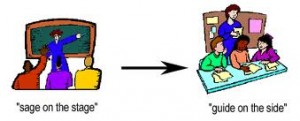
(can you believe that I found this on the internet? source)
In a world where the amount of information is doubling every 2.5 years (with much of it available at the click of a mouse) and where the top 10 in-demand jobs in 2010 did not even exist in 2004, encouraging kids to ask good questions and giving them life-long tools to investigate those questions is far more important than instructing them on how to produce correct responses. Even if those answers require some level of complexity, they are generally still straight-forward and predictable, which hardly prepares them for a world whose path is increasingly winding and unknown.
The culture of inquiry that is the hallmark of a good Montessori school is also a critical foundation for the creativity and innovation that America will need to compete in the 21st century. In December 2009, the Harvard Business Review published an article called, “The Innovator’s DNA” based on a six-year study of 3,000 creative executives including visionaries likeApple’s Steve Jobs, Amazon’s Jeff Bezos, Ebay’s Pierre Omidyar and Meg Whitman, and P&G’s A.G. Lafley. In an accompanying interview (with two of the three authors of the study) entitled “How Do Innovators Think?”, one of the professors that conducted the study noted (emphasis mine)
“We also believe that the most innovative entrepreneurs were very lucky to have been raised in an atmosphere where inquisitiveness was encouraged. We were struck by the stories they told about being sustained by people who cared about experimentation and exploration. Sometimes these people were relatives, but sometimes they were neighbors, teachers or other influential adults. A number of the innovative entrepreneurs also went to Montessori schools, where they learned to follow their curiosity. To paraphrase the famous Apple ad campaign, innovators not only learned early on to think different, they act different (and even talk different).”
2. No Homework

(source)
Many parents ask themselves, “If my child is spending six, seven or eight hours in school, why does she get so much homework?” If she were alive today, Dr. Maria Montessori would definitely be asking the same question.
My children do not have any daily homework at their Montessori school. While this varies at Montessori schools, most Montessori schools do not give kids any kind of daily homework. They may have research projects or long-term book reports (as do the students at my daughters’ Jewish Montessori school), but no daily homework.
The effectiveness of the Montessori approach usually obviates the need for homework. As one father in our school noted to me, “My 7 year-old was in a traditional school last year and he learns more in a day at this Montessori school than he did in a month at his regular school.” Since children in a high-quality Montessori school learn mostly by doing and by using as many of their senses as possible, in-school time is extremely productive and there is little or no requirement for homework to review and/or build upon their daily in-school lessons.
Without the crushing burden of homework that most American kids face each night, kids in a Montessori school are free to do whatever they like after school: play outside, watch TV, read, participate in sports, etc. The daily emotional battles over homework that most parents know all too well are also largely eliminated.
And homework is a waste of time. The research has shown consistently that homework at the grade school level has virtually no correlation with academic achievement. See this article from Time magazine which summarizes the leading research.
3. Calm and Peaceful Classroom Environment
Good Montessori classrooms have a sense of calm and order that is amazing; a setting where all kids are consistently engaged throughout the day in activities that they find meaningful and fun. We are starting to fully grasp how critical this type of environment is for learning and development, regardless of age. In the past three decades, there has been an explosion of important research that documents the connections between stress levels and the ability of a person to function and thrive, whether it be at home, work or school.
In a wonderful new book called “Brain Rules for Baby” by Dr. John Medina, a brain scientist, some of this research is examined and explored. Dr Medina, in a chapter on how to raise a smart child writes:
“First, I need to correct a misconception. Many well-meaning moms and dads think their child’s brain is interested in learning. That is not accurate. The brain is not interested in learning. The brain is interested in surviving. Every ability in our intellectual tool kit was engineered to escape extinction. Learning exists only to serve the requirements of this primal goal. It is a happy coincidence that our intellectual tools can do double duty in the classroom, conferring on us the ability to create spreadsheets and speak French. But that’s not the brain’s day job. That is an incidental byproduct of a much deeper force: the gnawing, clawing desire to live to the next day. We do not survive so that we can learn. We learn so that we can survive.
This overarching goal predicts many things, and here’s the most important: If you want a well-educated child, you must create an environment of safety. When the brain’s safety needs are met, it will allow its neurons to moonlight in algebra classes. When safety needs are not met, algebra goes out the window. Roosevelt’s dad held him first, which made his son feel safe, which meant the future president could luxuriate in geography.”
In Montessori classrooms, the methodology of engaging with children, the approach of the teachers and the way those teachers are trained all help build and foster this environment of safety where children can learn and flourish.
CONCLUSION
My commitment to my Jewish identity means that my kids need to go to a Jewish school so they can learn deeply about Judaism and their Jewish heritage. Every day I wake up grateful that an awesome Jewish Montessori school exists five minutes from my house in New Jersey.
But I am also an American who loves his country and cares deeply about all her children and their future, which of course will largely determine America’s future.
Our public education system needs radical transformation. Every child has gifts and talents that should be nurtured and we are wasting vast oceans of human ability and potential with our current system.
There are no silver bullets and I do not want to suggest that if every child went to a Montessori school, all of our educational challenges would be solved. Not every child is right for a Montessori school and Montessori is not right for every child.
But Montessori can be a great educational experience for many, many more American children and I urge all parents to spend two hours visiting a high-quality Montessori school, one that is certified by either the American Montessori Society (AMS) or Association Montessori Internationale (AMI)-USA.
There are an increasing number of public and charter Montessori schools. If your children do not live near one, then organize with other parents to demand that this approach be offered as an option in your school district. Get in touch with people from other cities who have found a way to provide this option to their children in a public school setting.
Superwoman arrived over 100 years ago and showed us how extraordinary school can be for all types of children. It is up to all of us to carry on her legacy and work. America’s children deserve nothing less.

(source)
* * *
Daniel C. Petter-Lipstein is the father of three children that thrive at Yeshivat Netivot Montessori, a Jewish Montessori school in NJ. He graduated from Harvard College and Columbia Law School and after a decade still finds satisfaction as a lawyer, though he sometimes wishes he could just take a month off and audit his daughters’ 4-6th grade upper elementary class where they are learning concepts like stellar nucleosynthesis and studying the history of marbles and creating their own marble games.
Additional notes from Daniel: The views and opinions expressed in this article are entirely my own. Not a single phrase, word or comma of this article was reviewed or approved by Yeshivat Netivot Montessori, AMS, AMI-USA or the Montessori Doughnut Plaza I plan to open in Laughing Waters, NY when I retire.
This article is dedicated in gratitude to Trevor Eissler, Montessori Dad and author of Montessori Madness, the best introduction and overview of Montessori available today (in my humble opinion). Thank you Trevor, for teaching me to embrace and cultivate my passion as a Montessori Dad.
*These are not the only three, just the ones that came together in my head as I wrote this article. There are dozens more, but Kate asked for an article/blog post, not a treatise, and she is my friend, so I listen to her.
And she gave us a superb educational model to end the “Race to Nowhere.”
Her name was Dr. Maria Montessori and in the first half of the 20th century she pioneered and refined the Montessori method of education. Today, there are over 17,000 Montessori schools worldwide including thousands of preschools in the USA and hundreds of Montessori schools in the U.S. at the K-8 level.
My children go to a private Jewish Montessori school in New Jersey called Yeshivat Netivot Montessori. After five years as a parent at Netivot, I now believe quite deeply that it is a national tragedy that Montessori is largely deemed to be an educational option only for privileged kids from families that can afford tuition at a progressive private school.
Millions more American children deserve access to a Montessori education.
There are about 350 public Montessori schools in the United States, a number that is shamefully small.
I am not writing to explain, “What is Montessori?” There are several good books, lots of internet videos and numerous websites to answer that question.
But I do want to offer three reasons* Why I love Montessori and believe that millions more American children could benefit from this extraordinary approach to teaching and learning:
1. Curiosity
In a Montessori classroom, questions matter more than answers and a child’s natural curiosity is welcomed, not shunned.
Newsweek ran an article last summer about America’s “creativity crisis” with this striking paragraph (emphasis mine):
“Preschool children, on average, ask their parents about 100 questions a day. Why, why, why—sometimes parents just wish it’d stop. Tragically, it does stop. By middle school they’ve pretty much stopped asking. It’s no coincidence that this same time is when student motivation and engagement plummet. They didn’t stop asking questions because they lost interest: it’s the other way around. They lost interest because they stopped asking questions.“
(some kids getting all Montessori with shapes. source)
In a Montessori school, this dynamic does not happen because teachers “follow the child” and are always encouraging the kids to ask questions. The Montessori method cares far more about the inquiry process and less about the results of those inquiries, believing that children will eventually master–with the guidance of their teachers and the engaged use of the hands-on Montessori materials which control for error–the expected answers and results that are the focus of most traditional classroom activity.
My daughter’s lower elementary teacher (Montessori classes are typically multi-age, lower elementary is grades 1-3 together) recently told me that a few kids in her classroom were learning about the triangle and they asked “Can a triangle have more or less than 180 degrees?” In classic Montessori style, the teacher turned the question back on them and said, “Use the hands-on geometric materials and try and make an actual triangle that is more or less than 180 degrees.” So the children have their question honored and arrive at the proper answer by themselves.
This story also highlights the role of a teacher in a Montessori classroom as being a “guide on the side” rather than the “sage on the stage.”
(can you believe that I found this on the internet? source)
In a world where the amount of information is doubling every 2.5 years (with much of it available at the click of a mouse) and where the top 10 in-demand jobs in 2010 did not even exist in 2004, encouraging kids to ask good questions and giving them life-long tools to investigate those questions is far more important than instructing them on how to produce correct responses. Even if those answers require some level of complexity, they are generally still straight-forward and predictable, which hardly prepares them for a world whose path is increasingly winding and unknown.
The culture of inquiry that is the hallmark of a good Montessori school is also a critical foundation for the creativity and innovation that America will need to compete in the 21st century. In December 2009, the Harvard Business Review published an article called, “The Innovator’s DNA” based on a six-year study of 3,000 creative executives including visionaries likeApple’s Steve Jobs, Amazon’s Jeff Bezos, Ebay’s Pierre Omidyar and Meg Whitman, and P&G’s A.G. Lafley. In an accompanying interview (with two of the three authors of the study) entitled “How Do Innovators Think?”, one of the professors that conducted the study noted (emphasis mine)
“We also believe that the most innovative entrepreneurs were very lucky to have been raised in an atmosphere where inquisitiveness was encouraged. We were struck by the stories they told about being sustained by people who cared about experimentation and exploration. Sometimes these people were relatives, but sometimes they were neighbors, teachers or other influential adults. A number of the innovative entrepreneurs also went to Montessori schools, where they learned to follow their curiosity. To paraphrase the famous Apple ad campaign, innovators not only learned early on to think different, they act different (and even talk different).”
2. No Homework
(source)
Many parents ask themselves, “If my child is spending six, seven or eight hours in school, why does she get so much homework?” If she were alive today, Dr. Maria Montessori would definitely be asking the same question.
My children do not have any daily homework at their Montessori school. While this varies at Montessori schools, most Montessori schools do not give kids any kind of daily homework. They may have research projects or long-term book reports (as do the students at my daughters’ Jewish Montessori school), but no daily homework.
The effectiveness of the Montessori approach usually obviates the need for homework. As one father in our school noted to me, “My 7 year-old was in a traditional school last year and he learns more in a day at this Montessori school than he did in a month at his regular school.” Since children in a high-quality Montessori school learn mostly by doing and by using as many of their senses as possible, in-school time is extremely productive and there is little or no requirement for homework to review and/or build upon their daily in-school lessons.
Without the crushing burden of homework that most American kids face each night, kids in a Montessori school are free to do whatever they like after school: play outside, watch TV, read, participate in sports, etc. The daily emotional battles over homework that most parents know all too well are also largely eliminated.
And homework is a waste of time. The research has shown consistently that homework at the grade school level has virtually no correlation with academic achievement. See this article from Time magazine which summarizes the leading research.
3. Calm and Peaceful Classroom Environment
Good Montessori classrooms have a sense of calm and order that is amazing; a setting where all kids are consistently engaged throughout the day in activities that they find meaningful and fun. We are starting to fully grasp how critical this type of environment is for learning and development, regardless of age. In the past three decades, there has been an explosion of important research that documents the connections between stress levels and the ability of a person to function and thrive, whether it be at home, work or school.
In a wonderful new book called “Brain Rules for Baby” by Dr. John Medina, a brain scientist, some of this research is examined and explored. Dr Medina, in a chapter on how to raise a smart child writes:
“First, I need to correct a misconception. Many well-meaning moms and dads think their child’s brain is interested in learning. That is not accurate. The brain is not interested in learning. The brain is interested in surviving. Every ability in our intellectual tool kit was engineered to escape extinction. Learning exists only to serve the requirements of this primal goal. It is a happy coincidence that our intellectual tools can do double duty in the classroom, conferring on us the ability to create spreadsheets and speak French. But that’s not the brain’s day job. That is an incidental byproduct of a much deeper force: the gnawing, clawing desire to live to the next day. We do not survive so that we can learn. We learn so that we can survive.
This overarching goal predicts many things, and here’s the most important: If you want a well-educated child, you must create an environment of safety. When the brain’s safety needs are met, it will allow its neurons to moonlight in algebra classes. When safety needs are not met, algebra goes out the window. Roosevelt’s dad held him first, which made his son feel safe, which meant the future president could luxuriate in geography.”
In Montessori classrooms, the methodology of engaging with children, the approach of the teachers and the way those teachers are trained all help build and foster this environment of safety where children can learn and flourish.
CONCLUSION
My commitment to my Jewish identity means that my kids need to go to a Jewish school so they can learn deeply about Judaism and their Jewish heritage. Every day I wake up grateful that an awesome Jewish Montessori school exists five minutes from my house in New Jersey.
But I am also an American who loves his country and cares deeply about all her children and their future, which of course will largely determine America’s future.
Our public education system needs radical transformation. Every child has gifts and talents that should be nurtured and we are wasting vast oceans of human ability and potential with our current system.
There are no silver bullets and I do not want to suggest that if every child went to a Montessori school, all of our educational challenges would be solved. Not every child is right for a Montessori school and Montessori is not right for every child.
But Montessori can be a great educational experience for many, many more American children and I urge all parents to spend two hours visiting a high-quality Montessori school, one that is certified by either the American Montessori Society (AMS) or Association Montessori Internationale (AMI)-USA.
There are an increasing number of public and charter Montessori schools. If your children do not live near one, then organize with other parents to demand that this approach be offered as an option in your school district. Get in touch with people from other cities who have found a way to provide this option to their children in a public school setting.
Superwoman arrived over 100 years ago and showed us how extraordinary school can be for all types of children. It is up to all of us to carry on her legacy and work. America’s children deserve nothing less.
(source)

* * *
Daniel C. Petter-Lipstein is the father of three children that thrive at Yeshivat Netivot Montessori, a Jewish Montessori school in NJ. He graduated from Harvard College and Columbia Law School and after a decade still finds satisfaction as a lawyer, though he sometimes wishes he could just take a month off and audit his daughters’ 4-6th grade upper elementary class where they are learning concepts like stellar nucleosynthesis and studying the history of marbles and creating their own marble games.
Additional notes from Daniel: The views and opinions expressed in this article are entirely my own. Not a single phrase, word or comma of this article was reviewed or approved by Yeshivat Netivot Montessori, AMS, AMI-USA or the Montessori Doughnut Plaza I plan to open in Laughing Waters, NY when I retire.
This article is dedicated in gratitude to Trevor Eissler, Montessori Dad and author of Montessori Madness, the best introduction and overview of Montessori available today (in my humble opinion). Thank you Trevor, for teaching me to embrace and cultivate my passion as a Montessori Dad.
*These are not the only three, just the ones that came together in my head as I wrote this article. There are dozens more, but Kate asked for an article/blog post, not a treatise, and she is my friend, so I listen to her.
Tuesday, February 22, 2011
Empowered Parents Are The Solution to Ending This Race the Nowhere
This was also published on The Huffington Post. If you’d like read the post and comments there visit this link.
What disturbed me most about the much-lauded educational documentary RACE TO NOWHERE was not the outcry of adolescents who explained how school led them to develop anorexia, cut themselves, consider suicide, or require hospitalization for severe anxiety. I knew all that. What disturbed me was the disempowerment of even the most passionate and devoted parents who have resigned themselves to believing that schools, not parents, have ownership over their children’s education. Vicki Abeles, a concerned mother turned filmmaker was inspired to create this film as she realized the high-stakes, high-pressure culture that has invaded our schools and our children’s lives had resulted in her three children each in someway falling victim to school-induced stress. The problem was so severe that in addition to mental anguish, her children experienced headaches, stomachaches, and depression that resulted in trips to the doctor’s office, therapist, and hospital. She dedicated the film to a beautiful young girl and gifted musician from her neighborhood named Devon who at 13 committed suicide. The suspected cause of death was that the pressure to succeed at school in general, algebra in particular, became extremely challenging causing self-doubt, depression, loss of self worth, anxiety, and ultimately death.
The film shines a light on the price our kids pay for what one kid in the film identifies as being in a “race to nowhere” resulting from an educational environment where stress-related illness, depression and burnout are rampant, cheating is commonplace, and yet even after all that, young people arrive at college and the workplace unprepared and uninspired. The documentary has put out a call to families, educators, experts and policy makers to examine current assumptions on how to best prepare the youth of America to become the healthy, bright, contributing and leading citizens in the 21st century.
Surprising, however, is that while RACE TO NOWHERE puts out this call to action, it fails to provide ideas about what can be done beyond, “examining current assumptions.” The movie did a great job of examining. Parents get it. Teachers get it. Students are getting it whether they like it or not. Now it’s time for real ideas about what to do next. This is absent from the movie where we discover even the passionate and desperate parents in the film are stuck in the “way things have always been” mindset. They feel powerless to do anything outside the options of stay in school or drop out. Toward the movie’s end, we discover Devon’s parents share their solution to raising their surviving child. They ask him less questions about his classes and more about how lunch and recess went. Another family featured a child wandering in fields who seemed rather lost after dropping out because she was unable to manage the pressures of school. Even filmmaker Vicki Ables, who paints an excellent picture of what is wrong with what schools are doing to our children and their parents who are driven to stop at nothing to get into top colleges, doesn’t see an alternative to school. Even after exposing all these problems, we learn her children are still in a traditional school. The only difference now is that the parents put less emphasis on homework and the importance of good grades. The solution for another family featured in the movie was to switch high schools to one known to be less academically rigorous.
I was left wondering why the only change these parents could come up with was to change THEIR behavior or drop out rather than demand a change in the cause of THE PROBLEM...an outdated, boring, and irrelevant school system, unnecessarily causing students to jump through hoops so they can ultimately pass more tests and more difficult tests. USC education professor Stephen Krashen recognizes the growing problem of a U.S. Department of Education that believes the key to college and career readiness is planning more tests including interim tests during the year, creating tests that are more difficult to pass, encouraging testing all subjects (not just reading and math) and also measuring growth, which likely means pre- and post-tests each year. He explains it this way,
So, why after all this is revealed, are parents still subjecting their children to this? Are they incapable of Thinking Outside the School as Kate Fridkis, so eloquently asks in her piece on the topic? It seems implausible that eliminating the source of the problem wouldn’t occur to the parents featured in this powerful documentary. Especially since the film distinctly acknowledges that many of today’s top CEOs know the truth about the unimportance of a college education. Heck, Bill Gates, Steve Jobs, Mark Zuckerberg, Ted Turner, and David Geffen never bothered graduating college. Many of today’s successful musicians (Lady Gaga), actors (Patrick Stuart), artists (Ansel Adams) didn’t bother with college either. Many well known writers (William Shakespeare, Jane Austen, George Orwell, J.K. Rowling, J.D. Salinger) never graduated or even bothered looking at colleges. Perhaps most interestingly is that several U.S. presidents (Truman, Washington, Lincoln and Van Buren) never attended college. More and more, smart students too are beginning to understand that a college education is not what it’s cracked up to be and they are dropping out.
But the masses seem to have been brainwashed into believing traditional school and college are the only keys to success even if our children are sick, depressed, or worse. DEAD. Are we not concerned that we expend little time or energy helping children discover what their dreams are for their lives beyond college? Or that college only need be part of the journey for a portion of the world. Aren’t we also developing citizens? People who treat each other with compassion, become our friends, colleagues, and significant others. What about helping students discover and develop their passions? Are parents conflicted knowing that we’re misleading this generation of future college graduates, known today as “Generation Debt” as they leave college with tens of thousand of dollars in debt for a degree that they’re often not even quite sure about what they will do with it? Are we really doing a service to the children of our future or are we making these choices because it’s what everyone else is doing? Keeping up with the Joneses if you will.
The reality of our past-- do well in school, go to college and the rest will take care of itself--is no longer true. First, what it took for the over-40 set to do well in school and what today’s students are required to do looks very different. As one parent in the audience viewing the film shared, “I feel responsible in part. They keep piling more and more work on these kids so we keep hiring more and more tutors. This fosters a vicious cycle that will never get better better because we’re just paying for the right to let schools take over the precious little time we have left with our children each day.”
Next, the cost of college has outweighed the economic gain. As hard as it is to believe, in most cases when you work the numbers, you are actually better off skipping your college experience and your college debt. Financial considerations aside, we’re raising a generation of students like Amy, Carlie, Jessica and Maria who have learned to do exactly what they’re told and are motivated to succeed, but they have no idea why. When you read each students bio, you’ll notice they are driven, motivated, and happen to be strong writers, but like most students there clearly has not been much attention placed on helping them identify and pursue their passions, talents, and interests.
Therein lies one of the big problems. If we never help students to discover what they love, what they’re good at or what they’re passionate about, how does all this learning and all these test scores really have intrinsic value or meaning? When the only answer to, “What do I need to know this for?” is “College” or “To pass the test.” what are we REALLY preparing students for?
While education as the cause of physical illness, mental illness, death and debt all sound rather bleak, there are answers. Answers that call for moving from examination to action and involve taking a stand and not following the mainstream. The answers are out there and as more and more parents believe they are entitled to become empowered to take ownership for their children’s learning we’ll see more joyous, passionate, successful happy children. It is time to move from acknowledgment to empowerment and for parents to take a stand and say, “I’m mad as hell and I’m not going to take this any more.” As hard as this may seem to do in an educational system driven from fear of failure by not following the norm, this is possible and there are already parents engaging in this work. Furthermore, there are school leaders and teachers who will be excited to have your passionate voices behind them to help them do what we all know is best for children.
To learn more about how you can help your child on the RACE TO SUCCESS visit this link.
What disturbed me most about the much-lauded educational documentary RACE TO NOWHERE was not the outcry of adolescents who explained how school led them to develop anorexia, cut themselves, consider suicide, or require hospitalization for severe anxiety. I knew all that. What disturbed me was the disempowerment of even the most passionate and devoted parents who have resigned themselves to believing that schools, not parents, have ownership over their children’s education. Vicki Abeles, a concerned mother turned filmmaker was inspired to create this film as she realized the high-stakes, high-pressure culture that has invaded our schools and our children’s lives had resulted in her three children each in someway falling victim to school-induced stress. The problem was so severe that in addition to mental anguish, her children experienced headaches, stomachaches, and depression that resulted in trips to the doctor’s office, therapist, and hospital. She dedicated the film to a beautiful young girl and gifted musician from her neighborhood named Devon who at 13 committed suicide. The suspected cause of death was that the pressure to succeed at school in general, algebra in particular, became extremely challenging causing self-doubt, depression, loss of self worth, anxiety, and ultimately death.
The film shines a light on the price our kids pay for what one kid in the film identifies as being in a “race to nowhere” resulting from an educational environment where stress-related illness, depression and burnout are rampant, cheating is commonplace, and yet even after all that, young people arrive at college and the workplace unprepared and uninspired. The documentary has put out a call to families, educators, experts and policy makers to examine current assumptions on how to best prepare the youth of America to become the healthy, bright, contributing and leading citizens in the 21st century.
Surprising, however, is that while RACE TO NOWHERE puts out this call to action, it fails to provide ideas about what can be done beyond, “examining current assumptions.” The movie did a great job of examining. Parents get it. Teachers get it. Students are getting it whether they like it or not. Now it’s time for real ideas about what to do next. This is absent from the movie where we discover even the passionate and desperate parents in the film are stuck in the “way things have always been” mindset. They feel powerless to do anything outside the options of stay in school or drop out. Toward the movie’s end, we discover Devon’s parents share their solution to raising their surviving child. They ask him less questions about his classes and more about how lunch and recess went. Another family featured a child wandering in fields who seemed rather lost after dropping out because she was unable to manage the pressures of school. Even filmmaker Vicki Ables, who paints an excellent picture of what is wrong with what schools are doing to our children and their parents who are driven to stop at nothing to get into top colleges, doesn’t see an alternative to school. Even after exposing all these problems, we learn her children are still in a traditional school. The only difference now is that the parents put less emphasis on homework and the importance of good grades. The solution for another family featured in the movie was to switch high schools to one known to be less academically rigorous.
I was left wondering why the only change these parents could come up with was to change THEIR behavior or drop out rather than demand a change in the cause of THE PROBLEM...an outdated, boring, and irrelevant school system, unnecessarily causing students to jump through hoops so they can ultimately pass more tests and more difficult tests. USC education professor Stephen Krashen recognizes the growing problem of a U.S. Department of Education that believes the key to college and career readiness is planning more tests including interim tests during the year, creating tests that are more difficult to pass, encouraging testing all subjects (not just reading and math) and also measuring growth, which likely means pre- and post-tests each year. He explains it this way,
“We have an educational system that thinks weighing the animal more frequently is more important than feeding it.”
So, why after all this is revealed, are parents still subjecting their children to this? Are they incapable of Thinking Outside the School as Kate Fridkis, so eloquently asks in her piece on the topic? It seems implausible that eliminating the source of the problem wouldn’t occur to the parents featured in this powerful documentary. Especially since the film distinctly acknowledges that many of today’s top CEOs know the truth about the unimportance of a college education. Heck, Bill Gates, Steve Jobs, Mark Zuckerberg, Ted Turner, and David Geffen never bothered graduating college. Many of today’s successful musicians (Lady Gaga), actors (Patrick Stuart), artists (Ansel Adams) didn’t bother with college either. Many well known writers (William Shakespeare, Jane Austen, George Orwell, J.K. Rowling, J.D. Salinger) never graduated or even bothered looking at colleges. Perhaps most interestingly is that several U.S. presidents (Truman, Washington, Lincoln and Van Buren) never attended college. More and more, smart students too are beginning to understand that a college education is not what it’s cracked up to be and they are dropping out.
But the masses seem to have been brainwashed into believing traditional school and college are the only keys to success even if our children are sick, depressed, or worse. DEAD. Are we not concerned that we expend little time or energy helping children discover what their dreams are for their lives beyond college? Or that college only need be part of the journey for a portion of the world. Aren’t we also developing citizens? People who treat each other with compassion, become our friends, colleagues, and significant others. What about helping students discover and develop their passions? Are parents conflicted knowing that we’re misleading this generation of future college graduates, known today as “Generation Debt” as they leave college with tens of thousand of dollars in debt for a degree that they’re often not even quite sure about what they will do with it? Are we really doing a service to the children of our future or are we making these choices because it’s what everyone else is doing? Keeping up with the Joneses if you will.
The reality of our past-- do well in school, go to college and the rest will take care of itself--is no longer true. First, what it took for the over-40 set to do well in school and what today’s students are required to do looks very different. As one parent in the audience viewing the film shared, “I feel responsible in part. They keep piling more and more work on these kids so we keep hiring more and more tutors. This fosters a vicious cycle that will never get better better because we’re just paying for the right to let schools take over the precious little time we have left with our children each day.”
Next, the cost of college has outweighed the economic gain. As hard as it is to believe, in most cases when you work the numbers, you are actually better off skipping your college experience and your college debt. Financial considerations aside, we’re raising a generation of students like Amy, Carlie, Jessica and Maria who have learned to do exactly what they’re told and are motivated to succeed, but they have no idea why. When you read each students bio, you’ll notice they are driven, motivated, and happen to be strong writers, but like most students there clearly has not been much attention placed on helping them identify and pursue their passions, talents, and interests.
Therein lies one of the big problems. If we never help students to discover what they love, what they’re good at or what they’re passionate about, how does all this learning and all these test scores really have intrinsic value or meaning? When the only answer to, “What do I need to know this for?” is “College” or “To pass the test.” what are we REALLY preparing students for?
While education as the cause of physical illness, mental illness, death and debt all sound rather bleak, there are answers. Answers that call for moving from examination to action and involve taking a stand and not following the mainstream. The answers are out there and as more and more parents believe they are entitled to become empowered to take ownership for their children’s learning we’ll see more joyous, passionate, successful happy children. It is time to move from acknowledgment to empowerment and for parents to take a stand and say, “I’m mad as hell and I’m not going to take this any more.” As hard as this may seem to do in an educational system driven from fear of failure by not following the norm, this is possible and there are already parents engaging in this work. Furthermore, there are school leaders and teachers who will be excited to have your passionate voices behind them to help them do what we all know is best for children.
To learn more about how you can help your child on the RACE TO SUCCESS visit this link.
Subscribe to:
Posts (Atom)