Showing posts with label vss2010. Show all posts

Sunday, November 21, 2010

Follow The Tweeter Who’s an Online Learning Leader - Top 200 Tweets from VSS2010

Listen to this article. Powered by  Odiogo.com
One of the best ways to get smart about any topic is by building your personal learning network through Twitter. Not only will you discover up-to-date information about a shared interest, you also develop a cadre of learning partners you can turn to when there’s something you need to know. During my recent foray into the world of online learning at iNacol’s Virtual Learning Symposium, I enjoyed my time in various sessions, but for me the real learning took place on Twitter where like-minded folks could discuss, real-time what they were learning and do so without disturbing anyone else. We were all tied together and found one another through the conference hashtag #vss2010.

Not only did I learn a lot from these Tweeps (people who Tweet) but after Tweeting out, “Anyone at #VSS2010 Heading to the airport for a 4:30 flight?” I even found someone with whom I could share a ride to the airport. Another fun Tweetcident (Twitter incident) occurred when I found myself in Twitosation (Twitter conversation) with a fellow attendee in reaction to disappointment in the commercialization of several presentations. We soon realized we were not only sitting in the same session but we were just seats apart from one another. How fun to be able to extend the Twitosation face-to-face.

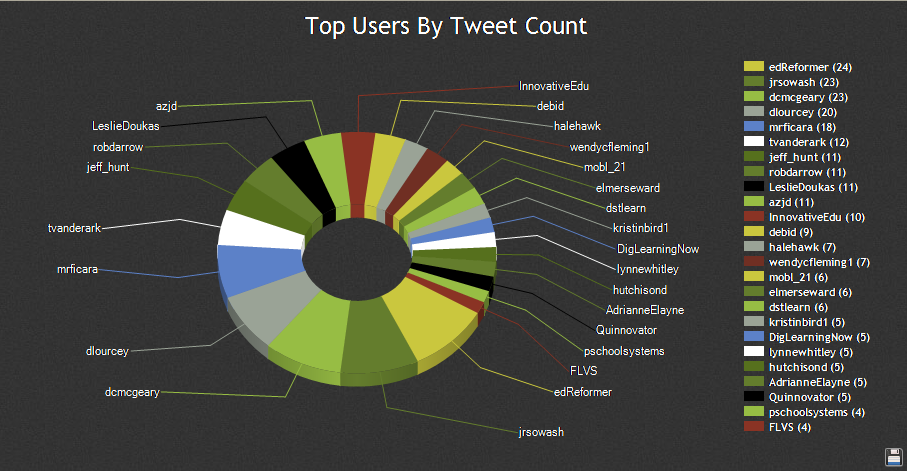
Innovative educators interested in connecting with others passionate about online learning can take a look at the chart below for a list of Tweeps interested in the topic. (Lookie! I’m top and center :-) If you click on the chart you’ll be taken to the source where you can just click on each person’s name and be brought directly to their Twitter account.

Below the chart you can see 200 Tweets I found worth highlighting sans those annoying commercials from the vendors (come on vendors, add some substance to your Tweets!)
Top 200 Tweets from iNacol’s Virtual School Symposium

Here are some interesting online learning Tweets shared at the conference. Find Tweeps you find interesting and connect with them by Tweeting using “@SelectedTwitter” i.e. “@innovativeedu. Your message will appear in their Twitter feed and the Twitosation begins!

Click here for the 200 Tweets.

Saturday, November 20, 2010

The Introductory Guide to Online Learning

I recently attended the Virtual School Symposium which brings educators interested in online learning together from around the world. Following my visit to the symposium I shared my Recommendations to Improve Online Learning and Reasons Students Say They Prefer Learning Online. Today, in places like New York City, online learning is being incorporated into the traditional classrooms, known as blended or hybrid learning, with tremendous success, especially for credit recovery, advanced placement (to promote college-readiness), continuity of learning during a pandemic, dual enrollment, and more.

The realization by administrators, teachers and parents that online courses can fill gaps in course offerings as well as complement traditional classroom instruction with engaging, interactive materials has generated many questions about implementing online learning programs:

  • What does an online course look like?
  • How do students interact with their teacher?
  • What qualifications and training are required of teachers?
  • Does online learning really work?
  • What state or school district policies are needed to implement online learning?
To help answer those questions, The International Association of K-12 Online Learning released an updated introduction to online learning this week. They also released a state-by-state update of progress. The National Primer on K-12 Online Learning provides a comprehensive overview of online learning by examining the basics about online teaching and learning, evaluating academic success, professional development, technology and other topics.


Highlights include:

  1. iNACOL’s official online learning definitions
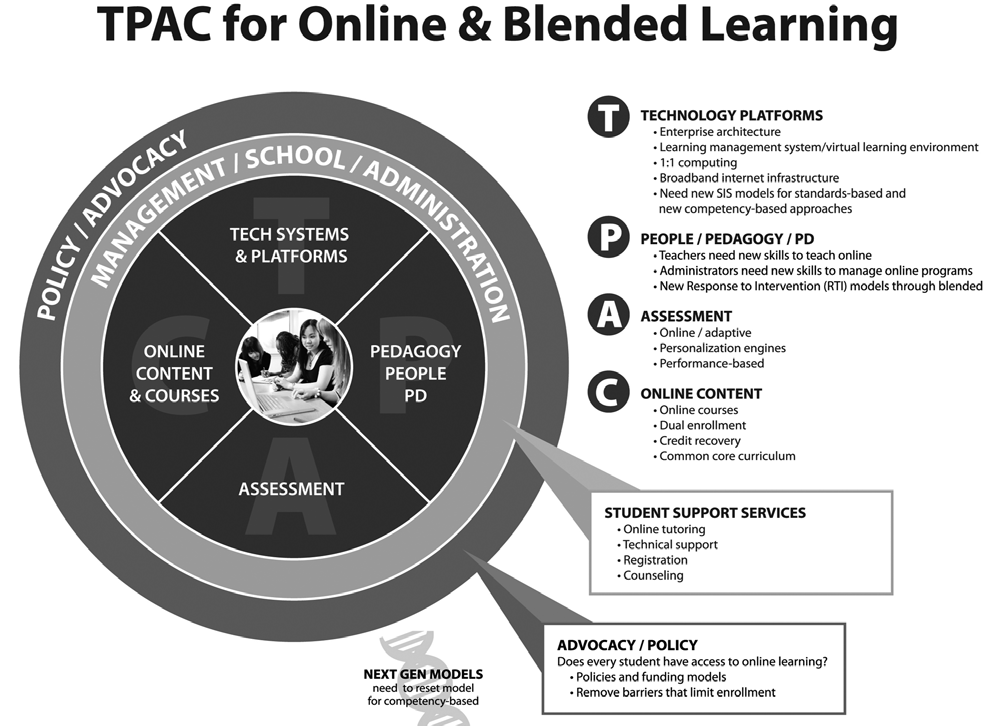
  2. A framework for online and blended learning adapted from the TPAC model to describe the key elements as an approach to systemic educational transformation (see chart below).
Online Learning Definitions

  • Asynchronous communication: Communication that is separated by time. Examples are email, online discussion forums, message boards, blogs, podcasts, etc.
  • Blended learning (also hybrid learning): Learning that is facilitated by the effective combination of different modes of delivery, models of teaching and styles of learning, and is based on transparent communication amongst all parties involved with a course.
  • Credit recovery: Refers to a student passing, and receiving credit for, a course that he/she previously attempted but did not succeed in earning academic credit towards graduation.
  • Cyberschool (also online school and virtual school): A formally constituted organization (public, private, state, charter, etc.) that offers full-time education delivered primarily over the Internet.
  • Learning Management System (LMS): The technology platform through which online courses are offered. A LMS generally includes software for creating and editing course content, communication tools, assessment tools, and other features for managing the course.
  • Online course: Any course offered over the Internet.
  • Online learning (also cyber learning, elearning, and virtual learning): Education in which instruction and content are delivered primarily over the Internet; online learning is a form of distance learning. The term does not include printed-based correspondence education, broadcast television or radio, videocassettes, and stand-alone educational software programs that do not have a significant Internet-based instructional component.
  • Online teacher: The person who is responsible for instruction in an online course.
  • State virtual school: An entity created and supported by a state to provide online academic courses to elementary, middle, and high school students using qualified online teachers.
  • Synchronous communication: Communication in which the participants interact in the same time space. Examples are telephone calls, videoconferencing, chat, and face-to-face communication.


Educators interested in finding out more about online learning can download a copy for free here.

-----------------------------------
Editor’s note: This post contains numerous excerpts from the National Primer on K-12 online learning's Preface from Susan D. Patrick, President and CEO, International Association for K-12 Online Learning (iNACOL).

Thursday, November 18, 2010

10 Reasons Students Say They Prefer Learning Online

Ever wonder how students feel about learning online? At the recent iNacol Virtual Schools Symposium participants were treated to an experience that is surprisingly is rarely available at education conferences. We had the opportunity to hear directly from a panel of students who explained why they preferred learning online. Here are some of the reasons shared by these students and others I heard from explaining why students preferred this method of learning.

10 Reasons Students Prefer Learning Online

1. I can sleep in
While this may sound indulgent to the over-30 crowd who is often of the mindset that students need to be prepared for the 9 – 5 world into which they will graduate, the reality is this.
  • Adolescents need more sleep.
  • Adolescents often function best late at night and do not function well early in the morning.
  • The jobs today’s adolescents will have quite likely will not fit the traditional 9 -5 mold.

It makes sense that students enjoy the opportunity to learn when they are well-rested and most alert. Research studies indicate that students enjoy learning on a schedule aligned to their circadian rhythms rather than the schedule that in many districts was created to enable bus companies to operate most efficiently. As a result traditional school has classes full of students who every day feel the kind of tired that is akin to being jet lagged.

2. I can pursue my passions
A flaw with the American education system is that there is little to no focus on pursuit of our dreams and passions which is often driven by a system that rewards rote memorization and mediocrity. Several students who learn online are doing so because they are pursuing a passion that does not allow them to fit in to the traditional school system. How wonderful it is that students are able to begin exploring and developing their passions while they are in school. We heard from a student who competes in horse competitions, for others it might be music, writing, acting, or filmmaking. We must stop teaching subjects and start teaching students who can be writers, scientists, singers, dancers, and historians today.

3. I can focus on my work without distractions from my classmates
For many students school is a huge distraction, especially in high school where the focus in often more on socializing and fitting in then on learning. Students shared that in online classes, many of the regular distractions from socializing, to intercom announcements, to disruptive students, no longer existed and they could place their attention on learning.

4. I can move at my own pace
A tremendous benefit of learning online is that, when done right, students can learn at their own pace. For some, this might mean they can demonstrate competency upfront and get credit for the class. For others this may mean moving at a slower pace and receiving additional supports if necessary.

5. I don’t have to compete to share my thoughts and ideas
Students in online environments enjoy the equity in the ability to share thoughts and ideas. No longer is it just the student in the front of the room or the one with the loudest voice who is heard. When learning online the playing field is leveled and opportunities are in place such as commenting on posts, videos, and student work or participating in discussion forums. These environments provide students with varied opportunities to share their thoughts and ideas.

6. I can take more interesting classes
Providing online opportunities for students means providing more choice. Students can more easily pursue study in areas of interest. They are no longer dependent on the staffing limitations of their particular school or community.

7. I can learn with a schedule that meets my needs
There are a number of reasons that students might not be able to participate in the traditional classroom environment. These students have often been left behind. One might be caring for a sick relative; another required to watch a sibling, for some pregnancy or incarceration has interfered with education attainment. These students no longer need to be left behind if online options are provided.

8. I can learn despite health issues that might get in the way of a traditional class setting
Students who haven’t found success in the traditional environment due to health issues can thrive in online environments. While this might include a student who is hospitalized, has certain disabilities, or is suffering from a terminal illness, many students have less obvious issues that have made success in traditional school settings difficult. Perhaps a student suffers from a sleeping disorder, social disorder, or from an intestinal condition that just doesn’t fit with the bell schedule. These are just a few examples that in the traditional school setting result in students who end up leaving the system due to excessive absences/tardiness, or labeled as just not paying attention…because they are sleeping in class and miss the material covered.

9. I can easily communicate with my teacher when I need to
Students participating in online environments often share that they appreciate the ease and opportunities available to communicate with their teacher. It is often difficult, if not impossible, to get your teacher’s attention in a traditional 45-minute period and if you do, you may not want to have your discussion heard by the entire class. Online environments typically have structures in place where students can easily send private instant messages or emails to their teacher leaving them feeling much more supported by and connected to their teacher.

10. I can easily communicate with my classmates when I want to
A traditional classroom setting often discourages students from communicating with one another. It can be considered disruptive to instruction or limited by the physical placement of students. The online environment makes it much easier for students to connect with one another on topics of interest in both synchronous and asynchronous environments.

Though the technology exists to provide these environments for students, sadly, few students have, or know they have, such opportunities available to them. For most students, they exist, or are unable to exist, in an educational system stuck in the past that has not introduced them to such options. Why? There are several reasons which include being in a system that requires us to follow outdated policies that may have worked for yesterday’s students, but do not work today. Changing these policies in a bureaucratic, slow-moving, political climate can be a tremendous task. Additionally, many of the customers (students and their parents) don’t even know this option exists. And, another reason of course, is because schools (and parents) are used to doing things the way they’ve always done them. However, doing things they way they’ve always been done hasn’t proven effective for most industries and it shouldn’t be accepted for our students any longer either.