Showing posts sorted by relevance for query fake news. Sort by date Show all posts

Sunday, March 26, 2017

Fight Fake News: A @CommonSenseEd #MediaLiteracy Toolkit

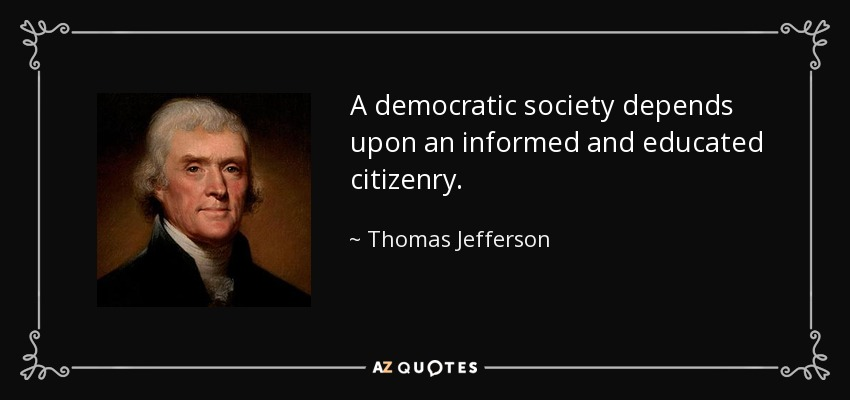
Innovative educators understand that they play a crucial role in our democratic society. However, a teacher’s job to ensure students are informed and educated has taken on a new meaning in the age of the internet where information is everywhere but accuracy, quality, and bias often remain unchecked.
Media literacy is a topic innovative educators cover with students within the broader topic of digital literacy. However, during the 2016 election the focus on fake news and alternative facts sped onto everyone’s radar.  It was then that educators began to realize that students were not prepared to evaluate the accuracy, perspective, credibility and relevance of information, media, data or other resources (3B - ISTE Student Standards).


A study from the Stanford History Education group confirms this pointing out that “Our ‘digital natives’ may be able to flit between Facebook and Twitter while simultaneously uploading a selfie to Instagram and texting a friend. But when it comes to evaluating information that flows through media channels, they are easily duped.


Fortunately, there’s help.


Common Sense Education has released their newest educator’s toolkit. The topic: News and media literacy. The toolkit is designed to provide educators with strategies to equip students with the core skills they need to think critically about today's media. The toolkit includes classroom-ready learning resources broken down by grade level. In it you’ll find the following educational content on news and media literacy:
  • Teaching tools and lessons by topic
  • Take-home student activities
  • Videos and interactive educational games
  • Supplemental materials for family engagement
  • Professional development for teachers
  • Materials available in multiple formats (low-tech and high-tech)


For teens there is also “Digital Bytes” where teachers are guided to provide students with interactive experiences on topics such as news literacy, internet hoaxes, and online tracking. For families there is a best-of list that looks at news sources that can be trusted.
Parents can use these kid-friendly sources as a jumping-off point to discuss how news is reported and how to be a critical media consumer. There is also a strand in Common Sense Education's Parent Concerns with articles, videos, and answers to questions about news and media literacy.


Innovative educators ready to get started are invited to join Kelly Mendoza, Director of Learning and Engagement at Common Sense Education, in a live webinar: News and Media Literacy: Building Critical Consumers and Creators. Kelly will lead participants on an exploration addressing these topics:
  • Why news and media literacy is more important than ever
  • Latest research on kids and news
  • What is “fake news” and how to spot it
  • Ways teachers can integrate news and media literacy into their curriculum
  • Rubrics you can use to assess students’ understanding of news literacy
She will also debut the new News and Media Literacy Toolkit. Those who join live will have the opportunity to ask questions and interact with colleagues. The webinar takes place Wednesday, March 29, 2017 @ 4:00 pm - 5:00 pm EDT. For more information visit: http://home.edweb.net/webinar/news-media-literacy-building-critical-consumers

Thursday, December 8, 2016

She’s Gone: The Innovative Educator Leaves Us & Other Fake News

JK. I’m still here. :-p
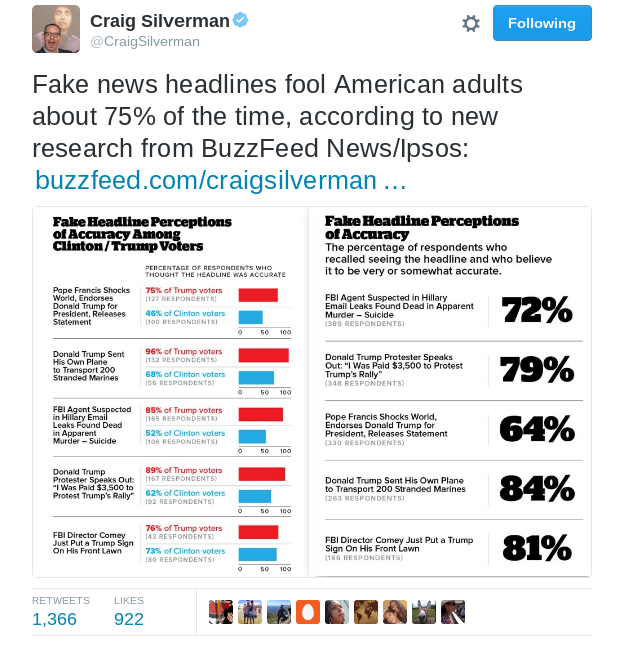
By now, you’ve probably heard a lot about fake news and the role that played in our presidential election.

Innovative educators realize the time has come to connect with students around literacy and how to determine what’s real from fake.

Are Your Students Prepared?

Can your students evaluate the accuracy, perspective, credibility and  relevance of information, media, data or other resources? (3B - ISTE Student Standards)

A study from the Stanford History Education group says probably not. The study indicates that “Our ‘digital natives’ may be able to flit between Facebook and Twitter while simultaneously uploading a selfie to Instagram and texting a friend. But when it comes to evaluating information that flows through media channels, they are easily duped.”

That's a problem because as Michael Spector, author of "Denialism" reminds us in his TED Talk, "Everyone's entitled to their opinion, but you're not entitled to your own facts."

There are many layers to this work. Here are just some of the types of literacies we must help our students acquire.

4 Types of Literacy

TypeDescription
1) Information literacyKnowing where and how to find accurate information
2) Media literacyUnderstanding media sources, potential biases, etc.
3) Factual literacyHow to tell truth from nonsense; how to empirically verify a “fact”
4) Emotional literacyUnderstanding how one’s prior experiences and opinions influence their view of information

When we consider each literacy area, we must keep in mind that it’s not that simple. Newspapers and news stations don’t always get it right. There are times when what you read in social media can be trusted. For example it can be a channel to get news directly from a primary source, rather than through another party.

Textbooks may not have their facts straight. As one Edutopia author put it “textbooks are processed into existence using the pulp of what already exists, rising like swamp things from the compost of the past.” It is also true that the content of these textbooks are influenced by those such as the Gablers who were expert organizers and founded a  nonprofit corporation 43 years ago, Educational Research Analysts, which continues to review textbooks and lobby against liberal content in them. More on that here.

So what’s an innovative educator to do?

You can start by selecting some real and fake news stories and work with students to analyze what they are reading. They should consider some of the following questions:

Ask Yourself These Questions:
  • Who created the story?
  • Why was it created?
  • Who was paid as a result of the story?
  • Who receives harm or benefit?
  • Is this fact or opinion?

You can visit Project Look Sharp and refer to this PDF and this website for more details on how to measure credibility.

You can turn to experts for advice on how to help students think about sources. Alexios Mantzarlis, director of the International Fact-Checking Network and Melissa Zimdars, assistant professor of communication and media at Merrimack College recommend doing the following:

Consider the Source:
  • Pay attention to the domain and URL
  • Read the "About Us" section
  • Look for quotes from sources
  • Look into the background of those quoted
  • Check the comments for accusations of false information
  • Reverse image search

You can read more about each piece of advice in this Fake or Real? article from KUOW.org.

Students aren’t the only ones who fall for fake news. Their parents can use some support too.

How have you addressed this where you work? Have you incorporated some of these strategies into your classroom? If so, what has worked or has been challenging? If not, is this something you might consider doing with your students? Their parents?

Sunday, February 12, 2017

Did Warren Buffett Really Ask You To Forward His Email? 5 Ways To Know.

Note: Twitter won't let you Tweet my blog url. Please use this shortened url instead: http://tinyurl.com/5WaystoIDFakeNews

Fake news isn’t a new thing and it isn’t an internet thing. Many of us had our first experience with fake news when we were told about Santa Claus coming to town. That was followed by old wives tales. Stories that were generally told to discourage some type of behavior. Of course there was never proof. This is where, “Because I told you so” comes into play.


Then there was the chain letter. If you broke the chain surely you would receive bad luck. There's also scare mail. You know that email that warns you of dangers like poisonous perfume samples or the fright mail that says if you dodn’t send money somewhere something bad would happen.  


The internet and social media make the spread of fake information more simple, but it has always been there. Let’s take a look at a story that has been making the rounds in social media (Twitter. Facebook.)

Have you seen this one?


Warren Buffett is asking everyone to forward this email to a minimum of 20 people, and to ask each of those to do likewise. In three days, most people in the United States will have the message. This is an idea that should be passed around.
The BUFFETT Rule (The email goes on with a bunch of “facts” and proposes a Congressional Reform Act.)


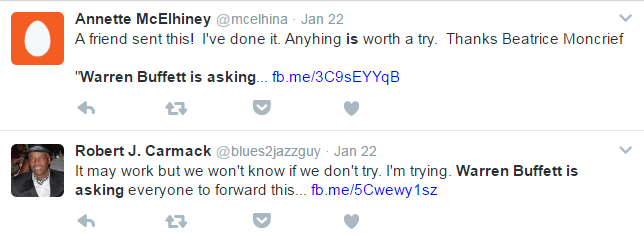
So, should this be passed on? Numerous people, like those below, thought it was worth a try.
But, was it really worth a try?

No.  Here’s why: If you are going to reach out to others and try to convince them to think or do something, it is your responsibility to determine if what you are asking is true, valid, and feasible.


5 Ways to Know What's True


  1. Send this to everyone you know!
If the communication is urging you to forward this message to all your friends, it is generally a hoax. There are exceptions of course, but this is your first red flag.


2)   Would this person really send a chain mail/communication?
Celebrities, billionaires, politicians don’t generally make it a habit of sending chain mails.  In the case of Warren Buffett’s assistant confirms this here.


3)   Check the source
How can you confirm the source? Check their feeds on Twitter, Facebook, their website. If there is a warning or call to action from someone person, search for the video where they said this. If you’re not finding evidence from the source, then chances are it’s not true.


4)   Fact Checking Sites
There are several fact checking sites. Snopes is probably the most well know. Fact Check and Truth or Fiction are others.  If we take a couple minutes and check the sources, we can see the Buffett story is just a tale.


5)   Check the News
Look for credible news sources coverage of the issue. In the case of the Buffet story here are two sources that uncover the truth.

Innovative educators are in a unique position to help educate young people with strategies to stop perpetuating false information. Empowering students to understand how to tell fact from fiction is a necessary and useful skill to ensure they are on the path to make educated and informed decisions during and on their way to adulthood.

Saturday, April 1, 2017

3 Hottest Posts Most Popular On The Innovative Educator

Haven’t been keeping up with The Innovative Educator? Don’t worry. That’s what this wrap up is for.  Here are the three hottest posts that you don’t want to miss!

What’s hot this week? Teen brains - it's not what you think, fake news, and using media to increase family engagement.

Making its way to the top for the first time is a post about the teen brain and some myths that should be reconsidered. The second most popular post on the blog looks at techniques, lessons, and strategies teachers can use with students and families to fight fake news. This is all packaged into one neat and useful toolkit from Common Sense Education.  Rounding out the top three posts is my recap of the #SXSWEdu panel discussion I participated in that was hosted by Common Sense Education. In the post I outline 9 ways to increase parent engagement using digital media.

So what are you waiting for? Now's your chance. Take a look at the posts below and click the link to read one(s) that looks of interest to you.

If you like any of these posts, I hope you’ll share with others using the buttons below on Twitter, Facebook, email or whichever platform you like best.

Saturday, March 18, 2017

3 Hottest Posts Most Popular On The Innovative Educator

Haven’t been keeping up with The Innovative Educator? Don’t worry. That’s what this wrap up is for.  Here are the three hottest posts that you don’t want to miss!

What’s hot this week? Fighting fake news, increasing parent engagement, and ePortfolios.

Making its way to the top for the first time is a post that points to four fabulous sites you can turn to fight fake news. Next up I recap my #SXSWEdu panel discussion hosted by Common Sense Education and outline 9 ways to increase parent engagement using digital media. Rounding out the top is a post that lays out how to get started with ePortfolios as well as some great options for doing that. 

So what are you waiting for? Now's your chance. Take a look at the posts below and click the link to read one(s) that looks of interest to you.

Entry
Pageviews
Feb 19, 2017, 
3041
Mar 12, 2017, 
2905
Feb 26, 2017, 
2732


If you like any of these posts, I hope you’ll share with others using the buttons below on Twitter, Facebook, email or whichever platform you like best.

Sunday, April 9, 2017

3 Useful #MediaLiteracy Resources You Might Not Know

During the #NYCSchoolsTech monthly Twitter chat Kelly Mendoza, Common Sense Education's #MediaLiteracy expert, shared ideas and resources including Common Sense Education's comprehensive Media Literacy Toolkit. However, Kelly wasn't the only one with great ideas and resources to share. Participate, where the chats are archived has a handy dandy feature where all shared resources are collected. This chat had a collection of 24 resources contributed by participants which you could view here.  Here are three resources that stood out to me as one's innovative educators could put to use right away.

Resource
Description
PolitEcho
PolitEcho shows you the political biases of your Facebook friends and news feed. The app assigns each of your friends a score based on our prediction of their political leanings then displays a graph of your friend list. Then it calculates the political bias in the content of your news feed and compares it with the bias of your friends list to highlight possible differences between the two. http://politecho.org
Cybrary Man’s Media Literacy Page

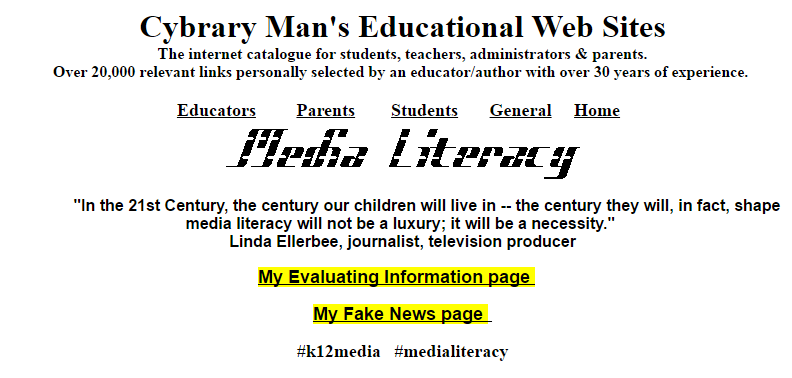
Jerry Blumengarten, famously known on Twitter as @cybraryman1 has a comprehensive media literacy page.  You can check it out at https://cybraryman.com/medialiteracy.html

This resource from Gale’s Opposing Viewpoints in Context series provides concrete strategies to analyze news.  Give current events a new twist.  Have students go through the elements of this infographic when they read and share the news.