Sunday, March 13, 2011

Learn Anything at The School of Everything!

As technology becomes more ubiquitous the reality that people don’t have to go to places to learn has increasingly become clear and is gaining popularity.  I recently shared ideas for ways Educators Can Save Time When They Stop Reinventing the Wheel with Online Educational Resources and I also explained 10 Reasons Students Say They Prefer Learning Online.  I even shared resources that kids could use to design their own learning.  Unfortunately, traditional schools often don’t serve up many interesting offering that Help Students Discover and Develop Their Passions and in many cases keeping the learning real is not a focus at many schools.  Additionally, more and more parents are realizing their children’s race to the top has really become a race to nowhere.   As a result some parents are taking action toward fixing schools, while others are considering alternative models for schools where passion (not just data) drive learning. Others have taken an approach that some consider radical called unschooling where students have no school and no curriculum, but rather learn naturally through life. 

I recently came across another option for parents, students, and teachers who want to take learning into their own hands.

The School of Everything was set up because its founders think the way the current education system is organized is rubbish, rigid and out of date. It seems the School of Everything follows in the style of the recent educational unconferences I’ve been attending where participants show up, place a post-it on a board indicating what they’ll teach, then others come to their session to learn.  The founders were inspired by a group of people who in the 1960s set up the Free U in sunny California. They started with blank piece of paper pinned to a notice board asking what people could teach and once subjects were listed and there were enough people signed up to each they ran the courses. The UK-based founders took this concept and with the power of the internet they created what they call, “a new fangled website thingy” where students can design your own education however you please. 

School of Everything operates on a simple premise
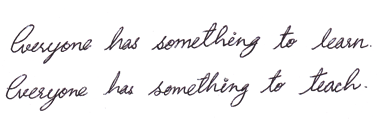
The website is your portal to learning whatever, whenever and wherever you want. From Biology to Beekeeping, History to Hula hooping, they've got much more than you’d find on your traditional school or university campus. And you don't need to go to the end of the earth to learn what you want. The site was created to help connect students who want to learn stuff that teachers are passionate about sharing.  The end result is that students can make their brains bigger right at their own doorstep.


Teachers can Teach Stuff
The School of Everything is always looking for great teachers. What's your specialist subject? School of Everything is the place for you to share your knowledge with others for hard cash or just for the love of it. You can start advertising for free and find new students.


Students can Learn Stuff
What do you or your students/children want to learn? Whether it's hot new dance moves to impress your friends; brushing up on a foreign language before your holiday; extra help with your academic studies or you just want to try something completely new - School of Everything is for you. On the site you simply share where you are, choose the subjects you're interested in and they'll help you find relevant teachers and lessons.


Teacher Evaluation
No need for fancy data systems and outsiders to evaluate teachers.  Let the most important people at the table assess teachers.  At The School of Everything, teachers are reviewed by their students. Reviews from students who pay through the School of Everything Marketplace are worth loads because who better to get a teacher recommendation from than another student!


"School of Everything has potential to become something like the Craigslist of education, where people can easily find each other for specific topics and everyone can benefit. The site is free and easy-to-use ... so there's not a lot holding it back from success except for a user base big enough to make it worthwhile."
- Jacqui Cheng, Ars Technica (September 2008)

-----------------------------------
You may also want to check out P2Pu.org. A similar organization described as, "Learning for everyone, by everyone, about almost anything...for free!"

Saturday, March 12, 2011

What's Popular This Week on The Innovative Educator

Here’s the roundup of what's been popular on The Innovative Educator blog this week. Below you’ll see my top weekly posts along with the number of pageviews in the past 7 days. If something looks interesting, check it out. If you’re so inspired leave a comment.

Diplomas Don't Prepare Students for the World. ePortfolios Do.
Mar 9, 2011, 3 comments 391 Pageviews
Cure ADHD without Drugs with These Resources from Doctors, Parents, & Educators
Feb 5, 2011, 19 comments 372 Pageviews
More than a Dozen Ideas to Update Outdated Meetings
Mar 8, 2011, 6 comments 341 Pageviews
Ideas for Using Voki in Education
Dec 13, 2010 294 Pageviews
10 Ways Technology Supports 21st Century Learners in Becoming Self-Directed
Jan 28, 2011, 8 comments 232 Pageviews
Gary Stager Finally Shares Why He Thinks Interactive Whiteboards Suck
Feb 23, 2011, 47 comments 231 Pageviews
The Ten No Nos of Teaching with a Projector or Interactive Whiteboard
May 10, 2010, 27 comments 219 Pageviews
How Are Schools Helping Students to Change the World?
Mar 7, 2011, 2 comments 205 Pageviews
5 Things You Can Do to Begin Developing Your Personal Learning Network
Oct 12, 2008, 12 comments 173 Pageviews
Educators Can Save Time When They Stop Reinventing the Wheel with OER
Dec 3, 2010, 13 comments 161 Pageviews
TESTS: Teaching Everyone Some Terrible Stuff
Mar 10, 2011, 3 comments 155 Pageviews


Thursday, March 10, 2011

TESTS: Teaching Everyone Some Terrible Stuff (Part I)

Vickie Bergman blogs about education and parenting at Demand Euphoria


If you are required to take one test or quiz every week of your school life, you could end up taking roughly 400 of them in twelve years. And you will be required to complete all 400 of these school tests all by yourself. You have to know or correctly guess sixty-five percent of the answers at the time of the test to be considered passing. What will these kinds of tests teach you? Something Terrible: that it is really important to know all the answers. That you are a failure if you don't remember or don't understand or never learned something. How will this prepare you for life after school?


Sure, you could grow up to be someone, like a surgeon or a pilot, who will be faced with making a lot of really important decisions. But even in these high-profile careers, you would have access to help most of the time, when needed. And it would be especially important for you to know when you needed help and seek it out, so you might avoid making a stupid mistake. It would only be in an unusual situation where you would have to make a completely independent decision when you weren't quite sure what to do. But this is why you wouldn't be allowed to perform surgery or fly planes without first amassing lots of knowledge and training and practice specific to these situations. This is different from compulsory schooling because, well, it's not compulsory. Anyone who is in training to be a surgeon or pilot has freely chosen his path, knowing in advance what it will entail, and being free to stop at any point. Any test taken along this path is taken by choice.

Admittedly, there will be some times when all of us will have to make decisions or solve problems without being able to consult a friend, or Google. For example, when driving cars, we have to make decisions that could even mean the difference between living and dying. But I'm pretty sure that what gets me through these times is my experience with and knowledge about driving, and maybe a little bit of luck, and has little to do with how many tests I ever took on unrelated topics.

I was one of those students who did well on tests. Apparently I had a good short-term memory, even for facts I didn't care about. And I did care about grades. That combination made me a strong student. But now, in my post-school life, it looks more like a weakness then a strength. It is a weakness, being afraid to admit to not knowing something. I hate it when I don't know an answer, or when people are talking about something I have never heard of. I expect myself to know everything. Because in the world of school, "I don't know" means you fail. And I almost never failed. The few times I did, it was not acceptable. Now I have to remind myself that it's OK not to know things. I have had to practice saying "I don't know."

But that shouldn't be such a big deal for anyone, because in most real-life situations, it is all right if you don't know all the answers, or even any of the answers. I would even say that you can hope for better results if you can quickly admit that you do not know the answer to a specific question, or the best solution to a problem. Because the best things to know are when you need help and where to go for help. And then you go there. And you ask for help. You are not alone and you don't have to figure things out on your own. Unless you are in school taking a test. Then you're on your own, sorry. Get back to work. You shouldn't even be reading this.

I can't remember the last time, outside of school, when I had to take a test, or even answer one question, where I didn't have time to or wasn't allowed to consult someone else or some technology to help me figure out the answers. So why do we force our children to perform this way on a weekly basis for more than a decade of each of their lives?


This video does a nice job of showing a view that differs from those who believe that tests in school (Naplan et al) are important to people who believe in the value of standardized tests as an important indicator of knowledge and skill.

Wednesday, March 9, 2011

Diplomas Don't Prepare Students for the World. ePortfolios Do.

I recently spoke to a frustrated young man who at 25 years old was graduating college in May with a degree in advertising and marketing but he was having a difficult time finding a job.  As we spoke a little longer, he shared the degree wasn't enough. Without experience, doors were being slammed in his face.  I was shocked.  He was pursuing a career in a field designed to market, advertise, showcase, yet no time or energy had been placed by the school in helping this student do the same for himself.  A true example of the College Myth that leaves so many young graduates disappointed.  Years and money down the toilet all in turn for a piece of paper heralded as preparation for life, but it is no longer enough!

School can not be a series of disconnected and inauthentic activities.  To prepare students for real life we must provide them with real experiences as well as a "real" method for capturing, advertising, and marketing their successes.  This does not mean purchasing some costly ePortfolio system. Instead it means giving every student a "real world" option for collecting the work they've done that will help them as they pursue academic, apprenticeship, and career opportunities like they do at College Unbound. By real I mean, the student, not the school, owns the portfolio.  No one does this better than Helen Barrett and while I've shared and applauded her work frequently, I was excited to learn that she had done the same with mine at a recent conference.  Below is a presentation that captures her recommendations for creating ePortfolios using Google Apps.  You can find out more at her blog, ePortfolios for Learning. 

Tuesday, March 8, 2011

14 Ideas to Help Educators Update and Enhance Traditional Meetings

"If your target audience isn't listening to you, it's not their fault, it's yours" Seth Godin


More than a decade into the 21st century and it’s still business as usual for many educators.  Unfortunately those charged with bringing classrooms, schools, departments, and districts beyond the 20th century are often stuck doing things the same old ways.  At a recent meeting of innovative educational leaders, staff members were told they were not allowed to use Blackberries or cell phones.  Additionally, the use of laptops was frowned upon. Handouts and materials used were not shared digitally and notes were expected to be captured on paper.  The unstated messages conveyed is that given the freedom to use technology, participants were unlikely to focus on the work at hand. The meeting organizers felt they could not be trusted to make decisions about how to best participate and do their work.  The rest of the day, like the "naughty children," we force to power down, adults could be seen sneaking their phones under tables, in the bathroom, etc. to do real work, but not wanting to be reprimanded by meeting organizers. 


Several innovative employees were frustrated. Technology is a part of the way many do business. Among other things, technology is a tool used to help them focus, collect, connect, and communicate. For some, the mandate to power down and disconnect resulted in doing the same with their attention. They powered down, disconnected and felt their expertise, professionalism, and working style were devalued.


Educators are charged with preparing our children for the future, but many are still doing things the same ol’ way.  What’s worse, they’re mandating others to remain stuck in the past with them. There are several ways that educational leaders can stop banning and start embracing technology to update how they do business with more efficient and effective results.


Here are a ideas to update face-to-face meetings followed by a description of each.
  1. Wiffiti and Twitter Enable You to Connect with Participants
  2. Paper.li and Twitter Allow You to Put Together A Professional Meeting Daily
  3. Camera Phones and Flickr Allow You  to Efficiently Capture Notes and Ideas
  4. Google Spreadsheets Allows You to Stop Wasting Time and Paper
  5. Learning Networks Enable You to Efficiently Capture, Collect, Reflect, and Respond to Ideas
  6. Texting, BBM, Crunch, etc. Promote the Sharing and Processing of Ideas
  7. Back-Channeling for Instant Feedback and Meaning Making
  8. Twitter  Allows You to Connect Globally
  9. Google Docs  and Twitter Make for Powerful Global Collaboration
  10. uStream Brings Meetings to Those Who Can’t Attend Face-2-Face
  11. iPads and Dropbox Make for an Efficient and Paperless Environment
  12. Free Wikispaces or Google Sites Provide a Digital Platform for All Meeting Materials and Resources
  13. Use Facebook to Share Links to Articles, Information, and Ideas of Interest
  14. Taking a Minute to Honor Technology

Wiffiti and Twitter Enable You to Connect with Participants

Set a Twitter hashtag for your department and/or meeting where participants can share thoughts and ideas.  Have those projected onto a Wiffiti board that participants and meeting leaders can take a look at.  This gives a terrific pulse of the members with an insight into their thoughts, ideas, and suggestions.  Using Wiffiti with Twitter is a great option because even those without a Twitter account, can send their thoughts into Wiffiti using the designated code.  

Paper.li and Twitter Allow You to Put Together A Professional Meeting Daily

High school English teacher, Cathy Stutzman, uses Twitter during large committee meeting
s and professional development training to share links to additional resources using the school or topic hashtag.  Following the meeting, in an instant using Paper.li, she and her coworkers can examine the articles and materials to inform next steps and actions. It also becomes a great resource to share with participants unable to attend the meeting.  Paper.li will make a daily newspaper following the Tweets of those a Twitter user follows, a Twitter hash tag or a list. The newspaper is delivered in a very reader-friendly format using the Twitter updates and links to bring readers stories, tweets, videos, photos and more. It is simple to create and the end result appears in under a minute and is beautiful. Here is a thumbnail of mine. Click the paper to see the actual paper. 

Camera Phones and Flickr Allow You  to Efficiently Capture Notes and Ideas

Have you ever been to one of those meetings with papers taped all around the room.  Usually, the information is handed off to someone to try to record/type or it is lost.  Why not whip out your phone and capture the picture, then email it using Flickr to instantly capture and collect those images into a slideshow that can be archived and accessed on demand.  

Google Spreadsheets Allows You to Stop Wasting Time and Paper

Another way to update the old fashioned way of doing things with flip charts is using Google docs. This is an efficient alternative  that enables all ideas to be captured and shared with one step.  Simply set up a spreadsheet.  In the left column place the questions/ideas the group is tackling.  In the top row indicate group names.  Rather than on chart paper, each group records feedback on the Google doc.  If all participants in each group have laptops, more than one can capture the input. If only one person has a laptop, that one device can be used for capture and input.  

During the share out, rather than trying to capture what is being said, simply project it.  There is no copying to do after the meeting, no compiling, no sharing.  All the ideas and information are captured and compiled right on the document.  

Learning Networks Enable You to Efficiently Capture, Collect, Reflect, and Respond to Ideas

While many schools or departments have put learning networks into place using tools like Ning, Wordpress, Group.ly or Facebook, today’s digital immigrants, might not actively participate in such environments.   Meetings are not only a great place to get the ball rolling, using learning networks also allows you to do so more efficiently while collecting the voice, inputs and thoughts of more participants.  

In advance of the meeting post some topics that you plan to have participants discuss.  While they are working in groups, have the group leader and/or group members capture thoughts and ideas in that discussion area.  Inform the group the time at which you’d like their feedback posted and then give them a chance to review the ideas from other groups.  Ask them to find at least one piece of feedback that resonated with them.  

When the team comes back together, all information is captured and participants can get to the thinking faster.  Everyone has read the ideas of all the others.  The discussion moves to making meaning of what they read and sharing the particular ideas that stood out for them.  

Texting, BBM, Crunch, etc. Promote the Sharing and Processing of Ideas

Have you ever been in a meeting when someone said something that needed clarification, you didn’t agree with, you didn’t understand, or just wanted to see how a colleague felt about this idea?  While passing notes or whispering is often considered distracting for the presenter or other participants, audience members can in essence read one-another’s minds with the use of Texting with SMS,  BlackBerry Messenger (BBM), Crunch or any such tool. Such tools allow participants to converse about topics and subtopics without interrupting the flow of the meeting.  

It also makes a meeting much more interactive.  Rather than traditional meetings where there is a sage on the stage, enabling participants to text and make meaning, gives some of the power to those in the rest of the room where they can deepen ideas and understanding.  

Back-Channeling for Instant Feedback and Meaning Making

Staff at Sidwell Friends Middle School often find it useful to engage in a backchannel conversation about the topic of the meeting using tools like Todaysmeet.com, Typewith.me, Skype, Twitter, Facebook, and Tinychat. 6th grade teacher Kimberly Clarkson explains that while some might find this distracting, others find it to be a perfect tool for keeping them engaged and focused.  Clarkson shares that different modes of processing information do not magically evaporate as one becomes an adult.  Allowing and encouraging the practice of relevant behind the scenes conversations during meetings can increase the engagement and productivity of meeting participants.

Twitter  Allows You to Connect Globally

Connect not only with the folks in the room, but with the world, during meetings with Twitter.  Have a thought, question,  idea, or simply involved in a brainstorming session and wondering what others might think?  Tweet it out.  Think of it sort of like a radio call in show where others with like interests can join in the collective intelligence.  

I’ve used this often in my work.  In fact, it is how we came up for one of the names of a citywide project my office is implementing.  Maybe an idea just doesn’t sound right, but you want to get the take of others.  Tweet out the idea followed by, “thoughts?” This quickly gives you a sense what those outside the room might be thinking.  Perhaps your discussing a topic that others are interested such as students with special needs (#spedchat), gifted and talented (#gtchat), or innovation (#innochat).  Simply use the proper twitter hashtag and see what others interested in that topic think.  While you’re there, perhaps you notice some names of leaders in the field.  Send them a direct message to inform your meeting with expert advice...FOR FREE!

Google Docs  and Twitter Make for Powerful Global Collaboration

Marry Twitter with Google docs and you have a tremendous way to not only connect and share ideas with a global audience, but you can also collaborate and create products that are beneficial to all.  This can be accomplished in a number of ways.  One way is if you’re trying to collect ideas about a particular topic you can create a Google form that feeds into a spreadsheet.  Just Tweet out the topic an url of the form and instantly your spreadsheet begins getting filled with input from a wide audience.  Perhaps you are collecting ideas for a project.  Create a G-doc with the project description and directions to contributors.  Let the collective wisdom of those inside and outside the room inform, influence, and impact your work.  

Gregory Richardson, a science teacher in New York, was thrilled when he did this.  He was working on creating a curriculum map.  He uploaded it as a Google Spreadsheet.  Next he Tweeted out the spreadsheet link with a request for help and ideas, and within seconds there was global collaboration and chat about his work.  Tweeps (Twitter people) from around the world shared ideas on his map and chatted with him.  

uStream Brings Meetings to Those Who Can’t Attend Face-2-Face

uStream is a free and easy tool that can be used to capture meetings with only a webcam, laptop, and internet.  Meeting presenters simply select “Live Broadcast” from uStream and those who can not attend face-to-face can see and hear the meeting.  They can also provide input and feedback using the chat function.  These meetings can also be recorded as a way to archive meetings or for viewing by those who need to watch what occured at a later time.  

iPads and Dropbox Make for an Efficient and Paperless Environment

At New York City Technology Coordinator Chris Casal’s school, teachers, coaches, Inquiry Team members, school leaders and others, have iPads. While they use the devices for conferring with students, grade books, etc. they also have found them to be  extremely valuable for meetings, team collaboration and “going paperless.”

iPad owners at the school use DropBox to store all folders and files that will be accessed during meetings.  For example, the school is involved in the Peer Review process which requires them to work with another school on school-wide evaluations. The process involves a number of documents. They have a  “Peer Review” DropBox folder which is shared with all the members of the Peer Review panel. Instead of printing out and sharing necessary documents, folders are set up before meetings and participants can instantly access folders and documents that have been set up for the, now paperless, meetings. The same has worked for their Inquiry Team. Among other duties, the team looks at our schools Acuity Predictive Assessments. Once the results are available the data is downloaded to a shared DropBox folder and instantly accessible to all team members at the meeting, or anytime/anywhere they need them.  

Wikispaces or Google Sites Provide a Digital Platform for Meeting Materials and Resources

We've all been at meetings where a PowerPoint and perhaps other material is shown and the presenter says something like, I'll email this out to everyone, or if you want a copy email me at...  More often than not the materials never reach the participants hands.  More importantly, having that information at the time of the meeting would enable participants to make meaning of what the presenter is saying, rather than copying it down.  At the Manhattan Office of Educational Technology, materials for all meetings and professional development are shared on the agenda via a wiki.  Taking notes are a thing of the past.  In the 21st  century we skip outdated note-taking and move right to meaning making.  Additionally, participant feedback is instantly captured and recorded.  You can see an example of what this looks like at these agendas: Innovate My class using Flip Videos and Digital Cameras or Innovate My Class with Pencasting and Screencasting.

Use Facebook to Share Links, Ideas, and Articles of Interest. 

Facebook serves as a great tool to share ideas, links, and articles that might be of interest to colleagues.  Simply take the link.  Share it on Facebook and tag both colleagues in the room as well as others who may be interested in the topic.  Rather than the outdated method of passing an article or book around the room, the link appears and everyone's wall and the result can be reach conversations and connections with those tagged as well as others interested in the topic.  

Taking a Minute to Honor Technology

At meetings at the Sidwell Friends Middle School, 6th grade teacher Kimberly Clarkson enjoys the “Tech Minute” that begins all meetings.  During “Tech Minute” time is taken to share technology tools that others can use to do their job more effectively.  These can be shared in a Google presentation like the one below,  posted separately in an appropriate discussion topic, or shared using a collaborative space like Dropbox.  


Like teachers, with their students,  it’s not enough for educational leaders to tell others to do as they say, not as they do.  Modeling and leading is the key to bringing about change for one's self, one's staff, and those with whom they work.  With all these ways technology can be used to enrich meetings today, it’s easy to see why we should stop banning and start embracing the use of technology to empower and engage learners and staff of all ages.  

Monday, March 7, 2011

Opportunity for Innovative Educators to Get Recognized as Expert Evaluators in Tech & Learning Magazine

AOE 11 logo gifTech & Learning has an opportunity for teachers to be recognized as expert evaluators of products that might be of interest to other innovative educators. Qualified candidates (if you’re reading this blog, that’s you!) will be selected to evaluate products for its annual Awards of Excellence. This will be a piece of cake for innovative educators who are already using many of these products. This is an opportunity to share what you know about the products you love (or do not love). Evaluation criteria include the following: quality and effectiveness, ease of use, creative use of technology, and suitability for use in an educational environment. This is a fun way to get a sneak peek at some of the latest technology tools being announced in the K-12 arena.

Judges will be recognized in the Awards issue of Tech & Learning. To become an official Tech & Learning judge email cweiser@nbmedia.com with “Awards of Excellence Evaluation Candidate” in the subject line. Share that you are a reader of this blog in the body of your email.

If this is of interest to you, check out the link to the winners of last year’s contest here.