Monday, October 18, 2010

Facebook Doesn’t Get Teachers Fired - Inappropriate Behavior Does

Today’s New York Post story, "Teachers fired for flirting on Facebook with Students” chronicles three educators who were fired for having inappropriate dealings with students on Facebook. The Post plays up the sensationalism of the story by making it seem, the tool is in part the culprit, further spreading the fear so many adults already have of the digital worlds in which their students thrive. While ,”They threw the Facebook at 'em!” makes for a nice headline, it was the teacher’s behavior, not the medium that is at fault.

According to the article, one of the teachers had been cut loose because of the social-networking scandal. The reality, is this is not a social networking scandal. It is an inappropriate conduct scandal, like all the others we’ve seen for years...pre-social networking. These teachers would be fired regardless of whether they were acting inappropriately online, on paper, through email or via face-to-face conduct. In fact, in most cases, these teachers also engaged in inappropriate activities off line as well.

The problem here is that the media is confusing the issue and policy makers and school administrators look like they’re doing a good thing when they take the easy way out enforcing bans and mandates in the name of child safety. The reality is that when we remove the ability of adults to exist in children’s worlds, we are doing just the opposite of keeping students safe. Enabling students to operate in online environments devoid of the watchful eye, guidance and advice of adult family members, teachers and mentors, is not in the best interests of children.

These teachers weren’t behaving inappropriately because of Facebook. There have always been inappropriately behaving adults. Facebook, in the case of these adults, didn’t cause their behavior, it just made it easier for them to get caught. The danger we run in to when we ban the tool rather than address the behavior is that without teaching students to appropriately harness the power of communication and technology tools available today, we aren’t preparing them for the world in which they live and not only survive, but also thrive.

We all know that the U.S. President wouldn’t be in office had he not had social media savvyness. Don’t we want our children to be educated in a way that would prepare them if they one day wanted to run for office, start a movement, change the world? You betcha! And, adults shouldn’t fool themselves that one must be of a certain age to harness the power of social media to make a difference. Kids around the globe are using social media to affect positive change today.

Fortunately, more and more adults see past the media hype and are not falling prey to the sensationalism. Instead they are harnessing the power of online media to connect and engage with students in important ways. In fact, I was recently mentioned in the New York Times after they came across a post I wrote about Friending Students on Facebook. In the piece they shared how Facebook enabled students and teachers to make meaningful connections with each other. Or, take for instance first grade teacher Erin Shoening who helps her elementary students harness the power of Facebook. You can see how she and a colleague do this in the below video.

The answer is not to follow in the footsteps of reactive states like Wisconsin, New Hampshire, and Ohio who have ordered or urged teachers not to "friend" students on social-networking sites. While it may be an easier solution for schools, it is not what is best for our students. If we want to ensure students are empowered to successfully communicate, operate, and make a difference in the world, we need to stop trying as The Post suggests, “to find policies that address teacher-student communication on Facebook” and instead enforce policies that address appropriate and inappropriate behavior regardless of the medium. That doesn't mean removing adults from the online worlds of students. It means ensuring that adults and children interact in safe and appropriate ways regardless of the medium that empower them to be self-directed, globally-connected learners and leaders.

Meeting the essential conditions necessary to effectively leverage technology for learning

Does your school meet the essential conditions necessary to effectively leverage technology for learning? Below is a chart you can use with your schools to help them see if they do.

Saturday, October 16, 2010

The Innovative Educator in Edutopia's Home-School Connection Guide

As a new teacher until today my very favorite resource is Edutopia. Not only do I just love the magazine and the nifty kit they sent us teachers, but I LOVED George Lucas's story. Like me he was bored in school and subscribes to the notion that we should Fix Boring Schools, Not Kids Who Are Bored. He shares, “I had to find my own way to learn about topics I was passionate about, as my school days were filled with memorizing isolated names and facts.” Lucas created Edutopia as part of the George Lucas Education Foundation, an organization that chronicles and advocates for innovative practices in K–12 education.

What a treat and honor it is to be included in my favorite resources new "Home-to-School Connections Guide: Tips, Tech Tools, and Strategies for Improving Family-to-School Communication." The new resource guide from Edutopia highlights new solutions for connecting home and school in order to improve student learning and success providing innovative educators with relevant and valuable ideas for how best to strengthen the bonds between schools, families, and communities.

Here’s what’s in the guide
1. Go Where Your Parents Are
2. Welcome Everyone
  • Features my ideas about connecting with parents who are speakers of languages other than English as shared in these articles
3. Being There, Virtually
4. Smart Phones, Smart Schools5. Seize the Media Moment
6. Make Reading a Family Affair
7. Bring the Conversation Home
8. Student-led Parent Conferences
9. Get Families Moving
10. Build Parent Partnerships

You can download your own free guide today by visiting http://www.edutopia.org/home-to-school-connections-guide

Friday, October 15, 2010

Change the World - A Class that Should be Added to the Core Curriculum


I just came across this website after a colleague shared her daughter had a related assignment. It shares 101 Ways to Change the World for a variety of audiences and purposes through several books available for free.

101 Ways to Change The World
101 Ways Your Business Can Change The World
101 Ways to Help Planet Earth
101 Ways Your School Can Change The World
101 Ways to Support Our Troops
101 Ways Women Can Change The World
101 Ways Your Church Can Change The World
101 Ways to Change The World for Animals
101 Ways to Show Appreciation to Volunteers
101 Ways Youth Can Change The World

As I took a look at these books, it got me thinking, of all things, this should be a class at the heart of the curriculum and students definitely should be given time each day to change the world. What a great way to get passion-based learning off the ground and in turn start at an early age with guidance on how to make the world a better place.

I'm sure innovative educators and leaders wouldn't have too much trouble figuring out a way to make that happen. In fact, I bet some already are. What can/are you doing with your students to change the world?

6 Steps for Rethinking Mobile Learning Devices in Schools

In his Education Week post Align Our Beliefs and Actions in Leader Talk, Ryan Bretag suggests to leaders that they think outside the ban and provides us with these 6 Steps for rethinking mobile learning devices in schools.
  1. Review your current mobile device policy and determined whether these are aligned to your beliefs about a 21st Century learning environment.
  2. Open Discussions and Showcases with Stakeholders: teachers, students, parents, and staff. Gather concerns, possibilities, and perceptions. For example, The Cooney Center notes that 85% of teachers see cell phones as distractions and 63% believe that they have no place in schools. Is this percentage accurate within your building? If so, what are the mindsets that have led to such beliefs? Are these perceptions or realities? How will you expand the notion of possibilities with these educators while also providing mechanisms to address their concerns?
  3. Collect concerns, ideas, and questions from stakeholders and create a discovery team that 1) visits schools that have an open policy on mobile learning devices 2.) identifies learning potentials 3.) presents findings to faculty. Provide various sources of data: observations, demonstrations, and case studies
  4. Create a policy rework team consisting of representatives from all stakeholders. Rework the policy, review using the six thinking hats, and frame a plan of action for communication and implementation including professional developments plans for leveraging these devices in formal learning spaces. WARNING: Avoid paralysis by analysis.
  5. Explain to your tech team the new policy and the changes they need to make happen to the system
  6. Implement and adjust the new policy based upon feedback from all stakeholders
The plan, is a good one. Perhaps my favorite piece of advice is the WARNING: Avoid paralysis by analysis. I have two related articles with similar and additional ideas for educators and leaders ready to go down this path. The 5 Steps to Harnessing the Power of Cells in Education Today does a good job of heeding Bretag’s warning as it starts educators using cell phones right away despite the ban for themselves, their students parents, guardians, and family, and for the students...away from school. All ways to get students and those who care for them comfortable with using cell phones for learning, while not technically going against the ban. In Ideas for Enhancing Teaching and Learning with Cell Phones Even in Districts that Ban Them I provide ten ideas for innovative educators and school leaders interested in allowing students to use mobile technologies to enhance learning. While I provide some helpful ideas in the article the comments are perhaps even more interesting. Finally, this post shares the The Three Important Lessons Banning Cell Phones Teaches Kids and provides a student-created acceptable use policy.

Innovative educators and school districts know it’s not a matter of if, but when, the powers that be will start thinking outside the ban and empower students, teachers, and leaders to harness the power of technologies that will help them learn.

Provide Students with a Personalized Newspaper Everyday for Free!

You can provide your students with a personalized daily newspaper tailored to your student's, classes' or school's passions and interests with a free service called Paper.li.

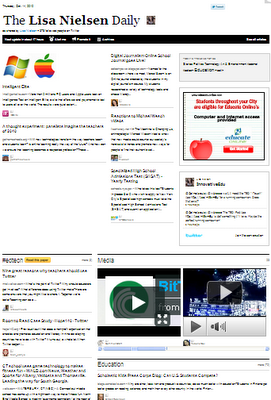
Paper.li will make a daily newspaper following the Tweets of those a Twitter user follows, a Twitter hash tag or a list. The newspaper is delivered in a very reader-friendly format using the Twitter updates and links to bring readers stories, tweets, videos, photos and more. It is simple to create and the end result appears in under a minute and is beautiful. Here is a thumbnail of mine. Click the paper to see the actual paper.


Innovative educators can use Paper.li in a number of ways.


For schools or classes
If you haven't already, set up a twitter tag for your school or class and ensure your students and teachers know to use that tag in their tweets. Recognize that tweets with links to articles, videos, and images, make the best content for Paper.li. A school could have administrators and teachers tweet using a particular hashtag resulting in a daily Paper.li newspaper that can be embedded on the school website. A teacher could do the same using a class hash tag. A teacher might want to invite parents and students into the equation sharing the hash tag with them. End result, a unique class newspaper that the whole community contributes to!

For students
First help students begin building their personal learning network on Twitter by following those who share their interests. Of course one way they can do this is by following their friends. Another way is for the student and their friends to come up with their own hash tag. To make global connections about topics of interest you can teach students to do a twitter search on a topic of interest and follow the people who are writing things you like on that topic. Once students have selected people to follow, Paper.li will do the rest. Talk about a new way for students to report on current events from a paper that is made just for them by their friends and the people whose interests they share. This is a transformational way to ingest and share personalized and newsworthy content.

Another option for using Paper.li with students is to create newspapers aligned to units of study. In literature you may create a paper that follows a particular author. In social studies you may follow a historical figure or historical event to see what people are saying about it today. Remember students and you can use that term in your tweets as well to contribute to the Paper.li newspaper. You could do the same thing for really any subject. Imagination is your only limit.

Get started with Paper.li
If you’re ready to get started with Paper.li here are five simple steps to get started.
1. Visit http://paper.li/
2. Select “Create a Paper”
3. You will be prompted to sign in. Sign in using Twitter.
4. Select “Create a newspaper”
5. Indicate either the list, tag, or twitter account from which you want the paper created