Sunday, March 19, 2017

5 Innovative School Models You Might Not Know

Note: Use this shortened url to share this post http://tinyurl.com/5InnovativeSchoolModels

When it comes to education, innovation is nothing new. Innovative models have been around but forgotten in the current climate of accountability and standardization. Before that there were models, like Montessori, that were more well known. These are models where students work on projects, learning is assessed with real-world measures, and the curriculum was customized to the student rather than standardized.

While innovative educators understand their value, such models are not able to thrive, or even survive, under the current public school structures. To follow are five innovative school models that influence my thinking about teaching and learning.  

Agile Learning Centers

Agile Learning Centers restore the joy of learning with a surprisingly effective educational approach: intentional culture supporting self-directed learning reinforced by agile management tools.
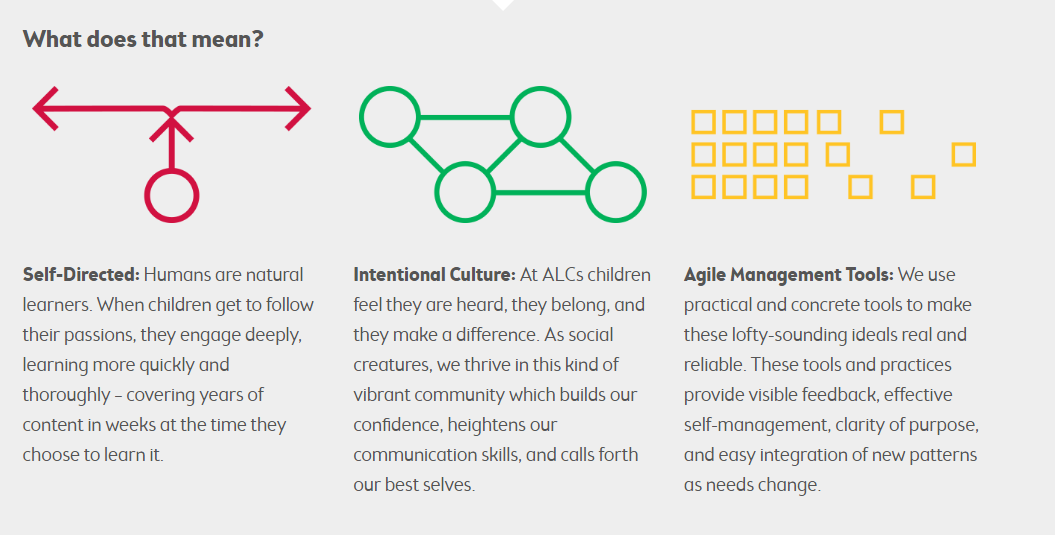
Read more about Agile Learning here and here.

School Wide Enrichment Model

This model identifies student’s strengths and talents, nurtures skills, and creates authentic opportunities for students to utilize these skills not just as students, but as practicing professionals providing experiences and opportunities to work and learn with others in the fields in which they are interested. These opportunities create pathways for future study, employment and lifelong pursuits. The world inside the school walls mirrors that which students will experience out in the real world.

Big Picture Learning

Students are at the center their own education. They spend considerable time in the community under the tutelage of mentors and they are not evaluated solely on the basis of standardized tests. Instead, students are assessed on exhibitions and demonstrations of achievement, on motivation, and on the habits of mind, hand, and heart  – reflecting the real world evaluations and assessments that all of us face in our everyday lives.


Democratic Schools

Democratic Schools employ a theory of learning and school governance in which students and staff participate freely and equally in a school democracy. In a democratic school, there is typically shared decision-making among students and staff on matters concerning living, working, and learning together. At such schools students individually decide what to do with their time, and learn as a by-product of ordinary experience rather than through classes or a standard curriculum. Students are given complete responsibility for their own education and the school is run by a direct democracy in which students and staff have an equal vote.

Regio Emilia

This is an approach based around these core values:
  • The child as an active participant in learning
  • The significance of environment
  • The teacher, parent and child as collaborators in the process of learning
  • Making learning visible
Read more here and watch here.

So what do you think? Are any of  these models ones you would like to implement with children where you work? Have you seen any of them in practice? Which ones resonate with you and could influence your practice?

Saturday, March 18, 2017

3 Hottest Posts Most Popular On The Innovative Educator

Haven’t been keeping up with The Innovative Educator? Don’t worry. That’s what this wrap up is for.  Here are the three hottest posts that you don’t want to miss!

What’s hot this week? Fighting fake news, increasing parent engagement, and ePortfolios.

Making its way to the top for the first time is a post that points to four fabulous sites you can turn to fight fake news. Next up I recap my #SXSWEdu panel discussion hosted by Common Sense Education and outline 9 ways to increase parent engagement using digital media. Rounding out the top is a post that lays out how to get started with ePortfolios as well as some great options for doing that. 

So what are you waiting for? Now's your chance. Take a look at the posts below and click the link to read one(s) that looks of interest to you.

Entry
Pageviews
Feb 19, 2017, 
3041
Mar 12, 2017, 
2905
Feb 26, 2017, 
2732


If you like any of these posts, I hope you’ll share with others using the buttons below on Twitter, Facebook, email or whichever platform you like best.

Wednesday, March 15, 2017

Easy Peasy Data Driven Snow Day Plan

#NY1Snow Photos
Note: Use this shortened url to share this post http://tinyurl.com/easypeasysnowdayplan 

There was a snow day for New York City schools this week. Everyone had something to say about whether or not schools should have stayed opened or closed. It was even the topic of the popular news program, "The Call." 

Some felt the city was too darn soft. Some felt the city made the right call.  It's a familiar refrain.

Unfortunately, regardless of the decision to keep schools open or closed no mayor, chancellor, or head of schools can ever make a judgement call that makes everyone happy.

But why?

Why must this decision rest on a judgement call?

Why not let the let data drive the decision?  If the National Weather Service says this and/or this... then do that. 

No one needs to be blamed when decisions are driven by data.  When we get more, new, or different data, we can update decisions.  

As long as we're talking about decisions, here's another plan that would help make this work better for everyone. 

It is hard to get to school / work for some staff on snow days, but some live near schools, and it's not so hard. So, why not make a plan that includes that data?

Just have a smaller percentage of schools open on days when weather or other factors are an issue. In places like New York City we already have a similar type plan through the Office of Emergency Management to set up schools and other spaces should there be a hurricane. Something similar can be done for a snowstorm.


Have staff that is nearby schools come in. Let the families who need to send their kids to school, send them. Staff who can come in, are identified in advance. They get a day added on to their personal day bank. Families who need options have them.

Easy peasy, data driven, snow day plan.  


Sunday, March 12, 2017

9 Ways to Increase Parent Engagement Using Media - #SXSWEdu Takeaways

Note: Use this shortened url to share this blog post http://tinyurl.com/SxSWEduParentEngagement

Ongoing parent engagement is an essential piece of building a positive culture of digital citizenship in schools. But what does effective parent engagement look like? How can schools address the unique needs of caregivers in their communities? What are co-engagement ideas where media brings parents and kids together?

I had the opportunity to join a panel at South by Southwest hosted by Common Sense Education called Helping Parents Guide Kids Media Use. (See panel discussion here and presentation materials here.) During the panel we addressed these questions providing perspectives at the city, district, and school level.  

You can checkout the key takeaways from participant and innovative educator Carl Hooker (@MrHooker) below and then read 9 ideas you can bring back to your work.


9 Ways to Increase Parent Engagement & Effective Student Media Use

  1. Create policies “with” not just for stakeholders
    Too often schools and districts create policies and guidelines for students, staff, and families. The New York City Department of Education took a different approach. They created social media and internet guidelines and responsibilities “with” students, staff, and families using a participatory design approach. Teachers and parents worked together to create materials and then brought it to the students to make sure they approved. Teachers and parents created guides on how to use these materials and ideas to support students.


  1. Ask your audience how they prefer receiving information
    Don’t just create materials the way it’s always been done. Speak to your audience and find out how they prefer receiving information. When the New York City Department of Education surveyed students they learned that for teens wanted information via infographics. Pre-teens wanted an activity book. As a result, rather than a static document on a page or brochure, they provided students with materials in the ways they said they wanted it.


  1. Speak their language
    If parents don’t understand the language in which materials are made available, they won’t be effective. Schools and districts should do their best to translate materials so families who do not speak english are able to read them. Did you know YouTube has an “add translation” feature? If you are making videos for a parent audience, consider using it.


  1. Don’t just show. Tell too.
    Just creating and publishing materials doesn’t go far enough. Bring parents together to explain the materials, review the content, and show how it works in action. Use real examples from others in your district.


  1. Meet parents where they are
    The best way to share information with families is by addressing them in the medium(s) they prefer. The best way to discover that is to survey them. The most popular tools schools are currently using are Remind to send out text messages to parents. Class Dojo to share stories of schools and classrooms. Facebook, Twitter, and/or Instagram to celebrate students and staff. One perk of Instagram is that images work across languages.  


  1. Meet parents when they are available
    Most of our students have working parents. That means we have to be creative in when and how we reach out to parents. Don’t schedule events only during the school day. Also consider events before school, after school, and on weekends. Even that might not work for many parents. Harness the power of livestreaming via tools like Google Hangouts and Facebook Live. Know how privacy settings work so you can determine if your opportunity is public or available to a select group.


  1. Invite students and parents will come
    Invite students to be a part of the events and activities that are being hosted for parents. Let the students be the ones to lead conversations and help parents learn. Common Sense Education has some excellent resources to make that happen. Their “Connecting Families Toolkit” helps a school host parent kickoff events like teen panels, video discussion nights, or surveying students and families about their digital lives.


  1. Take advantage of teachable moments
    Schools have busy schedules so sometimes when an issue comes up, it seems hard to take a breath, roll up our sleeves and address it in a real and meaningful way. Schools are in a unique position to address these issues and support students and families as issues arise. Try to work to create a culture where doing so is okay. Determine a team and strategy at schools and districts to not only get the word out, but to invite families to face-to-face on digital conversations about time-sensitive issues.


  1. Know and utilize quality resources
    You don’t have to start from scratch. There are many quality resources available for schools to share with families. Here are some you can visit to get started:


What do you think? Are these ideas that would be effective where you work? Why or why not? Have you tried any of these ideas? Any ideas missing?  


All panel members are on Twitter. Check out the info below if you want to follow them and see what they’re Tweeting about.
Presentation materials are at http://tinyurl.com/ParentsGuideToKidsMedia.

Saturday, March 11, 2017

3 Hottest Posts Most Popular On The Innovative Educator

Haven’t been keeping up with The Innovative Educator? Don’t worry. That’s what this wrap up is for.  Here are the three hottest posts that you don’t want to miss!

What’s hot this week? All things South by Southwest Edu. Missed the conference? This wrap up will keep you up-to-date on conference highlights.

The undercurrent at this year’s #SXSWEdu was for attendees to consider their privilege. That could mean their race, religion, physical or mental abilities, socio economic status, gender identity, and more. Tackling this head on to start the conference was Columbia University’s Chris Emdin (@chrisemdin) who received a standing ovation following his keynote presentation. Chris reminded us of our privilege and gave advice for educators who may have students from different backgrounds. Chris used real talk to get real with educators. This week’s number one post, “We Got It From Here. Thank You For Your Service” gives highlights from his keynote and includes a link to the presentation.

Next up was one of the nuttiest moments at #SXSWEdu, when Tim Ferriss addressed the crowd on International Women’s Day, but didn’t seem to realize that day existed or notice that his audience, educators, was comprised of a women majority. He talked of tools to success such as competing and brawn and downplayed a strength for which women are often lauded, their ability to multitask. He talked about the importance of accelerated learning and making students feel uncomfortable to an audience who recognizes the value in slow learning and making students feel safe and comfortable. 

The distaste of his ideas was palatable among audience members, and then one guy just lost his sh*t and I was able to get that caught on tape. Check out the article in second place to find out what happened.

Rounding out the top, is advice from Chris Emdin who wants to warn educators that tech is not answer. Read this week’s third place post to discover what is.

So what are you waiting for? Now's your chance. This week is juicy! Take a look at the posts below and click the link to read one(s) that looks of interest to you.

Entry
Pageviews
Mar 6, 2017, 
3914
Mar 8, 2017, 
3860
Mar 7, 2017, 
2894

If you like any of these posts, I hope you’ll share with others using the buttons below on Twitter, Facebook, email or whichever platform you like best.

Wednesday, March 8, 2017

At #SXSWEdu @TFerriss Espouses The Virtues of Discomfort. Then This Happened.

Note: Please share this blog post using this link http://tinyurl.com/timferrissdiscomfort 

Tim Ferriss told an audience of educators (and others who support them) that an effective learning strategy was causing discomfort and dissecting that. Ironically during his keynote at South by Southwest, Ferriss was put to the test. In case you don’t know him, Ferriss was named one of Fast Company's "Most Innovative Business People" and is the author of several books including The 4-Hour Workweek and his latest, Tools of Titans: The Tactics, Routines, and Habits of Billionaires, Icons, and World-Class Performers.   

Also ironic, in light of him presenting on International Women's Day, was his sparse attention to the accomplishments of women when it comes to learning. Ferriss shared stories of his wrestling coach who pushed students to work until they threw up and a navy seal who he thought would be good to bring into a classroom because students would definitely listen to an overbearing figure such as that. He also downplayed, and even criticized, a skill women are often praised for: multitasking. He thinks single-tasking is a super power. Tell that to a working mom who is successfully using the skill of multitasking to balance career and family.


Ferriss explained that the #1 skill students need today was to become comfortable with discomfort.


He shared his strategies for doing that.  Wearing crazy pants, funny collars, or helping toughen up students and make them more resilient in the face of criticism by using a marker to place a mark on their forehead. He also shared that most things don’t have irreversible, negative outcomes. Well...at least not for him.

Unlike Ferris, the marginalized groups served by many of the educators in the room, don’t need to dress up or mark up their foreheads to feel discomfort. They also know that for their students, many things have irreversible, negative outcomes.


The talk was in stark contrast to the opening keynote by Chris Emdin who highlighted issues like lack of diversity among teachers and the absence of educator and student (especially those who are not white) voice in conversations around what works best for schools and learning.


When it was time for Q&A, the undercurrent in the audience bubbled up and some uncomfortable questions were thrown Ferriss's way via Sli.do, the online question app. What the audience witnessed was that, although Ferris had just espoused the virtues of discomfort, he quickly dodged those questions which were out of his comfort zone...by ignoring AND deleting them.


The audience reacted!  Here are some examples.


One audience member was so outraged he shouted some comments to the stage and when Tim’s talk was over, this person took to the stage with his thoughts.

A surprised audience looked on. As educators we’re often programmed not to make noise. To listen when spoken to, not speak out of line and reminded that we should not question authority.

Educator Danieta Morgan caught him on film. Here is what he had to say.

The person speaking was innovative educator Derek Breen. He asks that rather than focusing on him, people focus on important causes like #InternationalWomensDay #BeBoldForChange #IWD2017

Derek is an educator, author, and a founding member of the Instructional Design and Educational Media Association. He is an active member of the ScratchEd community and worked as a graphic designer on the StarLogo Nova project (www.slnova.org) at MIT, as a teaching fellow in Instructional Design at Harvard Extension school and as a curriculum developer for i2camp.org.

While on stage, Derek striped off his clothes down to a dress to signify his solidarity with women. He also men must be given more access to having the voice they deserve. To do this he said he would be silencing himself by shutting down his social media profiles on places like Facebook and Twitter.  Looks like he already did that on Facebook and Twitter.

It seems he has already started dissecting the discomfort he felt during his public display of ineptitude in addressing the topic of inequity. You can check that out at https://www.facebook.com/TimFerriss/posts/10155088149337241

Will the South by Southwest Edu conference address this? How about a fireside chat with Ferris and opening keynote Chris Emdin? Emdin's game. Though, not surprisingly, it seems Ferriss has gone radio silent in responding to the invitation.

You can watch Ferriss's discomfort below. Start at about 45:00.

You can see another teacher's take on this all here. Here's a sketchnote summary of the talk from @empowerMINTed
No automatic alt text available.