Wednesday, June 7, 2017

7 Ways To Sabotage Meetings

When you want to get a project done it is imperative that when working with others you understand what elements lead to a high performing team as well as understand the strategies required to make meetings  effective. But what about when you don't like the work being done at your school, organization to which you belong, or in your community, etc.?

Well when that's the case, then it is important to know how to sabotage meetings. Coaching Psychologist Yaron Prywes (@Yaron321) revealed how to do just that as part of a full-day workshop on promising practices and pitfalls to avoid when conducting meetings.

This advice comes from an interesting source... declassified information from a CIA manual on how to sabotage productivity.  If you want to derail a meeting, here are seven strategies you can use:

  1. Insist on doing everything through "channels." Never permit short-cuts to be taken in order to expedite decisions.
  2. Make "speeches." Talk as frequently as possible and at great length. Illustrate your "points" by long anecdotes and accounts of personal experiences.
  3. When possible, refer all matters to committees, for "further study and consideration." Attempt to make the committee as large as possible — never less than five.
  4. Bring up irrelevant issues as frequently as possible.
  5. Haggle over precise wordings of communications, minutes, resolutions.
  6. Refer back to matters decided upon at the last meeting and attempt to re-open the question of the advisability of that decision.
  7. Advocate "caution." Be "reasonable" and urge your fellow-conferees to be "reasonable"and avoid haste which might result in embarrassments or difficulties later on.
Now, if you're goal is to keep a meeting on track, you might want to print this slide out as a reminder of what not to do. That way, when any of these strategies begin to take shape, you can point to this reminder of what to avoid.  
Source: CIA’s declassified manual on how to sabotage productivity. Article.
What do you think? Are there strategies here that you've experienced in contributing to a meeting going off track? Anything missing? Anything you disagree with? Please share in the comments.

Sunday, June 4, 2017

17 Strategies To Make Meetings More Effective

Most employees feel many meetings they attend are a waste of time but they don’t need to be. There are strategies you can implement as well as pitfalls you can avoid to help ensure your meetings are interesting, informative, productive and achieve desired outcomes.  

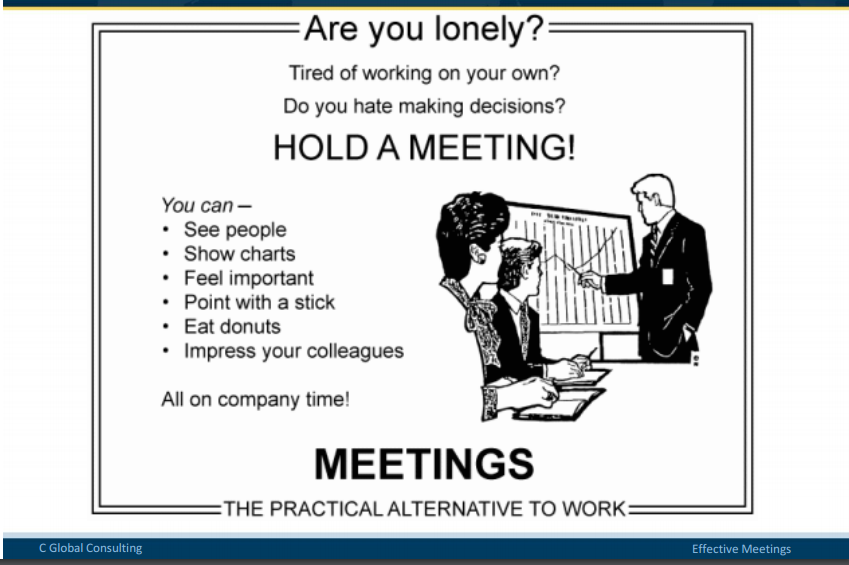
Coaching Psychologist Yaron Prywes (@Yaron321) conducted a full-day workshop revealing the secrets to successful meetings so that they don’t resemble the comic below.


To follow are elements you should consider as you
  • “P”lan for your meeting
  • “E”ngage participants, and
  • “P”ost meeting implementation

Strategies to “PEP” up your meetings:

PLAN

Element
Description
Strategies / Examples
1
Determine Necessity
Determine if this meeting is “really” necessary? Before scheduling a meeting think about if there is another way to accomplish your goal.  
If you’re just looking for input you may be able to create a Google doc, sheet, or have participants complete a survey. Maybe you can gather a sub-group to address the issue. If you are just sharing information maybe you could simply send an email, video, or an Office Mix where you have video embedded in slides.
2
Pre-Wire
Participants should know what to expect before arriving. What do you hope to accomplish. How should they prepare for the meeting?
Could be an email or call to let folks know about expectations and hoped for outcomes.
Example: A manager is hoping to get consensus on creation of a group calendar for events. Discuss with participants prior to identify any roadblocks, concerns, and how to best proceed.
3
Meeting Goals & Objectives
Participants should know in advance why they are at the meeting.
Indicate goals and objectives in the agenda i.e. At the close of the meeting, the group will...

Examples:
  • Make a decision about…
  • Generate ideas about..
  • Know the status of each project
  • Have information about
  • Be ready to begin planning a workshop about…
4
Meeting Type
Know the type of meeting you are conducting and that for some meeting types (i.e. informational), a meeting may not really be what is required.
Meeting Types -Wageman 2016
  • Informational - just sharing the information
    • 15 minute stand up meetings - keeping in short
  • Consultative - Giving advice
  • Coordination - What I do will directly affect you.  Sharing information that will directly affect meeting participants.
  • Joint Decision - Making decisions together
  • Collective Work - Together (shrum) we will work to accomplish something.
5
Participant Purpose
Participants should know what is expected of them in advance of the meeting. There should be an opportunity for participants to inform the meeting organizer if they feel their presence is not necessary.
Team members can’t participate effectively if they don’t know whether to simply listen, give their input, or be part of the decision making process. Prior to the meeting, let them know in advance if participants are expected to make a decision, provide input, or simply listen to information (in which case a meeting may not be needed). seek input, or make a decision.
ENGAGE

Element
Description
Strategies / Examples
6
Agenda
Every meeting should have an agenda. Send the agenda in advance of the meeting, ideally with the calendar invite.
Having an agenda may seem like an obvious step, but the devil is in the details such as the following:
  • Include on the agenda, the meeting purpose
  • Create a timed agenda
  • Indicate who is responsible for each part of the meeting
  • Consider listing agenda topics as questions rather than items. This enables team members to better prepare for discussion and determine whether they are on track.

Read this article from Harvard Business Review for more tips on effective agendas.

7
Slides and Other Materials
Provide slides and other materials in advance.
Too often slides and materials are shared after the presentation. This is old-school thinking where the meeting organizer must be the controler of information. If you provide materials in advance rather than worrying about taking notes on and try to remember what you share, participants can make meaning and engage.
8
Role
Assign roles, but be aware that there is a cost to roles i.e., if you’re taking notes you may not be able to participate as well. Also certain types of people are better at certain tasks than others.
Indicate role on the agenda.
Examples:
  • Timekeeper
  • Moderator / Facilitator
  • Notetaker
  • Whiteboarder – keeps a visual representation of the discussion in front of the group (using flip charts, whiteboard or blackboard)  
  • Parking Lot Attendant - If items are not on topic, this person places them in the parking lot and can assist in ensuring topics are addressed.
9
Comfort / Relationships
Ensure participants are comfortable.
Have an icebreaker that gets participants ready for the meeting. Think about how the meeting will affect participants. Will it motivate them? Build trust?
10
Norms / Rituals
Establish norms/rituals so participants know what to expect and to help establish community.
Examples:
  • Healthy snacks
  • A signal to begin.
  • A strategy for participation i.e. person holding a ball. Start and end on time
  • Avoid distractions i.e. cell phones on silent
11
Voices
Ensure participants have an opportunity for their voices to be heard.
Meetings should have a moderator who does their best to ensure equal / appropriate airtime.
12
Early engagement
Participants want to be engaged.
A standard ice breaker is one way to get participants interacting, engaged, and aware of something interesting about one another.  
13
Stay on track
Set up systems to adhere to the agenda / topics.
  • Have a timekeeper to help stay on track. Ensure the moderator / facilitator is reminded of where everyone is on the timed agenda.
  • Point appropriate topics to the parking lot.  
POST MEETING

Element
Description
Strategies / Examples
14
Summary
Summary of the meeting.
Send to participants following the meeting. This should be sent within a day of the meeting taking place.
15
Follow through on action items
Identify actionable items and who is responsible.
Ensure meeting participants know what they are responsible for and by when it should be completed.
16
Incorporate Improvements
Reflect on how future meetings can be improved.
What worked? What didn’t work? What are some ways the meeting can be improved in the future?
17
Plan for next meeting
Come up with a structure or strategy to plan for the next meeting.
Are there next steps? How will they be incorporated into the next meeting? Can an agenda be shared in advance where participants can give feedback and suggest agenda items?

So what do you think? Are there strategies here that you might implement, or stay away from? Are there any strategies that stand out that you haven't done but want to try to incorporate in the future? Anything missing? Anything you disagree with? Please share in the comments.
Wednesday, May 31, 2017

#NYCSchoolsTechChat: Discuss #Infographics with @Easel_ly & @Piktochart

twitterchat-5c-_22126724_2af924f522f7355bec940cc5d05bf0d45411a0f1.jpeg
On Thursday, June 1st at 6 pm, we invite you to join the #NYCSchoolsTechChat where we will discuss ways to use infographics to support teaching and learning.  Our special guests include Clemencia Acevedo (@Acevedo493) a teacher who uses infographics to support her work as well as representatives from two popular infographic providers, @easel_ly, and @romikid from @piktochart. They will, help us discover ideas, strategies, and resources to support teaching and learning with infographics.

#NYCSchoolTech teacher Eileen Lennon (@eileen_lennon) moderates with me throwing in my two cents.

You can prepare for the conversation by thinking about answers to these questions:


    Q1 What are types of #infographics you might use in your school? #NYCSchoolsTechChat
    Q2 Why are #infographics an effective tool to support student learning?  #NYCSchoolsTechChat
    Q3 What are positive results from having students create infographics? #NYCSchoolsTechChat
    Q4 What are your fears & challenges around creating #infographics? #NYCSchoolsTechChat
    Q5 Share do’s and don’ts of using infographics for teaching & learning. #NYCSchoolsTechChat
    Q6 Have you used an #infographic or the closest you’ve come to an infographic to support learning? Share links! #NYCSchoolsTechChat
    Q7 Give a shout out by RT, like, or reply to someone who has inspired you w/good ideas abt #Infographics in today's #NYCSchoolsTechChat


    Chat details are below:
    Remember to respond using the hashtag #NYCSchoolsTechChat and include the number of the question you are answering in your response i.e. A1 and your answer.

    We hope you can view the chat live, but if you are unable, please visit our archive at

    Sunday, May 28, 2017

    The Most Important Element for High-Performing Teams Is This

     Illustration by James Graham, New York Times
    Coaching Psychologist Yaron Prywes (@Yaron321) who specializes in innovation led a full-day workshop where among other topics, he shared what Google learned in its quest to build the perfect team. In fact while there are many important elements in building a team, if this one element is in place you are well on your way to success.

    The most important element required for high-performing teams is this:

    Psychological safety

    This is defined as a group culture that has a shared belief held by members of a team that the team is safe for interpersonal risk-taking. It is a sense of confidence that the team will not embarrass, reject or punish someone for speaking up. It is a climate characterized by interpersonal trust and mutual respect in which people are comfortable being themselves.

    What this may look like is a meeting where team members speak over one another at times, go on tangents, and socialize before coming back to the agenda. While it may look inefficient to a casual observer, team members actually are speaking as much as they need to and are sensitive to one another's moods and share personal stories and emotions. It is what coaching psychologists like Yaron may call "conversational turn-taking" and "average social sensitivity."

    Here are four additional key characteristics of successful teams:
    1. Dependability: Team members get things done on time and meet expectations.   
    2. Structure and clarity: High-performing teams have clear goals, and have well-defined roles within the group. 
    3. Meaning: The work has personal significance to each member. 
    4. Impact: The group believes their work is purposeful and positively impacts the greater good.
    The research is called the Aristotle Project and you can read more about it in this New York Times story and this article in Inc.