Showing posts with label #trumpeducation. Show all posts

Sunday, January 22, 2017

When Your Country's Leader Is A Tweeter - Action Innovative Educators Can Take

Twitter, Facebook and livestreaming can all help teachers be the 'storytellers in chief' of school life...
Whether or not you believe America’s president should be freewheeling it on Twitter, it appears that we can expect this to continue as he takes office. Donald Trump said to Matt Lauer on the Today Show that, "Frankly, it's a modern form of communication.” He explained: "I get it out much faster than a press release” and “much more honestly than dealing with dishonest reporters”.
Trump gets what research from Ipsos has shown. When it comes to millennials, they almost always trust and remember user generated content on social media over what they see in the mainstream media.


Thursday, December 8, 2016

She’s Gone: The Innovative Educator Leaves Us & Other Fake News

JK. I’m still here. :-p
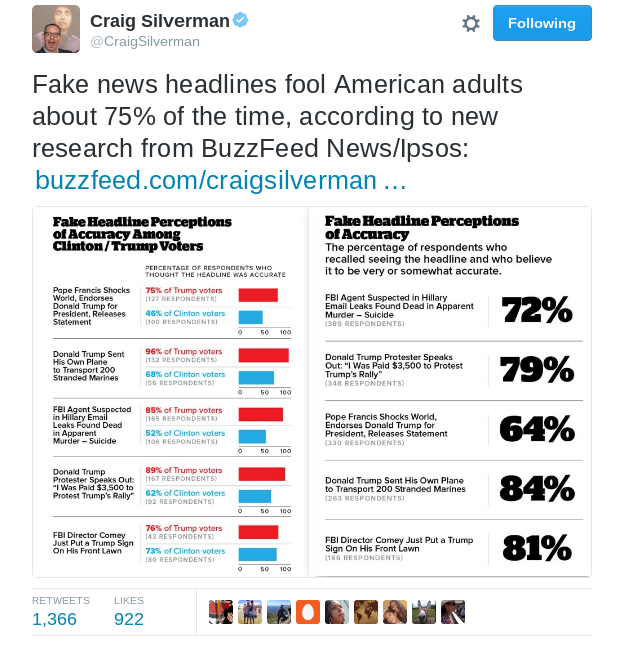
By now, you’ve probably heard a lot about fake news and the role that played in our presidential election.

Innovative educators realize the time has come to connect with students around literacy and how to determine what’s real from fake.

Are Your Students Prepared?

Can your students evaluate the accuracyperspectivecredibility and  relevance of information, media, data or other resources? (3B - ISTE Student Standards)

A study from the Stanford History Education group says probably not. The study indicates that “Our ‘digital natives’ may be able to flit between Facebook and Twitter while simultaneously uploading a selfie to Instagram and texting a friend. But when it comes to evaluating information that flows through media channels, they are easily duped.”

That's a problem because as Michael Spector, author of "Denialism" reminds us in his TED Talk, "Everyone's entitled to their opinion, but you're not entitled to your own facts."

There are many layers to this work. Here are just some of the types of literacies we must help our students acquire.

4 Types of Literacy

TypeDescription
1) Information literacyKnowing where and how to find accurate information
2) Media literacyUnderstanding media sources, potential biases, etc.
3) Factual literacyHow to tell truth from nonsense; how to empirically verify a “fact”
4) Emotional literacyUnderstanding how one’s prior experiences and opinions influence their view of information

When we consider each literacy area, we must keep in mind that it’s not that simple. Newspapers and news stations don’t always get it right. There are times when what you read in social media can be trusted. For example it can be a channel to get news directly from a primary source, rather than through another party.

Textbooks may not have their facts straight. As one Edutopia author put it “textbooks are processed into existence using the pulp of what already exists, rising like swamp things from the compost of the past.” It is also true that the content of these textbooks are influenced by those such as the Gablers who were expert organizers and founded a  nonprofit corporation 43 years ago, Educational Research Analysts, which continues to review textbooks and lobby against liberal content in them. More on that here.

So what’s an innovative educator to do?

You can start by selecting some real and fake news stories and work with students to analyze what they are reading. They should consider some of the following questions:

Ask Yourself These Questions:
  • Who created the story?
  • Why was it created?
  • Who was paid as a result of the story?
  • Who receives harm or benefit?
  • Is this fact or opinion?

You can visit Project Look Sharp and refer to this PDF and this website for more details on how to measure credibility.

You can turn to experts for advice on how to help students think about sources. Alexios Mantzarlis, director of the International Fact-Checking Network and Melissa Zimdars, assistant professor of communication and media at Merrimack College recommend doing the following:

Consider the Source:
  • Pay attention to the domain and URL
  • Read the "About Us" section
  • Look for quotes from sources
  • Look into the background of those quoted
  • Check the comments for accusations of false information
  • Reverse image search

You can read more about each piece of advice in this Fake or Real? article from KUOW.org.

Students aren’t the only ones who fall for fake news. Their parents can use some support too.

How have you addressed this where you work? Have you incorporated some of these strategies into your classroom? If so, what has worked or has been challenging? If not, is this something you might consider doing with your students? Their parents?

Sunday, November 27, 2016

Who Cares About Saving Public Schools? @BetsyDeVos as #TrumpEducation Secretary

Note: Twitter won't let you Tweet my blog url. Please use this shortened url instead http://tinyurl.com/IsYourSOE.

Trump has named Betsy DeVos ed secretary and now some public school teacher groups say they’re appalled.  

But should they be?

Appalled indicates you feel shock and outrage, but this was always the sort of person our president-elect said he wanted in charge of education. Trump said he supports vouchers and charters and DeVos is a great advocate of that. The time to be shocked and outraged was prior to the election or at least upon finding out election results.

#NotmySOE or not, she is.  This ship has sailed. America voted for a president who was crystal clear that he wanted to end public education as we know it (maybe even abolish the Department of Ed) and make education great again. DeVos Tweeted she is ready to do just that.

The Department of Education is a pretty new construct relatively speaking.  It wasn’t in place when I started school. Ask people who remember "the good ol days" and they’ll tell you that things seemed pretty decent before standards, testing, and “No Child Left Behind.” When I went to school, there were lots of electives, and no testing pressures. People are sick of mindless testing, think the Common Core is a disaster, and Trump picked up on that.  

Opponents such as The Network for Public Education, National Education Association, American Federation of Teachers are making their case against DeVos without sharing clearly who they support in her place that is a viable option for Trump. People were outraged when it was Eva Moskowitz who was in, then Michelle Rhee, but if not them, who? Well now we know. DeVos. And, even if these teacher groups call their elected officials to get her out, they are not offering a replacement who Trump may select that would be much different or better.

When public school teacher groups speak out against something, many in the general public see this just as an act to save their jobs. Like it or not, there are a growing number of individuals who don’t feel tenure/job security is fair, feel pensions are sucking budgets dry, and feel public schools still employ factory model teaching. Families want a change but these teacher groups are crying out for more of the same. They are also saying no to privatization, charters, and vouchers without sharing a compelling vision of what should stand in its place.

The issue is further obsecured, because as reported in EdWeek, former “American Federation of Teachers President Albert Shanker first proposed the creation of “charter schools”—publicly funded institutions that would be given greater flexibility to experiment with new ways of educating students.” Those who know the story, know it didn’t play out the way Shanker intended. Instead, of  small groups of teachers and parents submitting plans to educate kids in innovative ways, it has become corporations who are funding these schools and pushing unions out.  But, why not get behind something like Shanker’s original vision, for example?  

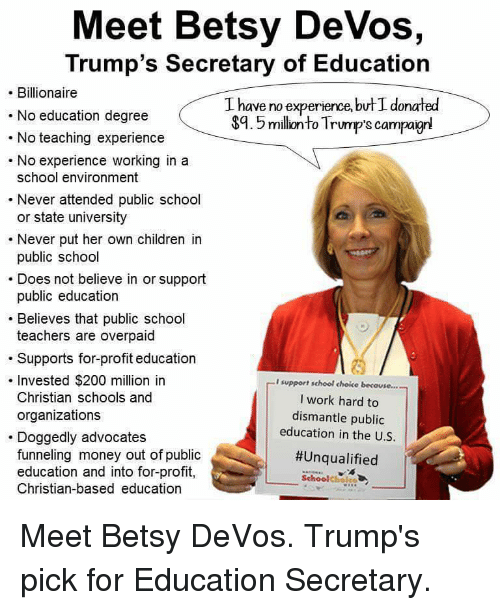
Instead, individuals and groups are using foolish arguments such as those outlined in this ineffective meme:  

It states that that DeVos donated millions to Trump’s campaign, yet the New Yorker stated that “In the 2016 campaign, DeVos continued to spend heavily, but not in favor of Trump, who, she declared, “does not represent the Republican Party.” This has been widely covered in the press so right at the start, the argument fizzles out.

Next she is accused of being a billionaire.  Guilty as charged, just like the man who many Americans voted into office. Apparently a lot of Americans don’t see wealth as a negative.

It goes on to share she didn’t have a teaching degree, teaching experience, didn’t attend public school, and her own kids don’t go to public school.

Translation:  She has the same lack of experience as Obama’s primary Ed Secretary Arne Duncan.  

Those against a #TrumpEducation fail to make a convincing case, and this is outside of the public school teacher bubble, many write them off as just trying to save their jobs.

Here is the kind of information families care about. “When you get past the lower grades, they find that enrolling in a private high school through choice programs increases the likelihood of a student graduating from high school, enrolling in a four-year college, and persisting in college by 4-7 percentage points (Report #30).” http://eric.ed.gov/?id=ED530066

When the anti-Trumpers cry that students from charters and vouchers have lower test scores, they sound foolish to those who’ve been following the education story. That's because these same people have been fighting against ineffective standardized tests for years.  You can’t now turn around and use them to measure success.  

DeVos is guilty as charged to the accusation that she doesn’t believe in or support public education and has invested in religious schools. But is this a surprise? No. That was a part of the platform Trump shared and for which Americans voted.

If public school advocates really want Americans to care, first tell them how this president and this education secretary will directly harm their families. Then provide an exciting and tangible plan for something better. It is only when those against a #TrumpEducation can stop talking about saving public “schools” and start focusing on why and what American families must do to save their own “children” will more of the population start to listen.  

Tuesday, November 22, 2016

Is It Okay Not To Be College Ready? #TrumpEducation Says Yes.

Vocational training CT cover image 7/17/12
Photo Credit: Bridging the skills gap: Vocational training takes center stage 
Note: Twitter won't let you Tweet my blog url. Please use this shortened url instead http://tinyurl.com/CareerReadyTrumpEd

This post takes a closer look at one of the areas: "College Readiness," that I shared in my post about What a #TrumpEducation Means...More or Less.  
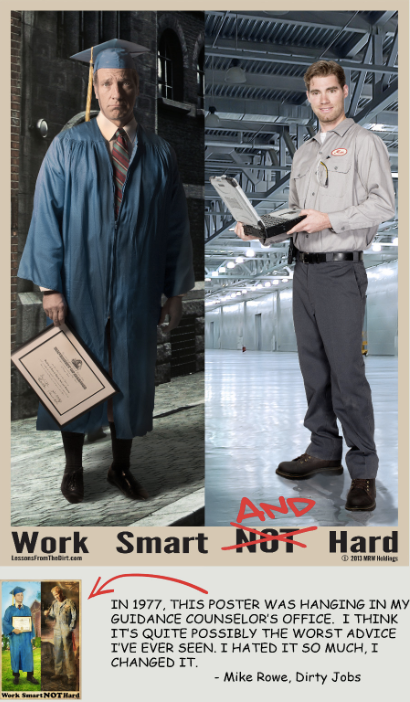
As any educator, parent, or student over the past decade is aware, the Obama administration laid out standards and assessments that required all students to be college AND career ready. Like it or not, college readiness was thrust upon all citizens. Those who felt college wasn't the path for them, were looked upon as "less than" and if they were unable to attain employment, well, that was their fault.

The problem in doing this, among other things, is that it alienated a large demographic in our country who has lost hope and who Trump has promised to help.

David Frum writes in the current issue of The Atlantic explains that as a result "The angriest and most pessimistic people in America are the people we used to call Middle Americans." "Middle-class and middle-aged; not rich and not poor; people who are irked when asked to press 1 for English and who wonder how white male became an accusation rather than a description. They are pissed off. And when Donald Trump came along, they were the people who told the pollsters, 'That's my guy.” “You can measure their pessimism in polls that ask about their expectations for their lives—and for those of their children. On both counts, whites without a college degree express the bleakest view. You can see the effects of their despair in the new statistics describing horrifying rates of suicide and substance-abuse fatality among this same group, in middle age.”

Saturday, November 19, 2016

#TrumpEducation RoundUp - Will a @RealDonaldTrump Presidency Make #Education #GreatAgain?

Note: Twitter won't let you Tweet my blog url. Please use this shortened url instead http://tinyurl.com/trumpeducationroundup

Wow.  What a wild ride these past ten days have been post election. Like many others, I didn’t see a Trump Presidency in our future. As a result I had not spent time looking into his thoughts and beliefs about education.  

If the same is true for you, don't worry! Time for us all to catch up.

I have spent dozens of hours sifting through three books, along with numerous articles and videos from and about Trump. I have discovered what you’re likely to see, more or less, with a #TrumpEducation then I dove into these seven areas you'll probably see less of and these three areas and these four areas you might see more of with a #TrumpEducation.  In the articles, each area is one where I point to evidence of where Trump stands and embed that with ideas about how this might play out based on what we know.

These are this week's most popular posts on The Innovative Educator blog. 

Entry
Pageviews
Nov 13, 2016, 
3615
Nov 12, 2016, 
2991
Nov 16, 2016, 
2456
Nov 15, 2016, 
2254

If any of these posts are of interest, check em out and share with others using the buttons below on Twitter, Facebook, email or whichever platform you like best.

Wednesday, November 16, 2016

4 Areas A #TrumpEducation Administration Could Focus On More

Note: Twitter won't let you Tweet my blog url. Please use this shortened url instead http://tinyurl.com/trumpeducationmoreof4 

Since the election, I’ve been reviewing the ideas President-Elect Donald Trump has been sharing since the turn of the century. He started with The America We Deserve, where he wrote about citizenship education, teachers unions, and school safety. Ten years later, in Think Like a Champion, he touched on American history and comprehensive education. Most recently, in 2015, Trump published Great Again: How to Fix Our Crippled America where he lays out specific policy in a number of areas including education.  

After spending dozens of hours sifting through all those books, along with dozens of articles and videos from and about Trump, I have discovered what you’re likely to see less of, as well as three areas we might expect to see more of with a #TrumpEducation administration. Below I share four additional areas.

Each area is one where I point to evidence of where Trump stands and embed that with ideas about how this might play out based on what we know.

4 areas you may see more of with a #TrumpEducation:

Tuesday, November 15, 2016

3 Areas A #TrumpEducation Admin Cld Focus On More

A #TrumpEducation administration could
embrace digital badges and micro-credentials.

Note: Twitter won't let you Tweet my blog url. Please use this shortened url instead
http://tinyurl.com/trumpeducation3areas 


As I shared in my post outlining what we’d see less of from  #TrumpEducation, I certainly hadn't realized there was any need to pay attention to the fact that Trump has been sharing ideas about education since the turn of the century. He started with The America We Deserve, where he wrote about citizenship education, teachers unions, and school safety. Ten years later, in Think Like a Champion, he touched on American history and comprehensive education. Most recently, in 2015, Trump published Great Again: How to Fix Our Crippled America where he lays out specific policy in a number of areas including education.  

Those three books, along with dozens of articles and videos from and about what Trump wants for education, point to what a  #TrumpEducation means, more or less. After sifting through all those materials I have discovered what you’re likely to see less of. Below I share three possibilities of areas where you might see a #TrumpEducation administration give more focus. Each area is one where I point to evidence of where Trump stands and embed that with ideas about how this might play out based on what we know. I will share four additional things you amy see more of in a follow up post.

3 things you may see more of with a #TrumpEducation:

Sunday, November 13, 2016

7 Areas You'll See Less of With A #TrumpEducation Administration

Photo Credit: Business Insider. Where Trump Stands On Education.
Note: Twitter won't let you Tweet my blog url. Please use this shortened url instead http://tinyurl.com/WhatATrumpEducationMeansLessOf
Who knew? I certainly hadn’t noticed that Trump has been sharing ideas about education since the turn of the century starting with The America We Deserve, where he wrote about citizenship education, teachers unions, and school safety. Ten years later, in Think Like a Champion, he touched on American history and comprehensive education.

Most recently, in 2015, Trump published Great Again: How to Fix Our Crippled America where he lays out specific policy in a number of areas including education.  

Those three books, along with dozens of articles and videos from and about what Trump wants for education, point to a number of things you'll see less of during a Trump presidency. Here they are.

7 areas you'll see less of with a #TrumpEducation:

Saturday, November 12, 2016

What a #TrumpEducation Means...More or Less

Note: Twitter won't let you Tweet my blog url. Please use this shortened url instead http://tinyurl.com/WhatTrumpMeansforEducation. Like many others, I was surprised about this week's election results. After doing some soul searching I realized my surprise was a result of believing what the smug American media was telling us. In fact I was primarily surrounded by, and a participant in, smug America liberalism. I was a part of Trump’s secret weapon and didn’t know it.

I was living in a bubble. I was not listening to what those people who live in forgotten corners of our country and my friends and their family in law enforcement were saying and feeling. I didn’t read what educators, and documentary filmmakers I generally follow were writing, unless they were sharing what I wanted to hear.  I was doing what education and career writer Penelope Trunk points to in her article calling Americans a bunch of liars.

I was happy believing Trump had no serious policy stances in general or stances on education in particular. Sure, Trump shared he would make America great, but I believed, as the media shared, that he had never gotten his hands dirty with facts explaining how he would do that. In his article about what Trump means for education, Frederick Hess, director of education policy studies at AEI and editor at Education Next, asks: “Who really knows what a Trump administration would actually try to do on schooling?”

But now that I have started looking into the question myself, I have discovered that we do know what Trump might try to do on schooling. Trump has shared his stance on education in three books, and several articles and videos. After reviewing what Trump, and those who are likely to be on his Cabinet, have said, I discovered the 7 areas you may see more of and 7 areas Trump would like you to see less of during his presidency. You can see what they are in the table below.

What a #TrumpEducation Means...More or Less